

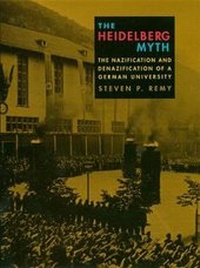
The Heidelberg Myth
The Nazification and Denazification of a German University
Published on 30. January 2003
Book
Hardback
352 pages
978-0-674-00933-2 (ISBN)
Description
In the first work to examine both nazification and denazification of a major German university, Steven Remy offers a sobering account of the German academic community from 1933 to 1957. Deeply researched in university archives, newly opened denazification records, occupation reports, and contemporary publications, The Heidelberg Myth starkly details how extensively the university's professors were engaged with National Socialism and how effectively they frustrated postwar efforts to ascertain the truth.
Many scholars directly justified or implemented Nazi policies, forming a crucial element in the social consensus supporting Hitler and willingly embracing the Nazis' "German spirit," a concept encompassing aggressive nationalism, anti-Semitism, and the rejection of objectivity in scholarship. In elaborate postwar self-defense narratives, they portrayed themselves as unpolitical and uncorrupted by Nazism. This "Heidelberg myth" provided justification for widespread resistance to denazification and the restoration of compromised scholars to their positions, and set the remarkably long-lasting consensus that German academic culture had remained untainted by Nazi ideology.
The Heidelberg Myth is a valuable contribution to German social, intellectual, and political history, as well as to works on collective memory in societies emerging from dictatorship.
Many scholars directly justified or implemented Nazi policies, forming a crucial element in the social consensus supporting Hitler and willingly embracing the Nazis' "German spirit," a concept encompassing aggressive nationalism, anti-Semitism, and the rejection of objectivity in scholarship. In elaborate postwar self-defense narratives, they portrayed themselves as unpolitical and uncorrupted by Nazism. This "Heidelberg myth" provided justification for widespread resistance to denazification and the restoration of compromised scholars to their positions, and set the remarkably long-lasting consensus that German academic culture had remained untainted by Nazi ideology.
The Heidelberg Myth is a valuable contribution to German social, intellectual, and political history, as well as to works on collective memory in societies emerging from dictatorship.
Reviews / Votes
The Heidelberg Myth is lucid, passionate, and scholarly beyond reproach. It should be read by anyone interested in the debates currently circulating about intellectuals and academic culture in the Third Reich. -- Anson Rabinbach, Princeton University In his fascinating book...Steven Remy deals with two purges--the one in 1933 when Hitler came to power and many of those in line with the "new spirit" were removed, and the second 1945-48 when the American authorities (Heidelberg being located in the U.S. zone of occupation) tried to undo the damage. It is microhistory, dealing with a relatively small group of people, but the group was important and the story is of much wider significance. For what took place in Heidelberg happened one way or another in all German universities--and many other institutions as well. -- Walter Laqueur * Washington Times * Will interest not only historians, but anyone interested in 20th century German intellectual history. -- Robert Weninger * Times Higher Education Supplement *More details
Language
English
Place of publication
Cambridge, Mass
United States
Target group
College/higher education
Professional and scholarly
Illustrations
None
Dimensions
Height: 235 mm
Width: 156 mm
Thickness: 32 mm
Weight
662 gr
ISBN-13
978-0-674-00933-2 (9780674009332)
Copyright in bibliographic data and cover images is held by Nielsen Book Services Limited or by the publishers or by their respective licensors: all rights reserved.
Schweitzer Classification
Person
Steven P. Remy is Associate Professor of History at Brooklyn College and the Graduate Center, City University of New York.
Content
Preface Introduction: The Swastika in the Ivory Tower 1. Embracing National Socialism 2. The "German Spirit" in Scholarship 3. The National Socialist University at War 4. Constructing the Myth 5. The Limits of Denazification 6. Whitewashing the Ivory Tower 7. A Culture of Forgetting Conclusion: Complicities and Silences Appendix A. The Structure of the German University Appendix B. Dissertations Supervised by Paul Schmitthenner, 1932-1941 Archival Sources Notes Index