

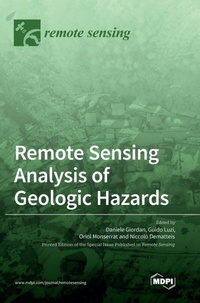
Remote Sensing Analysis of Geologic Hazards
MDPI AG (Publisher)
Published on 14. November 2022
Book
Hardback
254 pages
978-3-0365-5699-4 (ISBN)
Description
In recent decades, classical survey approaches have evolved and with the advent of new technologies and platforms, remote sensing systems have become popular and widely used in geosciences. Contactless devices are not invasive and allow for measuring without accessing the investigated area. This is an excellent advantage as earth surface processes often occur in remote areas and can be potentially dangerous or difficult to access. Satellite remote sensing offers the possibility of using multi-band high-resolution data over large areas. Therefore, it can be of great support for natural risk monitoring and analysis at a regional scale. On the other hand, terrestrial systems feature high spatial and temporal resolutions, which can assist in observing the evolution of fast and potentially dangerous phenomena. Therefore, proximal sensing systems are of great value for risk assessment and early warning procedures of natural hazards. This book focuses on recent and upcoming advances in the remote and proximal sensing monitoring of geologic hazards, warning procedures, and new data-processing techniques.
More details
Language
English
Product notice
sewn/stitched
Cloth over boards
Dimensions
Height: 250 mm
Width: 175 mm
Thickness: 21 mm
Weight
835 gr
ISBN-13
978-3-0365-5699-4 (9783036556994)
Copyright in bibliographic data and cover images is held by Nielsen Book Services Limited or by the publishers or by their respective licensors: all rights reserved.
Schweitzer Classification