

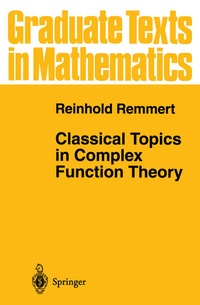
Classical Topics in Complex Function Theory
Published on 1. December 2010
Book
Paperback/Softback
XIX, 352 pages
978-1-4419-3114-6 (ISBN)
Description
An ideal text for an advanced course in the theory of complex functions, this book leads readers to experience function theory personally and to participate in the work of the creative mathematician. The author includes numerous glimpses of the function theory of several complex variables, which illustrate how autonomous this discipline has become. In addition to standard topics, readers will find Eisenstein's proof of Euler's product formula for the sine function; Wielandts uniqueness theorem for the gamma function; Stirlings formula; Isssas theorem; Besses proof that all domains in C are domains of holomorphy; Wedderburns lemma and the ideal theory of rings of holomorphic functions; Estermanns proofs of the overconvergence theorem and Blochs theorem; a holomorphic imbedding of the unit disc in C3; and Gausss expert opinion on Riemanns dissertation. Remmert elegantly presents the material in short clear sections, with compact proofs and historical comments interwoven throughout the text. The abundance of examples, exercises, and historical remarks, as well as the extensive bibliography, combine to make an invaluable source for students and teachers alike
More details
Series
Edition
Softcover reprint of hardcover 1st ed. 1997
Language
English
Place of publication
New York
United States
Target group
Primary & secondary/elementary & high school
Graduate
Illustrations
39 s/w Abbildungen
XIX, 352 p. 39 illus.
Dimensions
Height: 234 mm
Width: 156 mm
Thickness: 21 mm
Weight
570 gr
ISBN-13
978-1-4419-3114-6 (9781441931146)
DOI
10.1007/978-1-4757-2956-6
Schweitzer Classification
Other editions
Additional editions
Reinhold Remmert
Classical Topics in Complex Function Theory
E-Book
03/2013
Springer
€64.19
Available for download
Book
11/1997
Springer
€90.94
Shipment within 5-7 days
Persons
Hans Grauert (b. 1930 in Harem /Ems, Germany) and Reinhold Remmert (b. 1930 in Osnabrück, Germany) met at the University of Münster, where they both studied mathematics and physics from 1949 to 1954. In 1950 they were invited by Heinrich Behnke and Karl Stein to attend their "Oberseminar", which was held on Saturdays, for 2 hours from 9 a.m.
Five years after the tragic events of World War 2, Behnke's old friend Henri Cartan visited Münster. His lecture on recent developments in the theory of "Several Complex Variables" was a real eye-opener for the young students and had a strongly formative influence on them: indeed this was to determine the course of their scientific research careers from then on.
In June 1954 Grauert and Remmert received their respective doctorates from the University of Münster. In 1957 they both became lecturer (Privatdozent) there. In 1959 resp. 1960, Grauert and Remmert were appointed full professors at Göttingen resp. Erlangen.
The original German edition of "Theory of Stein Spaces" was written at a time when complex spaces, coherent analytic sheaves and the so-called Theorems A and B had already become established notions and theorems. Dedicated to Karl Stein, the book was published in 1977, and the English edition was to follow in 1979. The first announcement of the book, in Springer's promotion, consisted of the picture reproduced on the inside cover flap of this book, taken during the boat trip of the annual Bonn Arbeitstagung some time earlier, showing three men on a boat, with the minimalistic caption "Grundlehren 227".
Content
1 Infinite Products of Holomorphic Functions.- 2 The Gamma Function.- 3 Entire Functions with Prescribed Zeros.- 4* Holomorphic Functions with Prescribed Zeros.- 5 Iss'sa's Theorem. Domains of Holomorphy.- 6 Functions with Prescribed Principal Parts.- 7 The Theorems of Montel and Vitali.- 8 The Riemann Mapping Theorem.- 9 Automorphisms and Finite Inner Maps.- 10 The Theorems of Bloch, Picard, and Schottky.- 11 Boundary Behavior of Power Series.- 12 Runge Theory for Compact Sets.- 13 Runge Theory for Regions.- 14 Invariance of the Number of Holes.- Short Biographies.- Symbol Index.- Name Index.