

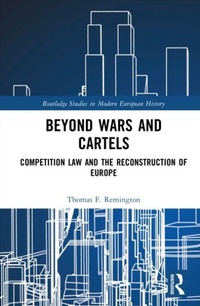
Beyond Wars and Cartels
Competition Law and the Reconstruction of Europe
1st Edition
Will be published approx. on 22. September 2026
Book
Hardback
194 pages
978-1-041-37162-5 (ISBN)
Description
This book argues that the European Coal and Steel Community in 1951 solved the historic French-German conflict over control of the coal deposits of the Ruhr valley. The product of a political bargain among the United States, France, and Germany, the treaty of Paris introduced radical new rules into the European order. For the first time in European history, cartels and powerful anti-competitive concentrations of economic power were banned.
The volume ties the problem of ensuring secure access to Ruhr coal to the larger security dilemma that long haunted French-German relations. It argues that, in effect, wars and cartels were alternative solutions to the same underlying dilemma in the period from the mid-19th to mid-20th centuries, which featured three wars and two armed occupations involving France and Germany. It discusses the importance of the economic complementarity between coal and ore in relation to the economic and security relations between France and Germany. Above all, it highlights the role played by the novel competition law regime in permanently ending the old cycle of wars and cartels that had cursed Europe through the end of World War II.
Beyond Wars and Cartels will be invaluable to those interested in post-war European history seen from a new angle as well as specialists in antitrust and competition law who compare US and American law, historians and political scientists.
The volume ties the problem of ensuring secure access to Ruhr coal to the larger security dilemma that long haunted French-German relations. It argues that, in effect, wars and cartels were alternative solutions to the same underlying dilemma in the period from the mid-19th to mid-20th centuries, which featured three wars and two armed occupations involving France and Germany. It discusses the importance of the economic complementarity between coal and ore in relation to the economic and security relations between France and Germany. Above all, it highlights the role played by the novel competition law regime in permanently ending the old cycle of wars and cartels that had cursed Europe through the end of World War II.
Beyond Wars and Cartels will be invaluable to those interested in post-war European history seen from a new angle as well as specialists in antitrust and competition law who compare US and American law, historians and political scientists.
Reviews / Votes
'Beyond Wars and Cartels is a penetrating analysis of cooperation in the development of European economic institutions. It focuses on cooperation relating to competition law, but its insights apply far more broadly. Prof. Remington recounts and deftly analyzes the obstacles to economic cooperation in Europe in the decades after the Second World War and the ways in which Europeans mobilized intellectual and political tools to overcome them. His insights into the dynamics of European cooperation are important not only for understanding European competition law, but also for grasping the dynamics of collaboration in the face of extreme challenges. The fragility of world order today presents similar obstacles, and this book can be of much value to those who wish to confront them - whether in Europe or elsewhere. I highly recommend Beyond Wars and Cartels. It shows that there are ways of moving beyond wars and cartels.'David J. Gerber, University Distinguished Professor Emeritus, Professor of Law Emeritus, Co-Director of the Program in International and Comparative Law Emeritus, Chicago-Kent College of Law
'Why did peace last in Europe after World War II but not after World War I? Thomas Remington addresses this important question in Beyond Wars and Cartels, one of the most impressively written and researched books I have read in the last decade. In a careful and sophisticated argument, Remington makes the case for importance of changes in competition law and the restructuring of European heavy industry. His analysis reveals the importance that leaders placed on addressing fundamental legal issues of resource allocation and economic development, in what ultimately proved to be a remarkable insight, creating the basis for decades of European political stability and societal flourishing. A true scholarly achievement!'
Thomas Schwartz, Vanderbilt University
More details
Series
Language
English
Place of publication
London
United Kingdom
Publishing group
Taylor & Francis Ltd
Target group
College/higher education
Undergraduate Advanced
Illustrations
15 s/w Abbildungen, 15 s/w Photographien bzw. Rasterbilder
15 Halftones, black and white; 15 Illustrations, black and white
Dimensions
Height: 234 mm
Width: 156 mm
ISBN-13
978-1-041-37162-5 (9781041371625)
Copyright in bibliographic data and cover images is held by Nielsen Book Services Limited or by the publishers or by their respective licensors: all rights reserved.
Schweitzer Classification
Other editions
Additional editions

E-Book
approx. 09/2026
Routledge
€60.49
Not yet available
E-Book
approx. 09/2026
Routledge
€60.49
Not yet available
Person
Thomas F. Remington is Visiting Professor of Government at Harvard University and Goodrich C. White Professor (Emeritus) of Political Science at Emory University. He is author of a number of books and articles. Among his books are The Returns to Power: A Political Theory of Economic Inequality (2023); Presidential Decrees in Russia: A Comparative Perspective (Cambridge University Press, 2014); and The Politics of Inequality in Russia (2011). His research concerns the political sources of economic inequality in the United States, Russia, China and Germany, as well as issues related to education, skill formation, and workforce development.
Content
1. The Puzzle of Postwar Peace and Prosperity 2. Coal, Cartels, and Conflict 3. The European Coal and Steel Community 4. Rebuilding Germany 5. Protecting Gains from Trade 6. The Limits of Competition Law