

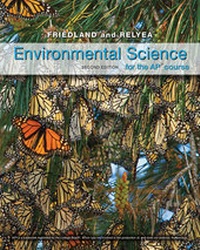
Environmental Science for AP*
2nd Edition
Published on 9. January 2015
Book
Hardback
656 pages
978-1-4641-0868-6 (ISBN)
Description
Written specifically for the AP® Environmental Science course, Friedland and Relyea Environmental Science for AP® Second Edition, is designed to help you realize success on the AP® Environmental Science Exam and in your course by providing the built-in support you want and need.
More details
Edition
2nd ed. 2015
Language
English
Place of publication
New York
United Kingdom
Publishing group
Macmillan Learning
Target group
Professional and scholarly
Edition type
Revised edition
Product notice
sewn/stitched
Cloth over boards
Illustrations
656 p.
Dimensions
Height: 277 mm
Width: 224 mm
Thickness: 33 mm
Weight
1837 gr
ISBN-13
978-1-4641-0868-6 (9781464108686)
Schweitzer Classification
Persons
Andrew J. Friedland - is The Richard and Jane Pearl Professor in Environmental Studies and Chair of the Environmental Studies Program at Dartmouth. He was the founding chair of the Advanced Placement Test Development Committee (College Board) for Environmental Science. He has a strong interest in high school science education and in the early years of APES he participated in a number of trainer and teacher workshops at Kimball Union Academy, Dartmouth College, and elsewhere. During many of the last ten summers, he has guest lectured at the St. Johnsbury Academy (Vermont) AP Institute for Secondary Teachers. Friedland regularly teaches introductory environmental science and energy courses and has taught courses in forest biogeochemistry, global change, and soil science, as well as foreign study courses in Kenya.
Rick Relyea - Director of the Darrin Fresh Water Institute at Rensselaer Polytechnic Institute. He also serves as Director of the Jefferson Project at Lake George, a groundbreaking partnership between Rensselaer, IBM, and the FUND for Lake George. For the project, Relyea leads a team of Rensselaer scientists, engineers, computer scientists, and artists who are using the latest in science and technology to understand, predict, and enable a resilient ecosystem for nearby Lake George.
Rick Relyea - Director of the Darrin Fresh Water Institute at Rensselaer Polytechnic Institute. He also serves as Director of the Jefferson Project at Lake George, a groundbreaking partnership between Rensselaer, IBM, and the FUND for Lake George. For the project, Relyea leads a team of Rensselaer scientists, engineers, computer scientists, and artists who are using the latest in science and technology to understand, predict, and enable a resilient ecosystem for nearby Lake George.
Content
Unit 1 IntroductionChapter 1 Environmental Science: Studying the State of Our Earth Chapter 2 Environmental Systems Unit 1 AP® Practice Exam Science Applied 1 What Happened to the Missing Salt? Unit 2 The Living WorldChapter 3 Ecosystem Ecology Chapter 4 Global Climates and Biomes Chapter 5 Evolution of Biodiversity Unit 2 AP® Practice Exam Science Applied 2 How Should We Prioritize the Protection of Species Diversity? Unit 3 Biological and Human PopulationsChapter 6 Population and Community Ecology Chapter 7 The Human Population Unit 3 AP® Practice Exam Science Applied 3 How Can We Manage Overabundant Animal Populations? Unit 4 Earth Systems and ResourcesChapter 8 Earth Systems Chapter 9 Water Resources Unit 4 AP® Practice Exam Science Applied 4 Is There a Way to Resolve the California Water Wars? Unit 5 Land UseChapter 10 Land, Public and Private Chapter 11 Feeding the World Unit 5 AP® Practice Exam Science Applied 5 How Do We Define Organic Food? Unit 6 Energy Resources and ConsumptionChapter 12 Nonrenewable Energy Sources Chapter 13 Achieving Energy Sustainability Unit 6 AP® Practice Exam Science Applied 6 Should Corn Become Fuel? Unit 7 PollutionChapter 14 Water Pollution Chapter 15 Air Pollution and Stratospheric Ozone Depletion Chapter 16 Waste Generation and Waste Disposal Chapter 17 Human Health and Environmental Risks Unit 7 AP® Practice Exam Science Applied 7 Is Recycling Always Good for the Environment? Unit 8 Global Change and a Sustainable FutureChapter 18 Conservation of Biodiversity Chapter 19 Global Change Chapter 20 Sustainability, Economics, and Equity Unit 8 AP® Practice Exam Science Applied 8 Can We Solve the Carbon Crisis Using Cap-and-Trade? Cumulative AP® Environmental Science Practice ExamAppendix: Reading Graphs Glossary Index