

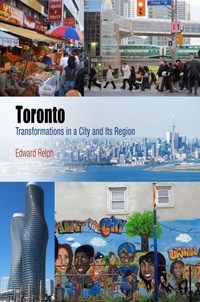
Toronto
Transformations in a City and Its Region
Published on 24. October 2013
Book
Hardback
216 pages
978-0-8122-4542-4 (ISBN)
Description
Extending a hundred miles across south-central Ontario, Toronto is the fifth largest metropolitan area in North America, with the highest population density and the busiest expressway. At its core old Toronto consists of walkable neighborhoods and a financial district deeply connected to the global economy. Newer parts of the region have downtown centers linked by networks of arterial roads and expressways, employment districts with most of the region's jobs, and ethnically diverse suburbs where English is a minority language. About half the population is foreign-born-the highest proportion in the developed world. Population growth because of immigration-almost three million in thirty years-shows few signs of abating, but recently implemented regional strategies aim to contain future urban expansion within a greenbelt and to accommodate growth by increasing densities in designated urban centers served by public transit.
Toronto: Transformations in a City and Its Region traces the city's development from a British colonial outpost established in 1793 to the multicultural, polycentric metropolitan region of today. Though the original grid survey and much of the streetcar city created a century ago have endured, they have been supplemented by remarkable changes over the past fifty years in the context of economic and social globalization. Geographer Edward Relph's broad-stroke portrait of the urban region draws on the ideas of two renowned Torontonians-Jane Jacobs and Marshall McLuhan-to provide an interpretation of how its current forms and landscapes came to be as they are, the values they embody, and how they may change once again.
Toronto: Transformations in a City and Its Region traces the city's development from a British colonial outpost established in 1793 to the multicultural, polycentric metropolitan region of today. Though the original grid survey and much of the streetcar city created a century ago have endured, they have been supplemented by remarkable changes over the past fifty years in the context of economic and social globalization. Geographer Edward Relph's broad-stroke portrait of the urban region draws on the ideas of two renowned Torontonians-Jane Jacobs and Marshall McLuhan-to provide an interpretation of how its current forms and landscapes came to be as they are, the values they embody, and how they may change once again.
Reviews / Votes
"U.S. urbanists are busy looking to Shanghai for the model of the coming metropolis. Edward Relph's study suggests that they should avoid the long plane trip and check out Toronto." (Carl Abbott, Portland State University) "A brilliant and much-needed book about Toronto! Published at a critical time in the history of the Canadian metropolis, Ted Relph's volume explains Toronto both to itself and to the world." (Roger Keil, York University)More details
Series
Language
English
Place of publication
Pennsylvania
United States
Target group
College/higher education
Product notice
Paper over boards
Illustrations
41 illus.
Dimensions
Height: 233 mm
Width: 165 mm
Thickness: 25 mm
Weight
484 gr
ISBN-13
978-0-8122-4542-4 (9780812245424)
Copyright in bibliographic data and cover images is held by Nielsen Book Services Limited or by the publishers or by their respective licensors: all rights reserved.
Schweitzer Classification
Other editions
Additional editions
E-Book
08/2013
1st Edition
University of Pennsylvania Press
€48.99
Available for download
Person
A longtime resident of Toronto, Edward Relph is Emeritus Professor of Geography at the University of Toronto Scarborough and author of Place and Placelessness and Modern Urban Landscapes.
Content
Preface
Chapter 1. Urban Transformations
Chapter 2. Confused Identities
Chapter 3. Shaping the Old City
Chapter 4. The Ascendancy of Metropolitan Toronto
Chapter 5. A Post-suburban Skyscraper City
Chapter 6. Diversity in the Outer Suburbs
Chapter 7. Polycentricity
Chapter 8. Globally Connected and Locally Divided
Chapter 9. Containing Growth
Chapter 10. A City for Everybody
Notes
Index
Chapter 1. Urban Transformations
Chapter 2. Confused Identities
Chapter 3. Shaping the Old City
Chapter 4. The Ascendancy of Metropolitan Toronto
Chapter 5. A Post-suburban Skyscraper City
Chapter 6. Diversity in the Outer Suburbs
Chapter 7. Polycentricity
Chapter 8. Globally Connected and Locally Divided
Chapter 9. Containing Growth
Chapter 10. A City for Everybody
Notes
Index