

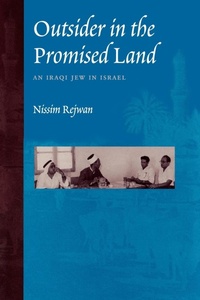
Outsider in the Promised Land
An Iraqi Jew in Israel
Published on 1. July 2006
Book
Paperback/Softback
262 pages
978-0-292-72236-1 (ISBN)
Description
In 1951, Israel was a young nation surrounded by hostile neighbors. Its tenuous grip on nationhood was made slipperier still by internal tensions among the various communities that had immigrated to the new Jewish state, particularly those between the politically and socially dominant Jewish leadership hailing from Eastern Europe and the more numerous Oriental Jews from the Middle East and North Africa. Into this volatile mix came Nissim Rejwan, a young Iraqi Jewish intellectual who was to become one of the country's leading public intellectuals and authors.
Beginning with Rejwan's arrival in 1951 and climaxing with the tensions preceding Israel's victory in the Six-Day War of 1967, this book colorfully chronicles Israel's internal and external struggles to become a nation, as well as the author's integration into a complex culture. Rejwan documents how the powerful East European leadership, acting as advocates of Western norms and ideals, failed to integrate Israel into the region and let the country take its place as a part of the Middle East. Rejwan's essays and occasional articles are an illuminating example of how minority groups use journalism to gain influence in a society. Finally, the letters and diary entries reproduced in Outsider in the Promised Land are full of lively, witty meditations on history, literature, philosophy, education, and art, as well as one man's personal struggle to find his place in a new nation.
Beginning with Rejwan's arrival in 1951 and climaxing with the tensions preceding Israel's victory in the Six-Day War of 1967, this book colorfully chronicles Israel's internal and external struggles to become a nation, as well as the author's integration into a complex culture. Rejwan documents how the powerful East European leadership, acting as advocates of Western norms and ideals, failed to integrate Israel into the region and let the country take its place as a part of the Middle East. Rejwan's essays and occasional articles are an illuminating example of how minority groups use journalism to gain influence in a society. Finally, the letters and diary entries reproduced in Outsider in the Promised Land are full of lively, witty meditations on history, literature, philosophy, education, and art, as well as one man's personal struggle to find his place in a new nation.
More details
Language
English
Place of publication
Austin, TX
United States
Target group
Professional and scholarly
Product notice
Paperback (trade)
Dimensions
Height: 229 mm
Width: 152 mm
Thickness: 16 mm
Weight
434 gr
ISBN-13
978-0-292-72236-1 (9780292722361)
Copyright in bibliographic data and cover images is held by Nielsen Book Services Limited or by the publishers or by their respective licensors: all rights reserved.
Schweitzer Classification
Other editions
Additional editions
E-Book
03/2009
1st Edition
University of Texas Press
from
€32.99
Available for download
Previous edition

Book
08/2006
University of Texas Press
€45.99
Article exhausted; check for reprint
Person
Nissim Rejwan (1924-2017) was Research Fellow at the Harry S. Truman Research Institute for the Advancement of Peace at the Hebrew University of Jerusalem.
Content
1. First Impressions
2. Probings
3. Arab Affairs Analyst of Sorts
4. Rachel
5. The Levantinism Scare
6. The Three Divides
7. Barbarians at the Gate
8. Gentlefolk and Upstarts
9. Israel's Communal Problem
10. Freedom of Speech, Israel Style
11. The Mystery of Education
12. The Debate Intensifies
13. Stepping on "Very Delicate Ground"
Afterword. Pride or Self-Effacement: On Refusing to Save Skin
2. Probings
3. Arab Affairs Analyst of Sorts
4. Rachel
5. The Levantinism Scare
6. The Three Divides
7. Barbarians at the Gate
8. Gentlefolk and Upstarts
9. Israel's Communal Problem
10. Freedom of Speech, Israel Style
11. The Mystery of Education
12. The Debate Intensifies
13. Stepping on "Very Delicate Ground"
Afterword. Pride or Self-Effacement: On Refusing to Save Skin