

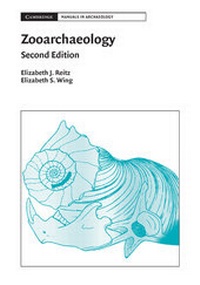
Zooarchaeology
2nd Edition
Published on 14. January 2008
Book
Paperback/Softback
560 pages
978-0-521-67393-8 (ISBN)
Description
This is an introductory text for students interested in identification and analysis of animal remains from archaeological sites. The emphasis is on animals whose remains inform us about the relationship between humans and their natural and social environments, especially site formation processes, subsistence strategies, the processes of domestication, and paleoenvironments. Examining examples from all over the world, from the Pleistocene period up to the present, this volume is organized in a way that is parallel to faunal study, beginning with background information, bias in a faunal assemblage, and basic zooarchaeological methods. This revised edition reflects developments in zooarchaeology during the past decade. It includes sections on enamel ultrastructure and incremental analysis, stable isotyopes and trace elements, ancient genetics and enzymes, environmental reconstruction, people as agents of environmental change, applications of zooarchaeology in animal conservation and heritage management, and a discussion of issues pertaining to the curation of archaeofaunal materials.
Reviews / Votes
'Students of zooarchaeology and seasoned practitioners alike will derive great benefit from this new edition of a classic work. Reitz and Wing have combined their considerable talents and decades of experience to produce a volume that is useful at every level. Issues particular to zooarchaeology are covered with clarity and thoroughness, while matters of general concern to the discipline, such as sampling, are prominently featured, making the book an excellent reference work. ... All archaeologists are indebted to the authors for producing such a worthy volume: I encourage them to repay the debt by purchasing it.' Journal of Archaeological ScienceMore details
Series
Edition
2nd Revised edition
Language
English
Place of publication
Cambridge
United Kingdom
Target group
College/higher education
Professional and scholarly
Edition type
Revised edition
Product notice
Paperback (trade)
Illustrations
Worked examples or Exercises
Dimensions
Height: 253 mm
Width: 178 mm
Thickness: 25 mm
Weight
892 gr
ISBN-13
978-0-521-67393-8 (9780521673938)
Copyright in bibliographic data and cover images is held by Nielsen Book Services Limited or by the publishers or by their respective licensors: all rights reserved.
Schweitzer Classification
Other editions
New editions
Elizabeth J. Reitz | Barnet Pavao-Zuckerman | Elizabeth S. Wing
Zooarchaeology
Book
approx. 12/2025
3rd Edition
Cambridge University Press
€63.60
Not yet published
Additional editions
Elizabeth J. Reitz | Elizabeth S. Wing
Zooarchaeology
E-Book
03/2008
2nd Edition
Cambridge University Press
€58.99
Available for download
Previous edition
Elizabeth J. Reitz | Elizabeth S. Wing
Zooarchaeology
Book
02/1999
Cambridge University Press
€42.16
Article exhausted; check for reprint
Persons
Elizabeth J. Reitz is professor of anthropology at the Georgia Museum of Natural History, University of Georgia. Her work is based on the identification and interpretation of animal remains from coastal archaeological sites, particularly in South America, the Caribbean, and the southeastern United States. She is the co-author and co-editor of several volumes, as well as the author of over 150 articles and chapters in books. Elizabeth S. Wing is Curator Emeritus at the Florida Museum of Natural History, University of Florida. Co-author of two books and author of many scholarly articles, she received the Fryxell Award from the Society for American Archaeology in 1996 for distinguished contributions to archaeology through interdisciplinary research. In 2006, Dr Wing was elected to the National Academy of Sciences and received the President's Medal from the University of Florida.
Content
1. Zooarchaeology; 2. Zooarchaeological history and theory; 3. Basic biology; 4. Ecology; 5. Disposal of faunal remains and sample recovery; 6. Gathering primary data; 7. Secondary data; 8. Humans as predators: subsistence strategies and other uses of animals; 9. Control of animals through domestication; 10. Evidences for past environmental conditions; 11. Conclusions.