

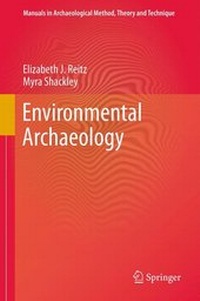
Environmental Archaeology
Published on 31. May 2012
Book
Paperback/Softback
480 pages
978-1-4614-3338-5 (ISBN)
Description
One of the most significant developments in archaeology in recent years is the emergence of its environmental branch: the study of humans' interactions with their natural surroundings over long periods, and of organic remains instead of the artifacts and household items generally associated with sites. With the current attention paid to human responsibility for environmental change, this innovative field is recognized by scientists, conservation and heritage managers, and policymakers worldwide. In this context comes Environmental Archaeology by Elizabeth Reitz and Myra Shackley, updating the seminal 1981 text Environmental Archaeology by Myra Shackley. Rigorously detailed yet concise and accessible, this volume surveys the complex and technical field of environmental archaeology for researchers interested in the causes, consequences, and potential future impact of environmental change and archaeology. Its coverage acknowledges the multiple disciplines involved in the field, expanding the possibilities for using environmental data from archaeological sites in enriching related disciplines and improving communication among them.
Introductory chapters explain the processes involved in the formation of sites, introduce research designs and field methods, and walk the reader through biological classifications before focusing on the various levels of biotic and abiotic materials found at sites, including: Sediments and soils.Viruses, bacteria, archaea, protists, and fungi.Bryophytes and vascular plants.Wood, charcoal, stems, leaves, and roots.Spores, pollen, and other microbotanical remains.Arthropods, molluscs, echinoderms, and vertebrates. Stable isotopes, elements, and biomolecules.The updated Environmental Archaeology is a major addition to the resource library of archaeologists, environmentalists, historians, researchers, policymakers--anyone involved in studying, managing, or preserving historical sites The updated Environmental Archaeology is a major addition to the resource library of archaeologists, environmentalists, historians, researchers, policymakers--anyone involved in studying, managing, or preserving historical sites
Introductory chapters explain the processes involved in the formation of sites, introduce research designs and field methods, and walk the reader through biological classifications before focusing on the various levels of biotic and abiotic materials found at sites, including: Sediments and soils.Viruses, bacteria, archaea, protists, and fungi.Bryophytes and vascular plants.Wood, charcoal, stems, leaves, and roots.Spores, pollen, and other microbotanical remains.Arthropods, molluscs, echinoderms, and vertebrates. Stable isotopes, elements, and biomolecules.The updated Environmental Archaeology is a major addition to the resource library of archaeologists, environmentalists, historians, researchers, policymakers--anyone involved in studying, managing, or preserving historical sites The updated Environmental Archaeology is a major addition to the resource library of archaeologists, environmentalists, historians, researchers, policymakers--anyone involved in studying, managing, or preserving historical sites
More details
Series
Edition
2012 ed.
Language
English
Place of publication
New York, NY
United States
Target group
College/higher education
Research
Illustrations
7 farbige Abbildungen, 36 s/w Tabellen, 147 s/w Abbildungen
145 black & white illustrations, 7 colour illustrations, 36 black & white tables
Dimensions
Height: 235 mm
Width: 155 mm
ISBN-13
978-1-4614-3338-5 (9781461433385)
DOI
10.1007/978-1-4614-3339-2
Copyright in bibliographic data and cover images is held by Nielsen Book Services Limited or by the publishers or by their respective licensors: all rights reserved.
Schweitzer Classification
Other editions
Additional editions
Elizabeth Reitz | Myra Shackley
Environmental Archaeology
Book
11/2013
Springer
€96.29
Shipment within 15-20 days
Elizabeth Reitz | Myra Shackley
Environmental Archaeology
Book
05/2012
Springer
€117.69
Shipment within 15-20 days
Persons
Dr. Elizabeth Reitz is a Professor of Anthropology at the University of Georgia. She is also a member of the Executive Committee, International Council on Archaeozoology, and the International Committee, International Council on Archaeozoology. She is currently the Director of the University of Georgia's Center for Archaeological Sciences. Dr. Myra Shackley is affiliated with the Nottingham Business School at Nottingham Trent University. She is a former head of the Centre for Tourism and Visitor Management at Nottingham Business School.
Content
Introduction to Environmental Archaeology.- Factors Affecting the Composition of an Assemblage.- Research Designs and Field Methods.- Classification and Nomenclature.- Sediments and Soils.- Seeds, Fruits, Nuts, and Tubers.- Woods and Charcoal.- Pollen.- Phytoliths, Starch Grains, and Spores.- Micro-organisms.- Arthropods: Spiders and Mites, fleas, Chironomids, Lice, Beetles, Rickettsiae, Ostracods, Nematode Worms, Crabs, Shrimp.- Echinoderms and Molluscs.- Vertebrate Bones and Teeth.- Other Vertebrate Tissues.- Stable Isotopes, Trace Elements, Ancient Genetics, and Enzymes.- Conclusion.