

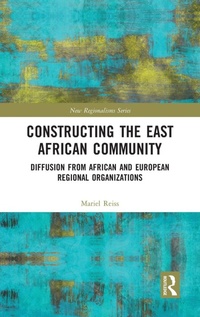
Constructing the East African Community
Diffusion from African and European Regional Organizations
1st Edition
Published on 28. April 2022
Book
Hardback
198 pages
978-1-032-01595-8 (ISBN)
Description
This book provides a systematic analysis of the establishment and decision-making processes concerning the institutional design of the East African Community (EAC) throughout the 1990s and discusses to what extent these were impacted and inspired by other regional organizations from Africa and Europe.
Analysing the decision-making processes that led to the set-up of the EAC, the book explores the extent to which they were impacted by several other regional organizations, namely the Organization of African Unity (OAU), the Common Market for Eastern and Southern Africa (COMESA), the Southern African Development Community (SADC), the European Union (EU), and the first EAC. The findings indicate that the relevant east African state and non-state actors adopted substantial aspects from the first EAC, the EU, and the COMESA and adapted them to set up the current EAC. This book demonstrates that the perception of other regional organizations and their institutional design considerably effected the construction of the EAC; here, its own past provided crucial learning objectives, which challenges the notion of mimicry or replica regional organizations of the EU in the Global South.
This work will be of particular interest to scholars and students of regional and international organizations, international relations, multilevel governance approaches as well as diffusion literature.
Analysing the decision-making processes that led to the set-up of the EAC, the book explores the extent to which they were impacted by several other regional organizations, namely the Organization of African Unity (OAU), the Common Market for Eastern and Southern Africa (COMESA), the Southern African Development Community (SADC), the European Union (EU), and the first EAC. The findings indicate that the relevant east African state and non-state actors adopted substantial aspects from the first EAC, the EU, and the COMESA and adapted them to set up the current EAC. This book demonstrates that the perception of other regional organizations and their institutional design considerably effected the construction of the EAC; here, its own past provided crucial learning objectives, which challenges the notion of mimicry or replica regional organizations of the EU in the Global South.
This work will be of particular interest to scholars and students of regional and international organizations, international relations, multilevel governance approaches as well as diffusion literature.
Reviews / Votes
"Rich in detail and through an engaging narrative that captures the past and present so well, Reiss' forensic analysis of East African regional integration is a much-needed addition to studies on the political economy of regional integration. This is a great reference for those interested in comparative regionalism, norm diffusion and African agency in global politics."Dr Toni Haastrup, University of Stirling, UK. "Rich in detail and through an engaging narrative that captures the past and present so well, Reiss' forensic analysis of East African regional integration is a much-needed addition to studies on the political economy of regional integration. This is a great reference for those interested in comparative regionalism, norm diffusion and African agency in global politics."
Dr Toni Haastrup, University of Stirling, UK.
"Mariel Reiss' work is the result of inspired thinking and a prodigious amount of research. Her examination of how and when the institutional design of a regional organization can be diffused - or not - to other regional organizations helps elevate our understanding of the foundational underpinnings of the East African Community. Moreover, her approach serves as a blueprint toward a more nuanced understanding of broader patterns within African regional integration. This is a major contribution to Africa-centred scholarship in the field of regionalism."
Dr John Kotsopoulos, University of Pretoria, South Africa
More details
Series
Language
English
Place of publication
London
United Kingdom
Publishing group
Taylor & Francis Ltd
Target group
College/higher education
Illustrations
15 s/w Abbildungen, 15 s/w Zeichnungen, 9 s/w Tabellen
9 Tables, black and white; 15 Line drawings, black and white; 15 Illustrations, black and white
Dimensions
Height: 240 mm
Width: 161 mm
Thickness: 16 mm
Weight
493 gr
ISBN-13
978-1-032-01595-8 (9781032015958)
Copyright in bibliographic data and cover images is held by Nielsen Book Services Limited or by the publishers or by their respective licensors: all rights reserved.
Schweitzer Classification
Other editions
Additional editions
Mariel Reiss
Constructing the East African Community
Diffusion from African and European Regional Organizations
Book
01/2024
1st Edition
Routledge
€65.10
Shipment within 10-20 days
Mariel Reiss
Constructing the East African Community
Diffusion from African and European Regional Organizations
E-Book
04/2022
1st Edition
Routledge
€59.49
Available for download
Mariel Reiss
Constructing the East African Community
Diffusion from African and European Regional Organizations
E-Book
04/2022
1st Edition
Routledge
€59.49
Available for download
Person
Mariel Reiss is a research fellow at the Center for Conflict Studies at the Philipps-University of Marburg and leads the research project "LGBTIQ+ Rights in Multilevel Governance Systems". Her publications discuss the establishment processes and development of regional organizations and the roles of state and non-state actors in this regard. Her main focus lies with African regional organizations, in particular the East African Community and the Southern African Development Community. She holds a Ph.D. in Political Science from the Phillips-University of Marburg and am M.A. in Political Science and Cultural Anthropology from the Gutenberg-University Mainz.
Content
1 Introduction 2 Diffusion: Interdependence of Regional Organizations 3 Problematization of the East African Community 4 Construction of the East African Community 5 The Impact of Positive Perception on Diffusion 6 Conclusion