

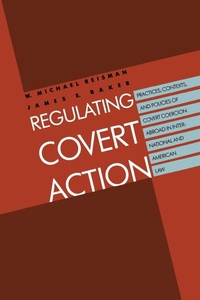
Regulating Covert Action
Will be published approx. on 8. March 2011
Book
Paperback/Softback
260 pages
978-0-300-17694-0 (ISBN)
Description
Covert activity has always been a significant element of international politics. When it has served their interests, governments have secretly disseminated propaganda in other countries, manipulated foreign economies, and abetted coups against their adversaries. What are the circumstances, if any, in which it is lawful, under international law or United States law, to resort to covert action either directly or through local proxies? When is it right to do so?
This book is the first to assess the lawfulness of covert action under United States and international law and to face candidly the implications for democratic states that covert operations pose. Michael Reisman and James E. Baker identify different types of covert actions, discussing a variety of cases that include the Trujillo assassination in 1961, the Rainbow Warrior in 1985, and the raid on Libya in 1986. After explaining the complex operations of the international legal system, they explore trends in decision making and the conditions that accounted for them-whether the covert operations were proactive, defensive, or reactive. They examine in detail the procedures followed in the United States to authorize and oversee covert activity and propose guidelines for political leaders who may contemplate using covert techniques. An appendix reviews twenty years of allegations of covert aggression brought to the attention of the United Nations Security Council.
This book is the first to assess the lawfulness of covert action under United States and international law and to face candidly the implications for democratic states that covert operations pose. Michael Reisman and James E. Baker identify different types of covert actions, discussing a variety of cases that include the Trujillo assassination in 1961, the Rainbow Warrior in 1985, and the raid on Libya in 1986. After explaining the complex operations of the international legal system, they explore trends in decision making and the conditions that accounted for them-whether the covert operations were proactive, defensive, or reactive. They examine in detail the procedures followed in the United States to authorize and oversee covert activity and propose guidelines for political leaders who may contemplate using covert techniques. An appendix reviews twenty years of allegations of covert aggression brought to the attention of the United Nations Security Council.
More details
Language
English
Place of publication
United States
Target group
Professional and scholarly
Product notice
Paperback (trade)
Dimensions
Height: 229 mm
Width: 152 mm
Thickness: 15 mm
Weight
384 gr
ISBN-13
978-0-300-17694-0 (9780300176940)
Copyright in bibliographic data and cover images is held by Nielsen Book Services Limited or by the publishers or by their respective licensors: all rights reserved.
Schweitzer Classification