

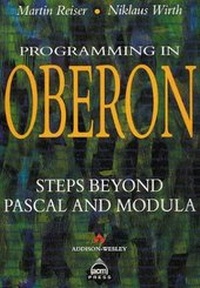
Programming in Oberon
Steps Beyond Pascal and Modula
Published on 18. May 1992
Book
Paperback/Softback
336 pages
978-0-201-56543-0 (ISBN)
Description
In 1985 Niklaus Wirth and Juerg Gutknecht embarked on a project to build a new workstation from scratch. The quote from Einstein: 'Make it as simple as possible, but not simpler' served as a signpost for their approach resulting in a system of exemplary lucidity, efficiency and compactness. Wirth was fascinated by the accuracy and reliability of the Voyager space probe then passing Oberon, one of the moons of Uranus. The project was christened Oberon in its honor.
This is the definitive guide to the Oberon language developed as a successor to Pascal and Modula 2. Programming in Oberon provides:
A programming tutorial that demonstrates modern programming concepts;
A complete language reference that explains the syntax and use of Oberon.
This unique tutorial will be suitable for students learning Oberon as well as providing a valuable reference for professional programmers.
Key features of the book
An early introduction to procedures and modules;
A unifying series of examples of increasing complexity which build up throughout the book towards a complete realistic simulation package;
An explanation of the object-oriented style of programming and its advantages.
This is the definitive guide to the Oberon language developed as a successor to Pascal and Modula 2. Programming in Oberon provides:
A programming tutorial that demonstrates modern programming concepts;
A complete language reference that explains the syntax and use of Oberon.
This unique tutorial will be suitable for students learning Oberon as well as providing a valuable reference for professional programmers.
Key features of the book
An early introduction to procedures and modules;
A unifying series of examples of increasing complexity which build up throughout the book towards a complete realistic simulation package;
An explanation of the object-oriented style of programming and its advantages.
More details
Language
English
Place of publication
Harlow
United Kingdom
Publishing group
Pearson Education Limited
Target group
Professional and scholarly
Dimensions
Height: 234 mm
Width: 170 mm
Thickness: 19 mm
Weight
570 gr
ISBN-13
978-0-201-56543-0 (9780201565430)
Copyright in bibliographic data and cover images is held by Nielsen Book Services Limited or by the publishers or by their respective licensors: all rights reserved.
Schweitzer Classification
Content
Why Oberon?
A First Oberon Program
Tokens and basic types
Declarations, expressions and assignments
Control structures
Procedures and modules
Input and output
Type declarations, array and record types
Dynamic data structures and pointer types
Stepwise refinement and data abstraction
Type extension and procedure types
Object-orientation
A simulation package
Oberon-2
A First Oberon Program
Tokens and basic types
Declarations, expressions and assignments
Control structures
Procedures and modules
Input and output
Type declarations, array and record types
Dynamic data structures and pointer types
Stepwise refinement and data abstraction
Type extension and procedure types
Object-orientation
A simulation package
Oberon-2