

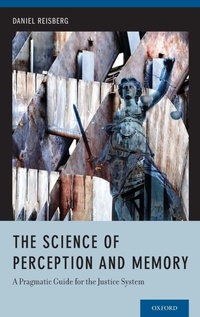
The Science of Perception and Memory
A Pragmatic Guide for the Justice System
Published on 23. October 2014
Book
Hardback
384 pages
978-0-19-982696-4 (ISBN)
Description
A robbery victim tries to remember how the crime unfolded and who was present at the scene. A medical patient recalls the doctor saying that the pain in her side wasn't worrisome, and now that the tumor is much larger, she's suing. An investigation of insider trading hinges on someone's memory of exactly what was said at a particular business meeting. In these and countless other examples, our ability to remember our experiences is crucial for the justice system. The problem, though, is that perception and memory are fallible. How often do our eyes or memories deceive us? Is there some way to avoid these errors? Can we specify the circumstances in which perceptual or memory errors are more or less likely to occur?
Professor Daniel Reisberg tackles these questions by drawing on the available science and his personal experience training attorneys. He provides detailed pragmatic advice that will prove helpful to law enforcement, prosecutors, defenders, and anyone else who hopes to maximize the quality of the evidence available to the courts -- whether the evidence is coming from witnesses, victims, or defendants.
This book is carefully rooted in research but written in a way that will make it fully accessible to non-scientists working in the justice system. Early chapters provide an overview of the relevant science and a broad portrait of how perception and memory function. Later chapters offer practical solutions for navigating situations involving eyewitness identifications, remembered conversations, evidence obtained from interviews with children, confession evidence, and the risks of false confession.
Professor Daniel Reisberg tackles these questions by drawing on the available science and his personal experience training attorneys. He provides detailed pragmatic advice that will prove helpful to law enforcement, prosecutors, defenders, and anyone else who hopes to maximize the quality of the evidence available to the courts -- whether the evidence is coming from witnesses, victims, or defendants.
This book is carefully rooted in research but written in a way that will make it fully accessible to non-scientists working in the justice system. Early chapters provide an overview of the relevant science and a broad portrait of how perception and memory function. Later chapters offer practical solutions for navigating situations involving eyewitness identifications, remembered conversations, evidence obtained from interviews with children, confession evidence, and the risks of false confession.
Reviews / Votes
This small, information-rich volume is essential for the library of everyone who cares about the accuracy of witness evidence. Professor Daniel Reisberg provides a comprehensive and comprehensible handbook for understanding how we observe, remember, and recall information that may be critical in a legal proceeding. The book offers not only an overview of the scientific method and its use in the study of memory and perception, but also a strong argument for its utility in the legal system in the search for justice... This book is an invaluable contribution to a responsible, reasoned, and well-informed use of science in the justice system. * Susan Elizabeth Reese, The Champion *More details
Language
English
Place of publication
New York
United States
Target group
College/higher education
Professional and scholarly
Illustrations
7 illustrations
Dimensions
Height: 240 mm
Width: 161 mm
Thickness: 25 mm
Weight
743 gr
ISBN-13
978-0-19-982696-4 (9780199826964)
Copyright in bibliographic data and cover images is held by Nielsen Book Services Limited or by the publishers or by their respective licensors: all rights reserved.
Schweitzer Classification
Other editions
Additional editions
E-Book
09/2014
1st Edition
OUP eBook
€69.99
Available for download
Person
Daniel Reisberg is Patricia and Clifford Lunneborg Professor of Psychology at Reed College, Oregon. His research focuses on a range of topics tied to perception and cognition, with special emphasis on visual imagery and memory for emotional events. He is the editor of the Oxford Handbook of Cognitive Psychology.
Content
Preface ; 1. Foundations ; 2. Perception ; 3. Memory ; 4. Witness IDs ; 5. ID Procedures ; 6. Voices and Conversation ; 7. Lies ; 8. Confessions ; 9. Jury Cognition ; 10. Kids ; 11. Kid Investigations ; Epilogue ; References