

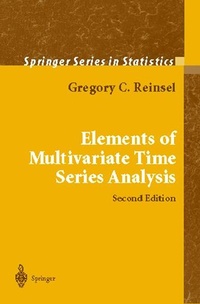
Elements of Multivariate Time Series Analysis
2nd Edition
Published on 31. October 2003
Book
Paperback/Softback
XVII, 358 pages
978-0-387-40619-0 (ISBN)
Description
In this revised edition, some additional topics have been added to the original version, and certain existing materials have been expanded, in an attempt to pro vide a more complete coverage of the topics of time-domain multivariate time series modeling and analysis. The most notable new addition is an entirely new chapter that gives accounts on various topics that arise when exogenous vari ables are involved in the model structures, generally through consideration of the so-called ARMAX models; this includes some consideration of multivariate linear regression models with ARMA noise structure for the errors. Some other new material consists of the inclusion of a new Section 2. 6, which introduces state-space forms of the vector ARMA model at an earlier stage so that readers have some exposure to this important concept much sooner than in the first edi tion; a new Appendix A2, which provides explicit details concerning the rela tionships between the autoregressive (AR) and moving average (MA) parameter coefficient matrices and the corresponding covariance matrices of a vector ARMA process, with descriptions of methods to compute the covariance matrices in terms of the AR and MA parameter matrices; a new Section 5.
More details
Series
Edition
Second Edition 1997
Language
English
Place of publication
New York
United States
Target group
Professional and scholarly
Research
Edition type
Revised edition
Illustrations
XVII, 358 p.
Dimensions
Height: 235 mm
Width: 155 mm
Thickness: 21 mm
Weight
575 gr
ISBN-13
978-0-387-40619-0 (9780387406190)
DOI
10.1007/978-1-4612-0679-8
Schweitzer Classification
Other editions
Additional editions
Gregory C. Reinsel
Elements of Multivariate Time Series Analysis
Book
04/1997
2nd Edition
Springer
€85.55
Article exhausted; check different version
Person
Gregory C. Reinsel (now deceased) was Professor of Statistics at the University of Wisconsin, Madison. He was a fellow of the American Statistical Association. He also author of the book Elements of Multivariate Time Series Analysis, Second Edition, and coauthor, with G.E.P. Box and G.M. Jenkins, of the book Time Series Analysis: Forecasting and Control, Third Edition. Greg will remain the first author, in our gratitude.
Raja P. Velu taught business analytics and finance at Syracuse University. The first version of the book was mainly based on his thesis written under the supervision of Professor Reinsel and Professor Dean Wichern. He works in the big data models area with interest in high-dimensional time series and forecasting applications. His book, Algorithmic Trading and Quantitative Strategies, co-authored with practitioners from CITI and JP Morgan Chase, is published by Taylor and Francis. He was recently (2021-2022) a visiting researcher at Google working with the Resource Efficiency Data Science team.
Kun Chen is an associate professor in the Department of Statistics at the University of Connecticut. He is a Fellow of the American Statistical Association and an Elected Member of the International Statistical Institute. The first version of the book has had profound influence on his research since his PhD study at the University of Iowa under the supervision of Professor Kung-Sik Chan. His related work has resulted in many publications in statistics, machine learning, and scientific journals and the developed methods have been applied to tackle consequential problems in various fields including public health, ecology, and biological sciences.
Content
1. Vector Time Series and Model Representations.- 1.1 Stationary Multivariate Time Series and Their Properties.- 1.2 Linear Model Representations for a Stationary Vector Process.- A1 Appendix: Review of Multivariate Normal Distribution and Related Topics.- A l. l Review of Some Basic Matrix Theory Results.- A l. 2 Vec Operator and Kronecker Products of Matrices.- A l. 3 Expected Values and Covariance Matrices of Random Vectors.- A1.4 The Multivariate Normal Distribution.- A1.5 Some Basic Results on Stochastic Convergence.- 2. Vector ARMA Time Series Models and Forecasting.- 2.1 Vector Moving Average Models.- 2.2 Vector Autoregressive Models.- 2.3 Vector Mixed Autoregressive Moving Average Models.- 2.4 Nonstationary Vector ARMA Models.- 2.5 Prediction for Vector ARMA Models.- 2.6 State-Space Form of the Vector ARMA Model.- A2 Appendix: Methods for Obtaining Autoregressive and Moving Average Parameters from Covariance Matrices.- A2.1 Iterative Algorithm for Factorization of Moving Average Spectral Density Matrix in Terms of Covariance Matrices.- A2.2 Autoregressive and Moving Average Parameter Matrices in Terms of Covariance Matrices for the Vector ARMA Model.- A2.3 Evaluation of Covariance Matrices in Terms of the AR and MA Parameters for the Vector ARMA Model.- 3. Canonical Structure of Vector ARMA Models.- 3.1 Consideration of Kronecker Structure for Vector ARMA Models.- 3.2 Canonical Correlation Structure for ARMA Time Series.- 3.3 Partial Autoregressive and Partial Correlation Matrices.- 4. Initial Model Building and Least Squares Estimation for Vector AR Models.- 4.1 Sample Cross-Covariance and Correlation Matrices and Their Properties.- 4.2 Sample Partial AR and Partial Correlation Matrices and Their Properties.- 4.3 Conditional Least Squares Estimation of Vector AR Models.- 4.4 Relation of LSE to Yule-Walker Estimate for Vector AR Models.- 4.5 Additional Techniques for Specification of Vector ARMA Models.- A4 Appendix: Review of the General Multivariate Linear Regression Model.- A4.1 Properties of the Maximum Likelihood Estimator of the Regression Matrix.- A4.2 Likelihood Ratio Test of Linear Hypothesis About Regression Coefficients.- A4.3 Asymptotically Equivalent Forms of the Test of Linear Hypothesis.- A4.4 Multivariate Linear Model with Reduced-Rank Structure.- A4.5 Generalization to Seemingly Unrelated Regressions Model.- 5. Maximum Likelihood Estimation and Model Checking for Vector ARMA Models.- 5.1 Conditional Maximum Likelihood Estimation for Vector ARMA Models.- 5.2 ML Estimation and LR Testing of ARMA Models Under Linear Restrictions.- 5.3 Exact Likelihood Function for Vector ARMA Models.- 5.4 Innovations Form of the Exact Likelihood Function for ARMA Models.- 5.5 Overall Checking for Model Adequacy.- 5.6 Effects of Parameter Estimation Errors on Prediction Properties.- 5.7 Motivation for AIC as Criterion for Model Selection, and Corrected Versions of AIC.- 5.8 Numerical Examples.- 6. Reduced-Rank and Nonstationary Cointegrated Models.- 6.1 Nested Reduced-Rank AR Models and Partial Canonical Correlation Analysis.- 6.2 Review of Estimation and Testing for Nonstationarity (Unit Roots) in Univariate ARIMA Models.- 6.3 Nonstationary (Unit-Root) Multivariate AR Models, Estimation, and Testing.- 6.4 A Canonical Analysis for Vector Autoregressive Time Series.- 6.5 Multiplicative Seasonal Vector ARMA Models.- 7. State-Space Models, Kaiman Filtering, and Related Topics.- 7.1 State-Variable Models and Kaiman Filtering.- 7.2 State-Variable Representations of the Vector ARMA Model.- 7.3 Exact Likelihood Estimation for Vector ARMAProcesses with Missing Values.- 7.4 Classical Approach to Smoothing and Filtering of Time Series.- 8. Linear Models with Exogenous Variables.- 8.1 Representations of Linear Models with Exogenous Variables.- 8.2 Forecasting in ARMAX Models.- 8.3 Optimal Feedback Control in ARMAX Models.- 8.4 Model Specification, ML Estimation, and Model Checking for ARMAX Models.- 8.5 Numerical Example.- Appendix: Time Series Data Sets.- Exercises and Problems.- References.- Author Index.