

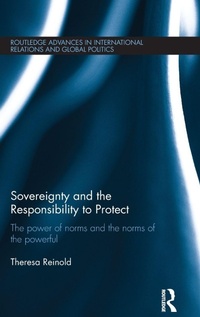
Sovereignty and the Responsibility to Protect
The Power of Norms and the Norms of the Powerful
1st Edition
Published on 31. August 2012
Book
Hardback
200 pages
978-0-415-62629-3 (ISBN)
Description
This book explores how the bedrock institution of today's global order - sovereignty - is undergoing transformation as a result of complex interactions between power and norms, between politics and international law.
This book analyses a series of controversial military interventions into the internal affairs of "irresponsible sovereigns" and discusses their consequences for the rules on the use of force and the principle of sovereign equality. Featuring case studies on Kosovo, Darfur and Afghanistan, It shows that frames from one discourse (for example the debate over the responsibility to protect) have been imported into other discourses (on counter-terrorism and nuclear non-proliferation) in an attempt to legitimize a bold challenge to the global legal order. Although the 'demise' of sovereignty is widely debated, this book instead seeks to 'deconstruct' sovereignty by explaining how this institution has been reconstituted by global powers whose hegemonic law-making activities have popularized the notion of sovereignty as responsibility.
Drawing on international relations theory, international law and sociology, Sovereignty and the Responsibility to Protect develops a truly interdisciplinary perspective on the transformation of sovereignty and will be of strong interest to students and scholars in these fields.
This book analyses a series of controversial military interventions into the internal affairs of "irresponsible sovereigns" and discusses their consequences for the rules on the use of force and the principle of sovereign equality. Featuring case studies on Kosovo, Darfur and Afghanistan, It shows that frames from one discourse (for example the debate over the responsibility to protect) have been imported into other discourses (on counter-terrorism and nuclear non-proliferation) in an attempt to legitimize a bold challenge to the global legal order. Although the 'demise' of sovereignty is widely debated, this book instead seeks to 'deconstruct' sovereignty by explaining how this institution has been reconstituted by global powers whose hegemonic law-making activities have popularized the notion of sovereignty as responsibility.
Drawing on international relations theory, international law and sociology, Sovereignty and the Responsibility to Protect develops a truly interdisciplinary perspective on the transformation of sovereignty and will be of strong interest to students and scholars in these fields.
More details
Series
Language
English
Place of publication
London
United Kingdom
Publishing group
Taylor & Francis Ltd
Target group
College/higher education
Dimensions
Height: 240 mm
Width: 161 mm
Thickness: 16 mm
Weight
493 gr
ISBN-13
978-0-415-62629-3 (9780415626293)
Copyright in bibliographic data and cover images is held by Nielsen Book Services Limited or by the publishers or by their respective licensors: all rights reserved.
Schweitzer Classification
Other editions
Additional editions
Theresa Reinold
Sovereignty and the Responsibility to Protect
The Power of Norms and the Norms of the Powerful
Book
04/2015
1st Edition
Routledge
€71.20
Shipment within 10-20 days
Theresa Reinold
Sovereignty and the Responsibility to Protect
The Power of Norms and the Norms of the Powerful
E-Book
12/2012
1st Edition
Routledge
€64.49
Available for download
Theresa Reinold
Sovereignty and the Responsibility to Protect
The Power of Norms and the Norms of the Powerful
E-Book
12/2012
Routledge
€64.49
Available for download
Person
Theresa Reinold is a Postdoctoral research fellow at the Wissenschaftszentrum Berlin, Germany. Her research focuses on Constitutionalization/fragmentation of international law, African regionalism, Terrorism/state failure and Human rights.
Content
1. Introduction 2. The theoretical context 3. Sovereignty - a conceptual history 4. The responsibility to protect 5. The obligation to control 6. The duty to prevent 7. Conclusion: Sovereignty as responsibility?