

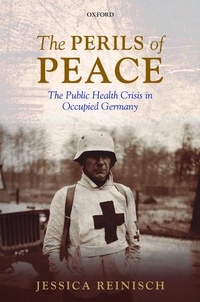
The Perils of Peace
The Public Health Crisis in Occupied Germany
Published on 20. June 2013
Book
Hardback
336 pages
978-0-19-966079-7 (ISBN)
Description
This is an open access title available under the terms of a CC BY-NC-ND 4.0 International licence. It is free to read at Oxford Scholarship Online and offered as a free PDF download from OUP and selected open access locations.
At the end of the war in 1945 Germany was a country with no government, little functioning infrastructure, millions of refugees and homeless people, and huge foreign armies living largely off the land. Large parts of the country were covered in rubble with no clean drinking water, electricity, or gas. Hospitals overflowed with patients but were short of beds, medicines, and medical personnel. In these conditions the potential for epidemics and public health disasters was severe.
In The Perils of Peace Jessica Reinisch considers how the four occupiers - Britain, France, the Soviet Union, and the United States - attempted to keep their own troops and the ex-enemy population alive. While the war was still being fought, German public health was a secondary consideration for them: an unaffordable and undeserved luxury. But once fighting ceased and the occupation began, it rapidly turned into an urgent priority. Public health was then recognized as an indispensable component of creating order, keeping the population governable, and facilitating the reconstruction of German society.
But they faced a number of problems in the process. Which Germans could be trusted to work with the occupiers and how were they to be identified? Who could be tolerated because of a lack of alternatives? How, if at all, could former Nazis be reformed and reintegrated into German society? What was the purpose of the occupation in the first place?
This is the first carefully researched comparison of the four occupation zones which looks at the occupation through the prism of public health, an essential service fundamentally shaped by political and economic criteria, and which in turn was to determine the success or failure of the occupation.
At the end of the war in 1945 Germany was a country with no government, little functioning infrastructure, millions of refugees and homeless people, and huge foreign armies living largely off the land. Large parts of the country were covered in rubble with no clean drinking water, electricity, or gas. Hospitals overflowed with patients but were short of beds, medicines, and medical personnel. In these conditions the potential for epidemics and public health disasters was severe.
In The Perils of Peace Jessica Reinisch considers how the four occupiers - Britain, France, the Soviet Union, and the United States - attempted to keep their own troops and the ex-enemy population alive. While the war was still being fought, German public health was a secondary consideration for them: an unaffordable and undeserved luxury. But once fighting ceased and the occupation began, it rapidly turned into an urgent priority. Public health was then recognized as an indispensable component of creating order, keeping the population governable, and facilitating the reconstruction of German society.
But they faced a number of problems in the process. Which Germans could be trusted to work with the occupiers and how were they to be identified? Who could be tolerated because of a lack of alternatives? How, if at all, could former Nazis be reformed and reintegrated into German society? What was the purpose of the occupation in the first place?
This is the first carefully researched comparison of the four occupation zones which looks at the occupation through the prism of public health, an essential service fundamentally shaped by political and economic criteria, and which in turn was to determine the success or failure of the occupation.
Reviews / Votes
Reinisch has written a fascinating study ... no one writing on early postwar Germany can afford to miss it. * Martijn Lak, German History * this book represents a necessary contribution to comparative work on the occupation of Germany. * Rebecca Boehling, American Historical Review * Jessica Reinisch has written an excellent book, touching on both the administration of post-1945 Germany and post-war public health care. She deals with general conditions of health care for the defeated country's population, including many non-Germans such as displaced persons (DPs) and Eastern European Jews. Her depictions of overall conditions are interspersed with those of particular situations governed by individual victor powers: the United States, Britain, France and the Soviet Union. Hence she provides a five-dimensional view. * Michael H. Kater, English Historical Review * Perils of Peace is a fascinating contribution determined by a broad range of sources that makes it profitable reading for historians of medicine and historians of German occupation alike. * Anita Winkler, Social History of Medicine * [A] meticulous, archivally based comparative analysis of their evolution from wartime planning to postwar implementation throughout the occupation period, in all four occupation zones. * Pertti Ahonen, Journal of Modern History *More details
Language
English
Place of publication
Oxford
United Kingdom
Target group
College/higher education
Product notice
sewn/stitched
Cloth over boards
Illustrations
5 black and white images
Dimensions
Height: 236 mm
Width: 160 mm
Thickness: 28 mm
Weight
658 gr
ISBN-13
978-0-19-966079-7 (9780199660797)
Copyright in bibliographic data and cover images is held by Nielsen Book Services Limited or by the publishers or by their respective licensors: all rights reserved.
Schweitzer Classification
Other editions
Additional editions
E-Book
06/2013
OUP eBook
€0.00
Available for download
Person
Jessica Reinisch grew up in Berlin and lives in London. She teaches and researches at Birkbeck College, University of London.
Content
PART I: ALLIES AND GERMANS; PART II: COMPROMISES AND CONFRONTATIONS, 1945-1949