

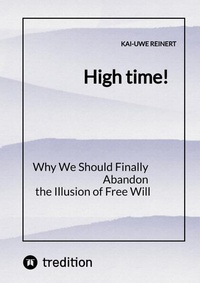
High time!
Why We Should Finally Abandon the Illusion of Free Will
2nd Edition
Published on 20. November 2025
Book
Paperback/Softback
144 pages
978-3-384-75209-3 (ISBN)
Description
Human behaviour and human tragedies, from both private and global perspectives, have been repeating in similar patterns for thousands of years, without humanity seemingly learning from them despite its technological advances. The parallel damage to our foundations of life brings the world ever closer to its limits of endurance. The question arises whether there is a way to move people toward fundamentally different thinking and behaviour. The author sees this way in questioning humanity's previous self-understanding and postulates that humans do not possess free will. The reasoning and implications for individual and societal life are explained in this essay.
More details
Language
English
Place of publication
Saarwellingen
Germany
Target group
People who question things; people who seek answers to global problems; people who want to understand other people, who ask themselves why and with what motivation other people act, how they think, how decisions come about, and how they themselves can best interact and communicate with others; people who question established thought models, ideologies, and religions, who are dissatisfied with the development of humanity and the environment, and who seek alternative paths
Product notice
Unsewn / adhesive bound
Dimensions
Height: 210 mm
Width: 148 mm
Thickness: 11 mm
Weight
219 gr
ISBN-13
978-3-384-75209-3 (9783384752093)
Schweitzer Classification
Other editions
Additional editions
E-Book
11/2025
tredition GmbH
€9.99
Available for download
Person
Author
Dr. med. Kai-Uwe Reinert ist 1960 geboren und lebt im Saarland, 1984 Approbation als Arzt, danach Weiterbildung zum Internisten und Pneumologen. 1994 Gründung einer pneumologischen Gemeinschaftspraxis in Saarbrücken, in der er bis heute arbeitet. Er ist verheiratet, hat einen Sohn und zwei Enkelkinder. Die Frage nach der Willensfreiheit des Menschen hat ihn bereits in der Jugend beschäftigt. Heute fühlt er sich durch die Erkenntnisse der Neurowissenschaft und seine Lebenserfahrung darin bestätigt, dass der Mensch über keinen freien Willen verfügt. Die Suche nach einem Weg, menschliches (Fehl)verhalten prinzipiell zu beeinflussen, führte zur Veröffentlichung dieses Essays.