

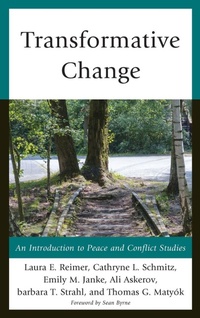
Transformative Change
An Introduction to Peace and Conflict Studies
Published on 21. August 2015
Book
Hardback
238 pages
978-0-7391-9812-4 (ISBN)
Description
This foundational Peace and Conflict Studies text is formatted to fit inside a 14 week college/university term. The chapters are designed to provide a succinct overview of research, theory, and practice that can be supplemented with material chosen by the professor. The book introduces students to the core concepts of the field, and provides an up to date alternative to the Peace and Conflict readers. It will move from historical development of the field to the way forward into the future. Each chapter will reflect current trends and research and contain up to date examples, questions for discussion or for potential student research topics, suggested reading, and engaged teaching activities.
Reviews / Votes
As a professor and practitioner in conflict resolution for over 40 years, I am very pleased to endorse the considerable benefits of this important book on conflict transformation. This comprehensive, user-friendly text succinctly covers major theories, frameworks, modules, terms, and distinctions in the field, though its primary focus in on conflict transformation competencies making it valuable to practitioners, students, and teachers. And the use of chapter questions, exercises and an innovative chapter by students on artistic expression is icing on the cake. -- Neil H. Katz, Syracuse University, Professor Emeritus Transformative Change is a very clearly written, comprehensive, and helpful survey of the Peace and Conflict Studies field. Its strength is its inclusive survey of micro-level theories, methods, and skills related to conflict and its resolution. It will make an invaluable contribution to students, practitioners, and academics in Peace and Conflict Studies and related fields. -- Jerry Buckland, Menno Simons College Transformative Change fuses theory, research, and practice through a stimulating and thought-provoking multidisciplinary, global perspective on peacebuilding and conflict transformation. Modeling empowerment, engagement, and participatory research, it serves as an ideal text to provide peace and conflict studies students in higher education with a solid foundation to launch their academic and professional development in the field. -- Christina Szurlej, Endowed Chair in Human Rights, St. Thomas UniversityMore details
Series
Language
English
Place of publication
United States
Publishing group
Bloomsbury Publishing Plc
Target group
College/higher education
Product notice
sewn/stitched
Cloth over boards
With dust jacket
Illustrations
6 Charts, 4 Tables
Dimensions
Height: 235 mm
Width: 157 mm
Thickness: 19 mm
Weight
543 gr
ISBN-13
978-0-7391-9812-4 (9780739198124)
Copyright in bibliographic data and cover images is held by Nielsen Book Services Limited or by the publishers or by their respective licensors: all rights reserved.
Schweitzer Classification
Persons
Laura E. Reimer is assistant professor at the University of Winnipeg.
Cathryne L. Schmitz is professor and chair of the Department of Peace and Conflict Studies and professor in the Department of Social Work at the University of North Carolina, Greensboro.
Emily M. Janke is associate professor in the Department of Peace and Conflict Studies and the founding director of the Institute for Community and Economic Engagement at the University of North Carolina, Greensboro.
Ali Askerov is assistant professor in the Department of Peace and Conflict Studies at the University of North Carolina, Greensboro.
barbara T. Strahl received her PhD in conflict analysis and resolution from Nova Southeastern University.
Thomas Matyok is associate professor and director of graduate studies in the Department of Peace and Conflict Studies at the University of North Carolina, Greensboro.
Cathryne L. Schmitz is professor and chair of the Department of Peace and Conflict Studies and professor in the Department of Social Work at the University of North Carolina, Greensboro.
Emily M. Janke is associate professor in the Department of Peace and Conflict Studies and the founding director of the Institute for Community and Economic Engagement at the University of North Carolina, Greensboro.
Ali Askerov is assistant professor in the Department of Peace and Conflict Studies at the University of North Carolina, Greensboro.
barbara T. Strahl received her PhD in conflict analysis and resolution from Nova Southeastern University.
Thomas Matyok is associate professor and director of graduate studies in the Department of Peace and Conflict Studies at the University of North Carolina, Greensboro.
Content
Chapter One: Introduction to the Field of Peace and Conflict Studies
Chapter Two: The Foundational Concepts, Models and Frameworks
Chapter Three: Empowering People through Praxis
Chapter Four: Community Engagement
Chapter Five: Interpersonal Communication
Chapter Six: Negotiation
Chapter Seven: Facilitating Group Processes for Transformative Change
Chapter Eight: Mediation
Chapter Nine: ADR: The Multi-Door Courthouse
Chapter Ten: Storytelling
Chapter Eleven: Restorative Practices
Chapter Twelve: Exploring Transformative Change through Artistic Expression
Chapter Two: The Foundational Concepts, Models and Frameworks
Chapter Three: Empowering People through Praxis
Chapter Four: Community Engagement
Chapter Five: Interpersonal Communication
Chapter Six: Negotiation
Chapter Seven: Facilitating Group Processes for Transformative Change
Chapter Eight: Mediation
Chapter Nine: ADR: The Multi-Door Courthouse
Chapter Ten: Storytelling
Chapter Eleven: Restorative Practices
Chapter Twelve: Exploring Transformative Change through Artistic Expression