

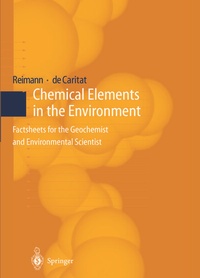
Chemical Elements in the Environment
Factsheets for the Geochemist and Environmental Scientist
Published on 10. December 2011
Book
Paperback/Softback
IX, 398 pages
978-3-642-72018-5 (ISBN)
Description
How large is the natural variation in concentration of the various elements in different media? How do the oft-cited "World average concentrations" in different media compare with actual analytical data? How low a detection limit do I need to attain if I want to analyse for an element in soils, sediments, water or plants? All these questions and many more can be answered by using this unique reference book. It collates data on the most important properties and uses of all naturally occurring chemical elements. It combines these with data obtained from actual analyses of different sample media (soil, stream sediment, stream water, ground water, plants, human body fluids). This combination of facts and actual data makes this book suitable for learning and teaching applied geochemistry as well.
More details
Edition
Softcover reprint of the original 1st ed. 1998
Language
English
Place of publication
Berlin
Germany
Publishing group
Springer Berlin
Target group
Professional and scholarly
Research
Illustrations
IX, 398 p.
Dimensions
Height: 235 mm
Width: 155 mm
Thickness: 23 mm
Weight
622 gr
ISBN-13
978-3-642-72018-5 (9783642720185)
DOI
10.1007/978-3-642-72016-1
Schweitzer Classification
Other editions
Additional editions
Clemens Reimann | Patrice de Caritat
Chemical Elements in the Environment
Factsheets for the Geochemist and Environmental Scientist
Book
03/1998
Springer
€117.69
Article exhausted; check different version
Content
Factsheet Description.- Getting More Out of the Factsheets.- Information Sources.- References.- Factsheets.- Ac Actinium.- Ag Silver.- Al Aluminium.- Ar Argon.- As Arsenic.- At Astatine.- Au Gold.- B Boron.- Ba Barium.- Be Beryllium.- Bi Bismuth.- Br Bromine.- C Carbon.- Ca Calcium.- Cd Cadmium.- Ce Cerium.- Cl Chlorine.- Co Cobalt.- Cr Chromium.- Cs Cesium.- Cu Copper.- Dy Dysprosium.- Er Erbium.- Eu Europium.- F Fluorine.- Fe Iron.- Fr Francium.- Ga Gallium.- Gd Gadolinium.- Ge Germanium.- H Hydrogen.- He Helium.- Hf Hafnium.- Hg Mercury.- Ho Holmium.- I Iodine.- In Indium.- Ir Iridium.- K Potassium.- Kr Krypton.- La Lanthanum.- Li Lithium.- Lu Lutetium.- Mg Magnesium.- Mn Manganese.- Mo Molybdenum.- N Nitrogen.- Na Sodium.- Nb Niobium.- Nd Neodymium.- Ne Neon.- Ni Nickel.- Np Neptunium.- O Oxygen.- Os Osmium.- P Phosphorus.- Pa Protactinium.- Pb Lead.- Pd Palladium.- Po Polonium.- Pr Praseodymium.- Pt Platinum.- Pu Plutonium.- Ra Radium.- Rb Rubidium.- Re Rhenium.- Rh Rhodium.- Rn Radon.- Ru Ruthenium.- S Sulphur.- Sb Antimony.- Sc Scandium.- Se Selenium.- Si Silicon.- Sm Samarium.- Sn Tin.- Sr Strontium.- Ta Tantalum.- Tb Terbium.- Te Tellurium.- Th Thorium.- Ti Titanium.- Tl Thallium.- Tm Thulium.- U Uranium.- V Vanadium.- W Tungsten.- Xe Xenon.- Y Yttrium.- Yb Ytterbium.- Zn Zinc.- Zr Zirconium.- Table A1. Conversion between element and oxide masses.- Table A2. Conversion between mg, mmol and meq.- Table A3. Conversion between selected units.- Table A4. Conversion between common concentration units.