

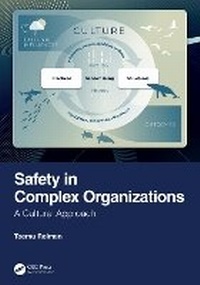
Safety in Complex Organizations
A Cultural Approach
1st Edition
Published on 17. November 2025
Book
Hardback
306 pages
978-1-032-78916-3 (ISBN)
Description
Managing safety in today's complex organizations is no easy feat. When looking at safety from a cultural perspective, organizations are seen as cultures, with their own internal dynamics and ways of interacting with, and interpreting, the outside world. Looking at organizations from a cultural perspective improves our ability to lead and manage them by increasing our understanding of these internal dynamics shaping their behavior. This book offers a theoretically sound yet practical approach to organizational and cultural issues. It investigates their influence on safety and acknowledges the complexity and dynamic nature of today's organizations.
The book is a comprehensive introduction to a cultural approach to safety. It explains the main principles in thinking about safety from a cultural perspective and provides the reader with tools for monitoring and developing culture for safety in organizations. Methods for developing a cultural approach to safety are introduced, and typical approaches to assessing culture for safety are critically reviewed. It draws on more than two decades of experience that the author has in the safety field as a researcher, consultant, and practitioner and includes practical examples, lessons learned, and research findings from several safety-critical fields, including the nuclear, healthcare, construction, petrochemical, and transportation sectors. The reader will develop a thorough overview towards developing their own cultural approach to safety through overviews of resilience and complexity thinking, organizational psychology, management sciences, leadership research, psychological safety, normalization, drift, decision making, leadership, and communication.
Safety in Complex Organizations: A Cultural Approach is a fascinating read for professionals from any discipline who deal with hazards and safety issues, especially those in the nuclear industry; transportation industries, including aviation, rail, and maritime; petrochemical industries; the food industry; healthcare; mining; construction; and conventional and renewable power industries.
The book is a comprehensive introduction to a cultural approach to safety. It explains the main principles in thinking about safety from a cultural perspective and provides the reader with tools for monitoring and developing culture for safety in organizations. Methods for developing a cultural approach to safety are introduced, and typical approaches to assessing culture for safety are critically reviewed. It draws on more than two decades of experience that the author has in the safety field as a researcher, consultant, and practitioner and includes practical examples, lessons learned, and research findings from several safety-critical fields, including the nuclear, healthcare, construction, petrochemical, and transportation sectors. The reader will develop a thorough overview towards developing their own cultural approach to safety through overviews of resilience and complexity thinking, organizational psychology, management sciences, leadership research, psychological safety, normalization, drift, decision making, leadership, and communication.
Safety in Complex Organizations: A Cultural Approach is a fascinating read for professionals from any discipline who deal with hazards and safety issues, especially those in the nuclear industry; transportation industries, including aviation, rail, and maritime; petrochemical industries; the food industry; healthcare; mining; construction; and conventional and renewable power industries.
Reviews / Votes
Links sound theoretical basis combined with a practical approach building on the author's experience from both research and practice Features examples from both research and practice Posseses a critical view on the weaknesses of simplistic measures and methods for assessing and developing safety culture Highlights a critical view on safety and how the cultural approach handles different types of safety Showcases systems view on culture building on the new view on safetyMore details
Language
English
Place of publication
London
United Kingdom
Publishing group
Taylor & Francis Ltd
Target group
Professional and scholarly
Professional Reference
Illustrations
7 s/w Abbildungen, 5 s/w Photographien bzw. Rasterbilder, 2 s/w Zeichnungen
2 Line drawings, black and white; 5 Halftones, black and white; 7 Illustrations, black and white
Dimensions
Height: 260 mm
Width: 183 mm
Thickness: 22 mm
Weight
799 gr
ISBN-13
978-1-032-78916-3 (9781032789163)
Copyright in bibliographic data and cover images is held by Nielsen Book Services Limited or by the publishers or by their respective licensors: all rights reserved.
Schweitzer Classification
Other editions
Additional editions
E-Book
11/2025
1st Edition
CRC Press
€172.99
Available for download
E-Book
11/2025
1st Edition
CRC Press
€172.99
Available for download
Person
Teemu Reiman has more than twenty-five years of experience working in the nuclear, healthcare, construction, and rail sectors, as well as experience in mining, maritime, aviation, oil & gas, research, defense, and manufacturing industries. Dr Reiman has a doctoral degree in Psychology from the University of Helsinki, Finland, and is an Associate Professor at Aalto University, Finland. He has worked as a Safety Culture Manager at a Finnish nuclear new build project and as a Senior Scientist at the Finnish technical research center, VTT. Today, his company Lilikoi (www.lilikoi.fi) offers his clients a deep understanding of organizational behavior, leadership, and culture and provides actionable insights and tailored strategies that help them manage safety.
Content
1. Organizational culture and safety. 2. Individuals and groups in organizations. 3. Why accidents happen - a cultural view. 4. What is safety - a cultural view. 5. Safety culture. 6. Structures and organizing. 7. Leadership and culture. 8. Safety departments and safety professionals. 9. Tools of safety management. 10. Safety and culture in context. 11. Assessing and monitoring culture. 12. Creating a culture for safety.