

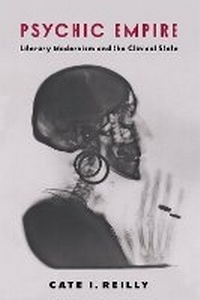
Psychic Empire
Literary Modernism and the Clinical State
Published on 11. June 2024
Book
Hardback
344 pages
978-0-231-21464-3 (ISBN)
Description
Shortlisted, 2025 Modernist Studies Association First Book Prize
In nineteenth-century imperial Germany and the Austro-Hungarian Empire, new scientific fields like psychophysics, empirical psychology, clinical psychiatry, and neuroanatomy transformed the understanding of mental life in ways long seen as influencing modernism. Turning to the history of psychiatric classification for mental illnesses, Cate I. Reilly argues that modernist texts can be understood as critically responding to objective scientific models of the psyche, not simply illustrating their findings. Modernist works written in industrializing Central and Eastern Europe historicize the representation of consciousness as a quantifiable phenomenon within techno-scientific modernity.
Looking beyond modernism's well-studied relationship to psychoanalysis, this book tells the story of the non-Freudian vocabulary for mental illnesses that forms the precursor to today's Diagnostic and Statistical Manual of Mental Disorders. Developed by the German psychiatrist Emil Kraepelin in the 1890s, this psychiatric taxonomy grew from the claim that invisible mental illnesses were analogous to physical phenomena in the natural world. Reilly explores how figures such as Georg Buechner, Ernst Toller, Daniel Paul Schreber, Nikolai Evreinov, Vsevolod Ivanov, and Santiago Ramon y Cajal understood the legal and political consequences of representing mental life in physical terms. Working across literary studies, the history of science, psychoanalytic criticism, critical theory, and political philosophy, Psychic Empire is an original account of modernism that shows the link between nineteenth-century scientific research on the mental health of national populations and twenty-first-century globalized, neuroscientific accounts of psychopathology and sanity.
In nineteenth-century imperial Germany and the Austro-Hungarian Empire, new scientific fields like psychophysics, empirical psychology, clinical psychiatry, and neuroanatomy transformed the understanding of mental life in ways long seen as influencing modernism. Turning to the history of psychiatric classification for mental illnesses, Cate I. Reilly argues that modernist texts can be understood as critically responding to objective scientific models of the psyche, not simply illustrating their findings. Modernist works written in industrializing Central and Eastern Europe historicize the representation of consciousness as a quantifiable phenomenon within techno-scientific modernity.
Looking beyond modernism's well-studied relationship to psychoanalysis, this book tells the story of the non-Freudian vocabulary for mental illnesses that forms the precursor to today's Diagnostic and Statistical Manual of Mental Disorders. Developed by the German psychiatrist Emil Kraepelin in the 1890s, this psychiatric taxonomy grew from the claim that invisible mental illnesses were analogous to physical phenomena in the natural world. Reilly explores how figures such as Georg Buechner, Ernst Toller, Daniel Paul Schreber, Nikolai Evreinov, Vsevolod Ivanov, and Santiago Ramon y Cajal understood the legal and political consequences of representing mental life in physical terms. Working across literary studies, the history of science, psychoanalytic criticism, critical theory, and political philosophy, Psychic Empire is an original account of modernism that shows the link between nineteenth-century scientific research on the mental health of national populations and twenty-first-century globalized, neuroscientific accounts of psychopathology and sanity.
Reviews / Votes
Psychic Empire presents a brilliant account of the porous boundaries between European modernist literature and psychiatric and psychoanalytic theories of the mind. Cate I. Reilly reads literature as scientific commentary and, conversely, scientific texts as fiction. This book provides historical depth to discussions on the place of literature today in the face of new technologies of the mind. -- Veronika Fuechtner, author of <i>Berlin Psychoanalytic: Psychoanalysis and Culture in Weimar Republic</i> Psychic Empire is a luminous book. Cate Reilly establishes the literary and historical epistemology of 'psychopower'-the quantification and popularization of mental health, with its pervasive, often pernicious effects. To follow her on the path through modernism in literature and psychopathology is to look anew at the influence of Central and Eastern Europe-and to understand how methods committed to ontologizing psychiatric illness carved out something more than a psychiatric unconscious: a literature that profiles meaning and negotiates it against the psyche. Psychic Empire offers a strikingly original approach to the hierarchies that determined the century we still endure. -- Stefanos Geroulanos, author of <i>The Invention of Prehistory: Empire, Violence, and Our Obsession with Human Origins</i> Psychic Empire is an imaginative and innovative work that examines anew the relationship between mind sciences and modernism. It powerfully tracks the moment of movement between psychic phenomena and generalizable concepts, between the individual and the body politic, as enshrined in classificatory systems such as the DSM. Showcasing writers excluded from the predominantly Anglophone modernist canon-and the laboratory of empirical psychology constituted by the German, Austro-Hungarian, Baltic, and Russian regions-it sheds brave new light on the literary toolkit of modernism. -- Ankhi Mukherjee, author of <i>Unseen City: The Psychic Lives of the Urban Poor</i> Psychic Empire is a stunning account of a new sovereignty in modernity built on objectively measurable minds; it is also a bravura conceptual argument for how modernist aesthetics reveal the disavowed presence of representation within the empirical modern self. -- Laura Salisbury, coeditor of <i>Neurology and Modernity: A Cultural History of Nervous Systems, 1800-1950</i> It necessitates reading for scholars working at the intersection of science and literature, in the neurohumanities, and those interested in new accounts of literary modernism. Psychic Empire, certainly, crucially intervenes in modernist studies. * The Modernist Review * Offers an eye-opening and mind-expanding account of the myriad ways that literature and psychiatry have shaped modern subjectivity, adopting a refreshingly welcome noncanonical, non-Anglophone focus. * Los Angeles Review of Books * Reilly brings a fresh, interdisciplinary perspective to her investigation of modernism in the context of the quantitative, empirical studies of mental processes undertaken by researchers in the late 19th and early 20th century...Recommended. * Choice *More details
Series
Language
English
Place of publication
New York
United States
Target group
College/higher education
Product notice
Trade binding
Dimensions
Height: 235 mm
Width: 156 mm
ISBN-13
978-0-231-21464-3 (9780231214643)
Copyright in bibliographic data and cover images is held by Nielsen Book Services Limited or by the publishers or by their respective licensors: all rights reserved.
Schweitzer Classification
Other editions
Additional editions
E-Book
07/2024
1st Edition
Columbia University Press
€33.99
Available for download
Person
Cate I. Reilly is an assistant professor in the Program in Literature at Duke University.
Content
Acknowledgments
Introduction. After Analysis: Literary Modernism and Diagnostic Reading
1. Buechner's Brain: On Psychopower
2. Before the Primal Scene: The Wolf-Man Between Sigmund Freud and Emil Kraepelin
3. Schreber's Law: Psychotic, Reading
4. Expressionist Weltrevolution and Psychopolitical Worlding
5. The Economic Hypothesis: Soul Markets of Soviet Fiction
6. Monodrama as Mass Spectacle: The Soviet Self on Stage
7. Something Wrong with Vero: Neural Landscapes of the Argentine Dirty War
Afterword. An Aesthetic Education in the Wake of the Neurocognitive Turn
Appendix 1.German Editions of Emil Kraepelin's Textbook of Psychiatry, 1883-1915
Appendix 2.English Translations of Emil Kraepelin's Psychiatric Textbooks, 1902-2002
Notes
Index
Introduction. After Analysis: Literary Modernism and Diagnostic Reading
1. Buechner's Brain: On Psychopower
2. Before the Primal Scene: The Wolf-Man Between Sigmund Freud and Emil Kraepelin
3. Schreber's Law: Psychotic, Reading
4. Expressionist Weltrevolution and Psychopolitical Worlding
5. The Economic Hypothesis: Soul Markets of Soviet Fiction
6. Monodrama as Mass Spectacle: The Soviet Self on Stage
7. Something Wrong with Vero: Neural Landscapes of the Argentine Dirty War
Afterword. An Aesthetic Education in the Wake of the Neurocognitive Turn
Appendix 1.German Editions of Emil Kraepelin's Textbook of Psychiatry, 1883-1915
Appendix 2.English Translations of Emil Kraepelin's Psychiatric Textbooks, 1902-2002
Notes
Index