

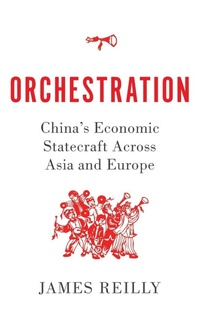
Orchestration
China's Economic Statecraft Across Asia and Europe
Published on 31. March 2021
Book
Hardback
284 pages
978-0-19-752634-7 (ISBN)
Description
The Chinese government has more control over more wealth than any other government in world history. With the Communist Party controlling the "commanding heights" of the world's second-largest economy, China appears ideally structured to pursue economic statecraft, using economic resources to advance its foreign policy goals. Yet as this book shows, domestic complications frequently constrain Chinese leaders. They have responded with a distinctive approach to economic statecraft: orchestration. Drawing upon extensive field research across Asia and Europe, Orchestration traces the origins, operations, and effectiveness of China's economic statecraft.
In this book, James Reilly examines the ideas and institutions at the heart of China's approach to economic statecraft, and assesses Beijing's orchestration in four cases: Myanmar, North Korea, Western Europe, and Central/Eastern Europe. China's unique experience as a planned economy, and then a developmental state, all under a single Leninist party, left Chinese leaders with unchallenged authority over their economy. However, despite successfully mobilizing companies, banks, and local officials to rapidly expand trade and investment abroad, Chinese leaders largely failed to influence key policy decisions overseas. For countries around the world, economic engagement with China thus yields more benefits with fewer costs than generally assumed.
Orchestration engages three central questions. First, why does China deploy economic statecraft in this particular fashion? Secondly, when is China's economic statecraft most effective? Finally, what can the China case tell us about economic statecraft more broadly? The findings show how China uses economic resources to exert influence abroad and identify when Beijing is most effective. By exploring the domestic drivers of China's economic statecraft, this book helps launch a new research field: the comparative study of economic statecraft.
In this book, James Reilly examines the ideas and institutions at the heart of China's approach to economic statecraft, and assesses Beijing's orchestration in four cases: Myanmar, North Korea, Western Europe, and Central/Eastern Europe. China's unique experience as a planned economy, and then a developmental state, all under a single Leninist party, left Chinese leaders with unchallenged authority over their economy. However, despite successfully mobilizing companies, banks, and local officials to rapidly expand trade and investment abroad, Chinese leaders largely failed to influence key policy decisions overseas. For countries around the world, economic engagement with China thus yields more benefits with fewer costs than generally assumed.
Orchestration engages three central questions. First, why does China deploy economic statecraft in this particular fashion? Secondly, when is China's economic statecraft most effective? Finally, what can the China case tell us about economic statecraft more broadly? The findings show how China uses economic resources to exert influence abroad and identify when Beijing is most effective. By exploring the domestic drivers of China's economic statecraft, this book helps launch a new research field: the comparative study of economic statecraft.
Reviews / Votes
Reilly's book on China's positive economic statecraft is an important contribution for students, scholars and policymakers interested in studying governance, foreign economic policy and institutions. * Xue Gong, S. Rajaratnam School of International Relations, Singapore, The China Quarterly * Further research could extend Reilly's useful framework to new frontiers where sovereignty is weak, contested or non-existent, like sea, space and cyber. * John Delury, Yonsei University, Global Asia * This analysis of Chinese economic statecraft and its shortcomings offers crucial insight into China's effectiveness as a global player. Highly recommended. * CHOICE * This is an excellent book about an important topic: China's current economic statecraft, which now represents China's most important foreign policy tool. * Steven F Jackson, International Relations of the Asia-Pacific * A central question associated with China's rise is how it will use its economic resources for political ends. With detailed case studies and an engaging narrative, Reilly offers a superb account of how China practices economic statecraft. A must-read for anyone interested in China's influence in the world today. * M. Taylor Fravel, Massachusetts Institute of Technology * Very few books achieve at this scale. Relying on years of extensive field research across Asia, Europe, and China - including remarkable work done in North Korea and Myanmar - James Reilly employs rich detail to insightfully reveal the whys and hows of China's single-most important instrument of power: its economic statecraft. He finds Beijing effective in orchestrating economic statecraft, but then shows us why it often fails to advance the strategic goals that policy aims to achieve. * Bates Gill, Macquarie University and Royal United Services Institute * A timely contribution to our understanding of China's role in a global economic order that faces new challenges in the mid-21st century. Reilly draws on social science theory, history, and an impressive set of cases illuminated by first-hand experiences across East Asia and Europe to present a nuanced view of China's effort to harness its new economic might to the regime's foreign policy goals. In contrast with images of a monolithic Chinese leadership commanding a threatening juggernaut, Reilly depicts the challenges Beijing has faced, including the difficulty of coordinating an array of domestic actors who are involved in formulating and implementing international economic policy. These challenges have shaped China's distinctive approach to economic statecraft - orchestration - with mixed results that Reilly carefully documents. * Avery Goldstein, University of Pennsylvania * Reilly has written a theoretically tight and empirically rigorous analysis of China's foreign economic policies. His social science training and area knowledge lead him to complex findings: First, there is variation in the success of the Chinese Communist Party's foreign economic policies. Second, this variation depends in large measure on whether the Party can find, and then coordinate with, sub-state economic actors with independent but overlapping interests, in the face of variations in state practice in target states. Third, the reality of China's foreign economic practices is quite distant from the U.S. policy makers' unsophisticated stereotype of a monolithic Party-State dictating exploitative outcomes around the world. * Alastair Iain Johnston, Harvard University *More details
Language
English
Place of publication
New York
United States
Target group
Professional and scholarly
Dimensions
Height: 240 mm
Width: 161 mm
Thickness: 20 mm
Weight
587 gr
ISBN-13
978-0-19-752634-7 (9780197526347)
Copyright in bibliographic data and cover images is held by Nielsen Book Services Limited or by the publishers or by their respective licensors: all rights reserved.
Schweitzer Classification
Other editions
Additional editions
E-Book
01/2021
1st Edition
OUP eBook
€46.99
Available for download
E-Book
01/2021
1st Edition
OUP eBook
€46.99
Available for download
Person
James Reilly is an Associate Professor in the Department of Government and International Relations at the University of Sydney. He has been a Jean Monnet Fellow at the European University Institute in Florence, Italy, and a post-doctoral research fellow at the University of Oxford. He also served as the East Asia Representative of the American Friends Service Committee (AFSC) in China from 2001-2008. His articles have appeared in numerous edited volumes and academic journals, and he is the author of Strong Society, Smart State: The Rise of Public Opinion in China's Japan Policy, and the co-editor of Australia and China at 40.
Content
Preface
Introduction
1. Learning China's History Lessons
2. Orchestrating China's Economic Statecraft
3. Never Let a Crisis go to Waste: Beijing's Economic Statecraft across Western Europe
4. Creating a Region: China's Economic Statecraft in Central and Eastern Europe
5. Engaging North Korea
6. Crossing Lines: China's Economic Statecraft in Myanmar
Conclusion
Notes
Bibliography
Index
Introduction
1. Learning China's History Lessons
2. Orchestrating China's Economic Statecraft
3. Never Let a Crisis go to Waste: Beijing's Economic Statecraft across Western Europe
4. Creating a Region: China's Economic Statecraft in Central and Eastern Europe
5. Engaging North Korea
6. Crossing Lines: China's Economic Statecraft in Myanmar
Conclusion
Notes
Bibliography
Index