

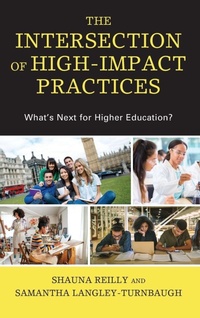
The Intersection of High-Impact Practices
What's Next for Higher Education?
Published on 3. May 2021
Book
Hardback
176 pages
978-1-7936-0615-0 (ISBN)
Description
The Intersection of High-Impact Practices: What's Next for Higher Education? examines high-impact practices and their impacts individually and collectively to demonstrate the added value of connecting high-impact practices. The research presented by Drs. Reilly and Turnbaugh-Langley illustrates that student success is not just a function of participation in one or many high-impact practices, but rather the order, timing, and interaction of these practices that yields the highest impact. These chapters discuss various high-impact practices such as study abroad experiences, student research initiatives, and internships to explore how these kinds of activities augment and enrich the success of students. The authors also speculate on where schools could increase the funding for these high-impact practices to maximize the institution's return on investment. Ultimately, this book strongly advocates for not only the benefits of high-impact practices, but making sure students have multiple experiences with them.
Reviews / Votes
Langley-Turnbaugh and Reilly's book, The Intersection of High-Impact Practices: What's Next for Higher Education?, is timely and warranted. As universities grapple with new, post-pandemic realities, we again find ourselves searching for distinction. The value-added elements of campus experiences are found within high-impact practices. And while the past fifteen years have seen George Kuh's (2008) concept embraced, with directors and offices of HIPs spread across campuses, very little has been done to validate the actual impact of these practices. These authors offer us a road map for that assessment, guided by their extensive efforts on their own campus. Any university taking on an accreditation effort, quality initiative, or strategic plan (as we see in their story) could follow the model provided. Reading their text gave me visions of a new classification system for colleges, much like one focused on community engagement. Langley-Turnbaugh and Reilly's system could consider HIPs across time, in terms of intensity, and then in combination - or in concert, as they say. Keep a look out for more to come from these authors. -- Jennifer Coleman, Western New Mexico University, Professor of PsychologyMore details
Language
English
Place of publication
United States
Publishing group
Bloomsbury Publishing Plc
Target group
Professional and scholarly
Illustrations
1 b/w illustrations;22 tables; 1 textboxes;
Dimensions
Height: 235 mm
Width: 157 mm
Thickness: 14 mm
Weight
415 gr
ISBN-13
978-1-7936-0615-0 (9781793606150)
Copyright in bibliographic data and cover images is held by Nielsen Book Services Limited or by the publishers or by their respective licensors: all rights reserved.
Schweitzer Classification
Other editions
Additional editions
Shauna Reilly | Samantha Langley-Turnbaugh
The Intersection of High-Impact Practices
What's Next for Higher Education?
E-Book
05/2021
1st Edition
Bloomsbury eBooks US
€91.49
Available for download
Shauna Reilly | Samantha Langley-Turnbaugh
The Intersection of High-Impact Practices
What'S Next for Higher Education?
E-Book
05/2021
1st Edition
Lexington Books
€91.49
Available for download
Persons
Shauna Reilly is director of the Institute for Student Research and Creative Activity at Northern Kentucky University.
Samantha Langley-Turnbaugh is vice provost for graduate education, research and outreach at Northern Kentucky University.
Samantha Langley-Turnbaugh is vice provost for graduate education, research and outreach at Northern Kentucky University.
Content
Ch. 1 - Introduction to High-Impact Practices
Ch. 2 - The First-year
Ch. 3 - Curriculum
Ch. 4 - Community Engagement
Ch. 5 - Study Abroad
Ch. 6 - Internships
Ch. 7 - Student Research Experiences
Ch. 8 - Conclusion and Advice for Higher Education
Bibliography
Appendix A: Survey Instrument
Appendix B: Focus Group Questions
Ch. 2 - The First-year
Ch. 3 - Curriculum
Ch. 4 - Community Engagement
Ch. 5 - Study Abroad
Ch. 6 - Internships
Ch. 7 - Student Research Experiences
Ch. 8 - Conclusion and Advice for Higher Education
Bibliography
Appendix A: Survey Instrument
Appendix B: Focus Group Questions