

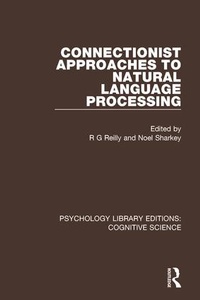
Connectionist Approaches to Natural Language Processing
1st Edition
Published on 27. June 2016
Book
Hardback
472 pages
978-1-138-64006-1 (ISBN)
Description
Originally published in 1992, when connectionist natural language processing (CNLP) was a new and burgeoning research area, this book represented a timely assessment of the state of the art in the field. It includes contributions from some of the best known researchers in CNLP and covers a wide range of topics.
The book comprises four main sections dealing with connectionist approaches to semantics, syntax, the debate on representational adequacy, and connectionist models of psycholinguistic processes. The semantics and syntax sections deal with a variety of approaches to issues in these traditional linguistic domains, covering the spectrum from pure connectionist approaches to hybrid models employing a mixture of connectionist and classical AI techniques.
The debate on the fundamental suitability of connectionist architectures for dealing with natural language processing is the focus of the section on representational adequacy. The chapters in this section represent a range of positions on the issue, from the view that connectionist models are intrinsically unsuitable for all but the associationistic aspects of natural language, to the other extreme which holds that the classical conception of representation can be dispensed with altogether.
The final section of the book focuses on the application of connectionist models to the study of psycholinguistic processes. This section is perhaps the most varied, covering topics from speech perception and speech production, to attentional deficits in reading. An introduction is provided at the beginning of each section which highlights the main issues relating to the section topic and puts the constituent chapters into a wider context.
The book comprises four main sections dealing with connectionist approaches to semantics, syntax, the debate on representational adequacy, and connectionist models of psycholinguistic processes. The semantics and syntax sections deal with a variety of approaches to issues in these traditional linguistic domains, covering the spectrum from pure connectionist approaches to hybrid models employing a mixture of connectionist and classical AI techniques.
The debate on the fundamental suitability of connectionist architectures for dealing with natural language processing is the focus of the section on representational adequacy. The chapters in this section represent a range of positions on the issue, from the view that connectionist models are intrinsically unsuitable for all but the associationistic aspects of natural language, to the other extreme which holds that the classical conception of representation can be dispensed with altogether.
The final section of the book focuses on the application of connectionist models to the study of psycholinguistic processes. This section is perhaps the most varied, covering topics from speech perception and speech production, to attentional deficits in reading. An introduction is provided at the beginning of each section which highlights the main issues relating to the section topic and puts the constituent chapters into a wider context.
More details
Series
Language
English
Place of publication
London
United Kingdom
Publishing group
Taylor & Francis Ltd
Target group
College/higher education
Dimensions
Height: 234 mm
Width: 156 mm
Weight
1060 gr
ISBN-13
978-1-138-64006-1 (9781138640061)
Copyright in bibliographic data and cover images is held by Nielsen Book Services Limited or by the publishers or by their respective licensors: all rights reserved.
Schweitzer Classification
Other editions
Additional editions
R. G. Reilly | Noel Sharkey
Connectionist Approaches to Natural Language Processing
Book
06/2018
1st Edition
Routledge
€81.20
Shipment within 10-20 days
R. G. Reilly | Noel Sharkey
Connectionist Approaches to Natural Language Processing
E-Book
07/2016
Routledge
€61.99
Available for download
Persons
R G Reilly, Noel Sharkey
Content
Preface 1. Connectionist Natural Language Processing Noel E. Sharkey and Ronan Reilly Part 1: Semantics 2. Distributed Symbol Discovery through Symbol Recirculation: Toward Natural Language Processing in Distributed Connectionist Networks Michael G. Dyer, Margot Flowers and Yih-Jih Alan Wang 3. Representing Meaning Using Microfeatures Richard F. E. Sutcliffe 4. Noun Phrase Analysis with Connectionist Networks Stefan Wermter and Wendy G. Lehnert 5. Parallel Constraint Satisfaction as a Comprehension Mechanism Mark F. St. John and James L. McClelland Part 2: Syntax 6. Self-correcting Connectionist Parsing John E. Rager 7. A Net-linguistic "Earley" Parser H. Schnelle and R. Doust Part 3: Representational Adequacy 8. The Demons and the Beast - Modular and Nodular Kinds of Knowledge Thomas G. Bever 9. Representational Adequacy and the Case for a Hybrid Connectionist/Marker-parsing Model George Berg 10. A Step Toward Sub-symbolic Language Models without Linguistic Representations George Dorffner Part 4: Computational Psycholinguistics 11. Connectionist Models of Speech Perception Dominic W. Massaro 12. Connectionism: A New Breed of Bottom-up Model? Dennis Norris 13. Models of Form-related Priming in Comprehension and Production Padraig G. O'Seaghdha, Gary S. Dell, Robert R. Peterson and Cornell Juliano 14. Reading with Attentional Impairments: A Brain-damaged Model of Neglect and Attentional Dyslexias Michael C. Mozer and Marlene Behrmann. Author Index. Subject Index.