

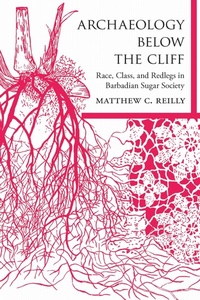
Archaeology Below the Cliff
Race, Class, and Redlegs in Barbadian Sugar Society
Published on 30. September 2019
Book
Hardback
272 pages
978-0-8173-2028-7 (ISBN)
Description
First book-length archaeological study of a nonelite white population on a Caribbean plantation.
Archaeology below the Cliff: Race, Class, and Redlegs in Barbadian Sugar Society is the first archaeological study of the poor whites of Barbados, the descendants of seventeenth-century European indentured servants and small farmers. ""Redlegs"" is a pejorative to describe the marginalized group who remained after the island transitioned to a sugar monoculture economy dependent on the labor of enslaved Africans. A sizable portion of the ""white"" minority, the Redlegs largely existed on the peripheries of the plantation landscape in an area called ""Below Cliff,"" which was deemed unsuitable for profitable agricultural production. Just as the land on which they resided was cast as marginal, so too have the poor whites historically and contemporarily been derided as peripheral and isolated as well as idle, alcoholic, degenerate, inbred, and irrelevant to a functional island society and economy.
Using archaeological, historical, and oral sources, Matthew C. Reilly shows how the precarious existence of the Barbadian Redlegs challenged elite hypercapitalistic notions of economics, race, and class as they were developing in colonial society. Experiencing pronounced economic hardship, similar to that of the enslaved, albeit under very different circumstances, Barbadian Redlegs developed strategies to live in a harsh environment. Reilly's investigations reveal that what developed in Below Cliff was a moral economy, based on community needs rather than free-market prices.
Reilly extensively excavated households from the tenantry area on the boundaries of the Clifton Hall Plantation, which was abandoned in the 1960s, to explore the daily lives of poor white tenants and investigate their relationships with island economic processes and networks. Despite misconceptions of strict racial isolation, evidence also highlights the importance of poor white encounters and relationships with Afro-Barbadians. Historical data are also incorporated to address how an underrepresented demographic experienced the plantation landscape. Ultimately, Reilly's narrative situates the Redlegs within island history, privileging inclusion and embeddedness over exclusion and isolation.
Archaeology below the Cliff: Race, Class, and Redlegs in Barbadian Sugar Society is the first archaeological study of the poor whites of Barbados, the descendants of seventeenth-century European indentured servants and small farmers. ""Redlegs"" is a pejorative to describe the marginalized group who remained after the island transitioned to a sugar monoculture economy dependent on the labor of enslaved Africans. A sizable portion of the ""white"" minority, the Redlegs largely existed on the peripheries of the plantation landscape in an area called ""Below Cliff,"" which was deemed unsuitable for profitable agricultural production. Just as the land on which they resided was cast as marginal, so too have the poor whites historically and contemporarily been derided as peripheral and isolated as well as idle, alcoholic, degenerate, inbred, and irrelevant to a functional island society and economy.
Using archaeological, historical, and oral sources, Matthew C. Reilly shows how the precarious existence of the Barbadian Redlegs challenged elite hypercapitalistic notions of economics, race, and class as they were developing in colonial society. Experiencing pronounced economic hardship, similar to that of the enslaved, albeit under very different circumstances, Barbadian Redlegs developed strategies to live in a harsh environment. Reilly's investigations reveal that what developed in Below Cliff was a moral economy, based on community needs rather than free-market prices.
Reilly extensively excavated households from the tenantry area on the boundaries of the Clifton Hall Plantation, which was abandoned in the 1960s, to explore the daily lives of poor white tenants and investigate their relationships with island economic processes and networks. Despite misconceptions of strict racial isolation, evidence also highlights the importance of poor white encounters and relationships with Afro-Barbadians. Historical data are also incorporated to address how an underrepresented demographic experienced the plantation landscape. Ultimately, Reilly's narrative situates the Redlegs within island history, privileging inclusion and embeddedness over exclusion and isolation.
Reviews / Votes
Archaeology below the Cliff is a very holistic and strong anthropological approach to Caribbean history and archaeology. The book exemplifies the very best in anthropological methodologies and theoretical approaches."" - Georgia L. Fox, author of The Archaeology of Smoking and Tobacco""Archaeology below the Cliff is theoretically sophisticated and breaks new ground by exploring the lives of people who have been ignored in traditional Caribbean history and archaeology. It is a provocative historical anthropological study that blurs disciplinary boundaries of archaeology, history, and anthropology."" - Frederick H. Smith, author of The Archaeology of Alcohol and Drinking
More details
Series
Language
English
Place of publication
Alabama
United States
Target group
Professional and scholarly
Product notice
sewn/stitched
Cloth over boards
Illustrations
19 black & white figures, 4 maps, 1 table
Dimensions
Height: 231 mm
Width: 152 mm
Thickness: 30 mm
Weight
2200 gr
ISBN-13
978-0-8173-2028-7 (9780817320287)
Copyright in bibliographic data and cover images is held by Nielsen Book Services Limited or by the publishers or by their respective licensors: all rights reserved.
Schweitzer Classification
Other editions
Additional editions

E-Book
09/2019
1st Edition
University of Alabama Press
€152.99
Available for download
Person
Matthew C. Reilly is an assistant professor of anthropology at the City College of New York.
Content
List of Illustrations
Preface
Acknowledgments
Introduction
Chapter 1. Archaeologies of Plantation Modernity
Chapter 2. Redlegs on the Plantation Landscape
Chapter 3. Below Cliff: Excavating and Engaging with a Plantation Community
Chapter 4. Socioeconomic (In)Activity
Chapter 5. ""A Numerous Race of Mulattoes"": (De)Constructing Racial Barriers
Chapter 6. Alternative Modernities below the Cliff
Notes
References Cited
Index
Preface
Acknowledgments
Introduction
Chapter 1. Archaeologies of Plantation Modernity
Chapter 2. Redlegs on the Plantation Landscape
Chapter 3. Below Cliff: Excavating and Engaging with a Plantation Community
Chapter 4. Socioeconomic (In)Activity
Chapter 5. ""A Numerous Race of Mulattoes"": (De)Constructing Racial Barriers
Chapter 6. Alternative Modernities below the Cliff
Notes
References Cited
Index