

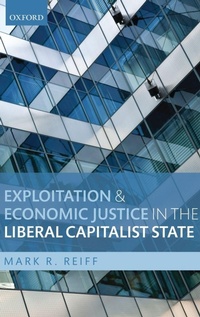
Exploitation and Economic Justice in the Liberal Capitalist State
Published on 28. February 2013
Book
Hardback
360 pages
978-0-19-966400-9 (ISBN)
Description
Exploitation and Economic Justice in the Liberal Capitalist State develops the first new, liberal theory of economic justice to appear since John Rawls and Ronald Dworkin proposed their respective theories back in the 1970s and early 1980s. It does this by presenting a new, liberal egalitarian, non-Marxist theory of exploitation that is designed to be a creature of capitalism, not a critique of it. Indeed, the book shows how we can regulate economic inequality using the presuppositions of capitalism and political liberalism that we already accept. In doing this, the book uses two concepts or tools: a re-conceived notion of the ancient doctrine of the just price, and the author's own concept of intolerable unfairness. The resulting theory can then function as either a supplement to or a replacement for the difference principle and luck egalitarianism, the two most popular liberal egalitarian theories of economic justice of today. It provides a new, highly-topical, specific moral justification not only for raising the minimum wage, but also for imposing a maximum wage, for continuing to impose an estate tax on the wealthiest members of society, and for prohibiting certain kinds of speculative trading, including trading in derivatives such as the now infamous credit default swap and other related exotic financial instruments. Finally, it provides a new specific moral justification for dealing with certain aspects of climate change now regardless of what other nations do. Yet it is still designed to be the object of an overlapping consensus -- that is, it is designed to be acceptable to those who embrace a wide range of comprehensive moral and political doctrines, not only liberal egalitarianism, but right and left libertarianism too.
Reviews / Votes
There can be no doubt that Reiffs suggestions would lead to considerable improvements in comparison to the status quo (and realizing them might open up new paths for farther-going changes). For that reason, and because it opens up a new and extremely interesting perspective on questions of justice in the economic realm, this book is a must-read. * Lisa Herzog, Res Publica *More details
Language
English
Place of publication
Oxford
United Kingdom
Target group
College/higher education
Dimensions
Height: 240 mm
Width: 161 mm
Thickness: 24 mm
Weight
708 gr
ISBN-13
978-0-19-966400-9 (9780199664009)
Copyright in bibliographic data and cover images is held by Nielsen Book Services Limited or by the publishers or by their respective licensors: all rights reserved.
Schweitzer Classification
Other editions
Additional editions
E-Book
02/2013
1st Edition
OUP eBook
€71.99
Available for download
Person
Mark R. Reiff is the author of Punishment, Compensation, and Law: A Theory of Enforceability (Cambridge Studies in Philosophy and Law, Cambridge University Press, 2005), as well as various papers on topics within legal, political, and moral philosophy. During the 2008-09 academic year, Dr. Reiff was a Visiting Faculty Fellow at the Edmond J. Safra Center for Ethics at Harvard University. This book is the product of that fellowship. He is a Senior Lecturer in Legal and Political Philosophy at the University of Manchester School of Law.
Content
Introduction ; 1. Exploitation and Justice ; 2. Exploitation and the Just Price ; 3. The Limits of Exploitation ; 4. What Price is Just? ; 5. Exploitation and Intolerable Unfairness ; 6. Implementation and Enforcement ; 7. The Prospects for an Overlapping Consensus