

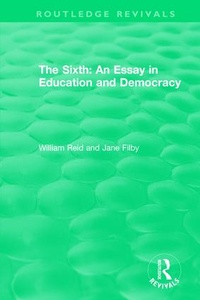
The Sixth: An Essay in Education and Democracy
1st Edition
Published on 27. July 2018
Book
Hardback
288 pages
978-1-138-31432-0 (ISBN)
Description
Developments in educational systems are inextricably linked with the social and political evolution of nations. Nowhere is this more clearly to be seen than in the history of the English sixth form. Originally published in 1982, this book, whose authors had been associated with a number of research projects into 16-19 education, traces the tradition of the sixth form from its origins in the public schools of the nineteenth century through to controversies at the time, over sixth form and tertiary colleges and the extension of 16-19 education to embrace youth opportunities programmes and other semi-vocational courses.
It shows that 'the sixth' has not only been a significant element in its own right in the adjustment of English society to the challenge of democratic ideals, but has also played a key role in the evolution of secondary education from the endowed school of the nineteenth century, through the municipal grammar schools set up after the 1902 Education Act, to the comprehensive secondary schools of today. In fact, the fate and future of comprehensive schooling becomes fully understandable only through a study of the sixth form tradition which has shaped the activities of educationists and policy-makers over the last hundred years.
The authors conclude that educational policy-making is both facilitated and constrained by the existence of enduring traditions stemming from the past: in fact, the work of policy-making lies precisely in the constructive reinterpretation of that inheritance. This book describes and clarifies the nature of the tradition of sixth form education which has been handed down to us, and its relation to democratic values and institutions.
It shows that 'the sixth' has not only been a significant element in its own right in the adjustment of English society to the challenge of democratic ideals, but has also played a key role in the evolution of secondary education from the endowed school of the nineteenth century, through the municipal grammar schools set up after the 1902 Education Act, to the comprehensive secondary schools of today. In fact, the fate and future of comprehensive schooling becomes fully understandable only through a study of the sixth form tradition which has shaped the activities of educationists and policy-makers over the last hundred years.
The authors conclude that educational policy-making is both facilitated and constrained by the existence of enduring traditions stemming from the past: in fact, the work of policy-making lies precisely in the constructive reinterpretation of that inheritance. This book describes and clarifies the nature of the tradition of sixth form education which has been handed down to us, and its relation to democratic values and institutions.
More details
Series
Language
English
Place of publication
London
United Kingdom
Publishing group
Taylor & Francis Ltd
Target group
College/higher education
Professional and scholarly
Dimensions
Height: 234 mm
Width: 156 mm
Weight
700 gr
ISBN-13
978-1-138-31432-0 (9781138314320)
Copyright in bibliographic data and cover images is held by Nielsen Book Services Limited or by the publishers or by their respective licensors: all rights reserved.
Schweitzer Classification
Other editions
Additional editions
William Reid | Jane Filby
The Sixth: An Essay in Education and Democracy
Book
12/2019
1st Edition
Routledge
€48.46
Shipment within 10-20 days
William Reid | Jane Filby
The Sixth: An Essay in Education and Democracy
E-Book
10/2018
1st Edition
Routledge
€32.99
Available for download
William Reid | Jane Filby
The Sixth: An Essay in Education and Democracy
E-Book
10/2018
1st Edition
Routledge
€32.99
Available for download
Persons
William Reid, Jane Filby
Content
Acknowledgements. 1. Education, Democracy and the Sixth Form 2. Origins of an Educational Ideal 3. Secondary Education and the Middle Class 4. A National Institution 5. A State Responsibility 6. The Grammar School Tradition 7. The Category Expands 8. The Golden Age 9. The Forces of Change 10. Colleges and Comprehensives 11. A Clash of Ideologies 12. Understanding the Past and Choosing the Future. Statistical Appendix. Name Index. Subject Index.