

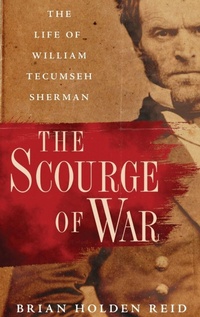
The Scourge of War
The Life of William Tecumseh Sherman
Published on 17. September 2020
Book
Hardback
640 pages
978-0-19-539273-9 (ISBN)
Description
William Tecumseh Sherman, a West Point graduate and veteran of the Seminole War, became one of the best-known generals in the Civil War. His March to the Sea, which resulted in a devastated swath of the South from Atlanta to Savannah, cemented his place in history as the pioneer of total war.
In The Scourge of War, preeminent military historian Brian Holden Reid offers a deeply researched life and times account of Sherman. By examining his childhood and education, his business ventures in California, his antebellum leadership of a military college in Louisiana, and numerous career false starts, Holden Reid shows how unlikely his exceptional Civil War career would seem. He also demonstrates how crucial his family was to his professional path, particularly his wife's intervention during the war. He analyzes Sherman's development as a battlefield commander and especially his crucial friendships with Henry W. Halleck and Ulysses S. Grant. In doing so, he details how Sherman overcame both his weaknesses as a leader and severe depression to mature as a military strategist. Central chapters narrate closely Sherman's battlefield career and the gradual lifting of his pessimism that the Union would be defeated. After the war, Sherman became a popular figure in the North and the founder of the school for officers at Fort Leavenworth, Kansas, known as the "intellectual center of the army." Holden Reid argues that Sherman was not hostile to the South throughout his life and only in later years gained a reputation as a villain who practiced barbaric destruction, particularly as the neo-Confederate Lost Cause grew and he published one of the first personal accounts of the war.
A definitive biography of a preeminent military figure by a renowned military historian, The Scourge of War is a masterful account of Sherman' life that fully recognizes his intellect, strategy, and actions during the Civil War.
In The Scourge of War, preeminent military historian Brian Holden Reid offers a deeply researched life and times account of Sherman. By examining his childhood and education, his business ventures in California, his antebellum leadership of a military college in Louisiana, and numerous career false starts, Holden Reid shows how unlikely his exceptional Civil War career would seem. He also demonstrates how crucial his family was to his professional path, particularly his wife's intervention during the war. He analyzes Sherman's development as a battlefield commander and especially his crucial friendships with Henry W. Halleck and Ulysses S. Grant. In doing so, he details how Sherman overcame both his weaknesses as a leader and severe depression to mature as a military strategist. Central chapters narrate closely Sherman's battlefield career and the gradual lifting of his pessimism that the Union would be defeated. After the war, Sherman became a popular figure in the North and the founder of the school for officers at Fort Leavenworth, Kansas, known as the "intellectual center of the army." Holden Reid argues that Sherman was not hostile to the South throughout his life and only in later years gained a reputation as a villain who practiced barbaric destruction, particularly as the neo-Confederate Lost Cause grew and he published one of the first personal accounts of the war.
A definitive biography of a preeminent military figure by a renowned military historian, The Scourge of War is a masterful account of Sherman' life that fully recognizes his intellect, strategy, and actions during the Civil War.
Reviews / Votes
...leaves the readers wanting more... * Jennifer M. Murray, The Annals of Iowa * [T]his deeply researched and deftly argued investigation will likely prove to be the definitive one for the foreseeable future....[Holden] Reid carefully connects Sherman's personality traits to his military strengths and weaknesses. * Gordon Berg, History Net * Brian Holden Reid offers us a wide-ranging biography that serves the field well by placing Sherman within the larger military, political, and intellectual forces of the nineteenth century-in the process helping to restore an oftmaligned historical figure to his rightful place as a supreme military thinker. * Zachery A. Fry, Military History Review * Military history with a twist... A complicated portrait of a complex man in a nation at war. * Paul Lay, History Today * In this compelling and lucid reassessment of William Tecumseh Sherman (1820-91), Reid (King's Coll. London; America's Civil War) dispels the myths and misreadings of the commanding general of the Union Army and, later, secretary of war, recasting him as a man of wide intellectual interests who understood that winning demanded strategic vision and assiduous planning. Reid's Sherman grew from an officer unsure of himself to a confident general at once bold in thought, meticulous in planning, and deft and decisive in action....Sometimes argumentative but always insightful, this study of Sherman ranks among the best renderings of the man and the conduct of the Civil War, and will help readers reconsider Sherman's character and the discipline necessary to succeed in war. * Library Journal * It would be hard to find an author better qualified to write a study of the American Civil War general, William Tecumseh Sherman, than Brian Holden Reid. He is a master historian and the preeminent British scholar of that war, who has walked many of its battlefields and written extensively on the subject...Holden Reid's assessment of Sherman reflects his own experience as a mentor in the operational art... Holden Reid's study of Sherman is as perfect as one could wish. He has captured the essence of a great commander and a fascinating human being * Julian Thompson, RUSI Journal * Holden Reid...is skeptical of the provincialism that characterizes many American histories of the Civil War. The moment one places the March to the Sea in the overall context of nineteenth-century warfare in Europe and elsewhere, the impression of Sherman's unprecedented brutality fades away... Holden Reid's concluding chapter... is a gem of scholarly military analysis worth the price of the book. * Allen Guelzo, First Things * Holden Reid probes Sherman's intellect and moves the iconic figure beyond familiar conversations of total war; he assesses Sherman's US Army career at various command echelons from the bottom up to see Sherman's successes and failures at the tactical, operational, and strategic levels of war. On the subject of Sherman's tenure as commanding general, Holden Reid is the most thorough to date and points to new directions in Sherman scholarship. * Mitchell G. Klingenberg, Parameters * Essential reading and an instant standard in the field, Holden Reid's The Life of William Tecumseh Sherman....will profit students of military history for years to come...For all of its erudition and scope, and more than its decisive refutation of the false view that Sherman inaugurated total war in the American context, The Scourge of War never loses sight of Sherman's humanity. Indeed, its author has demonstrated why his subject remains one of the most compelling figures of the Civil War and Reconstruction eras. The story of Sherman's life is improbable, almost incredible, and yet relatable. * Mitchell G. Klingenberg, Army History *More details
Language
English
Place of publication
New York
United States
Target group
Professional and scholarly
Illustrations
20 illustrations
Dimensions
Height: 240 mm
Width: 161 mm
Thickness: 38 mm
Weight
1109 gr
ISBN-13
978-0-19-539273-9 (9780195392739)
Copyright in bibliographic data and cover images is held by Nielsen Book Services Limited or by the publishers or by their respective licensors: all rights reserved.
Schweitzer Classification
Other editions
Additional editions
E-Book
05/2020
OUP eBook
€15.49
Available for download

E-Book
05/2020
OUP eBook
€15.49
Available for download
Person
Brian Holden Reid is Professor of American History and Military Institutions at King's College London. He is the author of Robert E. Lee: Icon of a Nation, The Civil War and the Wars of the Nineteenth Century, and America's Civil War: The Operational Battlefield, 1861-1863, among other books. In 2019, he was awarded the Samuel Eliot Morison Prize from the Society for Military History for his contributions to the field.
Content
Preface
Introduction
Part 1: Formtive Years, 1822-1861
Chapter 1: Origin and Evolution of the Sherman Species, 1600-1840
Chapter 2: Leaping the Mark: Soldier or Civilian? 1840-1852
Chapter 3: Unfortunate Civilian, 1853-1861
Part 2: Working His Way, March 1861-March 1864
Chapter 4: Brigade Commander, March-August 1861
Chaper 5: Departmental Commander--and Disaster, August-December 1861
Chapter 6: Divisional Commander, January-July 1862
Chapter 7: Corps Commander, July-December 1862
Chapter 8: From Corps Command to Army Command, January-December 1863
Chapter 9: Army Command, October 1863-March 1864
Part 3: Command of the Military Division of the Mississippi
Chapter 10: First Contact, March-May 1864
Chapter 11: Over the Chattahoochee, May-July 1864
Chapter 12: Slogging on to Atlanta, July-September 1864
Chapter 13: Marching on to Savannah, September-December 1864
Chapter 14: Marching to Victory, December 1864-April 1865
Part 4: Things Will Never Be the Same Again: The Reckoning
Chapter 15: Indian Fighter and Reluctant Negotiator, 1865-1869
Chapter 16: Commanding General of the Army, 1865-1884
Chapter 17: Retirement of a Kind, 1884-1891
Conclusion: Weighed in the Balance and Not Found Wanting
Notes
Bibliography
Index
Introduction
Part 1: Formtive Years, 1822-1861
Chapter 1: Origin and Evolution of the Sherman Species, 1600-1840
Chapter 2: Leaping the Mark: Soldier or Civilian? 1840-1852
Chapter 3: Unfortunate Civilian, 1853-1861
Part 2: Working His Way, March 1861-March 1864
Chapter 4: Brigade Commander, March-August 1861
Chaper 5: Departmental Commander--and Disaster, August-December 1861
Chapter 6: Divisional Commander, January-July 1862
Chapter 7: Corps Commander, July-December 1862
Chapter 8: From Corps Command to Army Command, January-December 1863
Chapter 9: Army Command, October 1863-March 1864
Part 3: Command of the Military Division of the Mississippi
Chapter 10: First Contact, March-May 1864
Chapter 11: Over the Chattahoochee, May-July 1864
Chapter 12: Slogging on to Atlanta, July-September 1864
Chapter 13: Marching on to Savannah, September-December 1864
Chapter 14: Marching to Victory, December 1864-April 1865
Part 4: Things Will Never Be the Same Again: The Reckoning
Chapter 15: Indian Fighter and Reluctant Negotiator, 1865-1869
Chapter 16: Commanding General of the Army, 1865-1884
Chapter 17: Retirement of a Kind, 1884-1891
Conclusion: Weighed in the Balance and Not Found Wanting
Notes
Bibliography
Index