

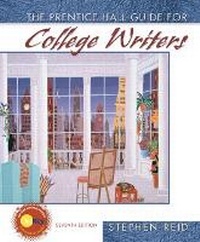
Prentice Hall Guide for College Writers
7th Edition
Published on 2. February 2005
Book
Hardback
816 pages
978-0-13-191822-1 (ISBN)
Description
For first-semester Freshman Composition courses where instructors want to emphasize the writing process and purpose and want consistency in their first -year writing program.
As the composition coordinator at Colorado State University, Stephen Reid found that both his students and his instructors struggled with their textbook. The constant flipping around required in most writing guides made it difficult for students to follow along and difficult for instructors to teach. As a result, Stephen Reid created his market-leading writing guide, which integrates purpose, process, audience, and rhetorical strategies into every chapter-ending the flipping back and forth and offering a seamless presentation. Its well-thought organization and interesting readings make it the ideal text for teaching first-year composition. Available in hardback version or in paperback version without handbook.
As the composition coordinator at Colorado State University, Stephen Reid found that both his students and his instructors struggled with their textbook. The constant flipping around required in most writing guides made it difficult for students to follow along and difficult for instructors to teach. As a result, Stephen Reid created his market-leading writing guide, which integrates purpose, process, audience, and rhetorical strategies into every chapter-ending the flipping back and forth and offering a seamless presentation. Its well-thought organization and interesting readings make it the ideal text for teaching first-year composition. Available in hardback version or in paperback version without handbook.
More details
Edition
7th edition
Language
English
Place of publication
United States
Publishing group
Pearson Education (US)
Target group
Professional and scholarly
Dimensions
Height: 232 mm
Width: 191 mm
ISBN-13
978-0-13-191822-1 (9780131918221)
Copyright in bibliographic data and cover images is held by Nielsen Book Services Limited or by the publishers or by their respective licensors: all rights reserved.
Schweitzer Classification
Other editions
Previous edition
Book
11/2003
6th Edition
Pearson
€49.51
Article exhausted; check for reprint
Content
1. Writing Myths and Rituals.
Writing Fitness: Rituals and Practice. Place, Time, and Tools. Energy and Attitude. Keeping a Journal. Warming Up: Journal Exercises. "On Keeping a Journal," Roy Hoffman.
2. Situations, Purposes and Processes for Writing.
Rhetorical Situations. Writer, Occasion, Purpose, Audience, Genre, Context. Purposes for Writing. Writer-Based Purposes. Subject- and Audience-Based Purposes. Combinations of Purposes. Subject, Purpose, and Thesis. Purpose and Audience. Audience Analysis. Purpose, Audience, and Genre. The Rhetorical Situation. Purpose and Audience in Two Essays.
"The Struggle to Be an All-American Girl," Elizabeth Wong. "I'm OK, but You're Not," Robert Zoellner. Dimensions of the Writing Process. Collecting, Shaping, Drafting, Revising. The Whole Process. Writing with a Computer. Warming Up: Journal Exercises. A Writing Process at Work: Collecting and Shaping. "Athletes and Education," Neil H. Petrie. "On Writing `Athletes and Education'," Neil H. Petrie. A Writing Process at Work: Drafting and Revising. From "The Declaration of Independence."
3. Observing.
Techniques for Writing About Observations. Observing People. Observing Places. From "Sierra," John Muir. Observing Objects. Observing Images. Events. Warming Up: Journal Exercises. From "Scenes from the American Dream," Charles Rosen and Henri Zerner. Warming Up: Journal Exercises. From "September 18, 2001," by Robin Morgan. "Take This Fish and Look at It," Samuel H. Scudder. "Observing Wolves," Farley Mowat. Observing: The Writing Process. Choosing a Subject. Collecting, Shaping, Drafting, Revising. Postscript on the Writing Process. "Permanent Tracings," Jennifer Macke. "Empty Windows," Stephen White.
4. Remembering.
Techniques for Writing About Memories. Remembering People. Remembering Places. Remembering Events. Warming Up: Journal Exercises. "The Day Language Came into My Life," Helen Keller. "Lives on the Boundary," Mike Rose. "Beauty" When the other Dancer Is the Self," Alice Walker. Remembering: The Writing Process. Choosing a Subject. Collecting, Shaping, Drafting, Revising. Peer Response. Postscript on the Writing Process. "The Wind Catcher," Todd Petry. *"The Red Chevy," Juli Bovard.
5. Reading.
Techniques for Writing about Reading. Critical Reading Strategies. Guidelines for Class Discussion. Summarizing and Responding to an Essay. "Teach Diversity-with a Smile," Barbara Ehrenreich. Summarizing. Responding. Summarizing and Responding to Images. "Beauty and Violence," Adam Forest. "Some Don't Like their Blues at All," Karyn Lewis. Warming Up: Journal Exercises. "Letter to America," Margaret Atwood. "Vows," Christopher Caldwell. "Atlas Shrugs,"Nicholas Lemann. Reading and Writing Processes. Choosing a Subject.
"Teaching Tolerance in America," Dudley Erskine Devlin. Collecting, Shaping, Drafting, Revising. Avoiding Plagiarism. Peer Response. Postscript on the Writing Process. "Letter to Margaret Atwood," Dean C. Swift.. "Two Responses to Deborah Tannen," Jennifer Koester and Sonja H. Browe.
6. Investigating.
Techniques for Investigative Writing. Summary of a Book or Article. A Brief Report with Graphics. "Gimme An A (I Insist!), Abigail Sullivan Moore. Investigation Using Multiple Sources.
"That Parent-Child Conversation Is Becoming Instant, and Online," John Schwartz. Profile of a Person. "Rick Steves's Not-So-Lonely Planet," Sara Corbett. Extended Interview. Cheryl Dellasega Discusses her Book, Girl Wars" with Kelly O'Donnel. Warming Up: Journal Exercises. "Surfin' the Louvre," Elizabeth Larsen. "Plotting a Net Gain," Connie Koenenn.
"The End of Cheap Oil," Tim Appenzeller. "The Homeless and Their Children," Jonathan Kozol. Investigating: The Writing Process. Choosing a Subject. Collecting, Shaping, Drafting, Revising. Community Service Learning. Research Tips and Strategies. Doing Field Research. Peer Response. Postscript on the Writing Process. "The Hollywood Indian," Lauren Strain. "My Friend, Michelle, An Alcoholic," Bridgid Stone.
7. Explaining.
Techniques for Explaining. Explaining What. Explaining How. Explaining Why. Warming Up: Journal Exercises. "Multiracialness," La Mer Stepptoe. "Miss Clairol's Does She...Or Doesn't She?': How to Advertise a Dangerous Product," James B. Twitchell. "The Global Village Finally Arrives," Pico Iyer. "How Male and Female Students Use Language Differently," Deborah Tannen. Explaining: The Writing Process. Choosing a Subject. Collecting, Shaping, Drafting, Revising. Tips for Integrating Images. Peer Response. Postscript on the Writing Process.
"English Only," Christine Bishop. "Anorexia Nervosa," Nancie Brosseau.
8. Evaluating.
Techniques for Writing Evaluations. Evaluating Commercial Products or Services. "The Hybrid Grows Up," Consumer Reports. Evaluating Works of Art. Evaluating Performances.
"Peter Jackson's Sorcery," Richard Alleva. Warming Up: Journal Exercises. "All's Not Well in Land of `The Lion King'," Margaret Lazarus. Today's Special," David Sedaris. "Prime Time Art," Kathyrn Hughes and Ben Rogers. "First Born, Later Born," Geoffrey Cowley. "Watching the Eyewitless News," Elayne Rapping. Evaluating: The Writing Process. Choosing a Subject. Collecting, Shaping, Drafting, Revising. Peer Response. Postscript on the Writing Process. "Borrowers Can be Choosy," Linda Meininger. "The Big Chill," Kent Y'Blood.
9. Problem Solving.
Techniques for Problem Solving. Demonstrating That a Problem Exists. Proposing a Solution and Convincing Your Readers. Warming Up: Journal Exercises. "How to End Grade Inflation: A Modest Proposal," Michael Berube. "Solving for Pattern," Wendell Berry. *"The Argument Culture," Deborah Tannen. "Virtual Students, Digital Classroom," Neil Postman. Problem Solving: The Writing Process. Choosing a Subject. Collecting, Shaping, Drafting, Revising. Peer Response. Postscript on the Writing Process. "No Parking," by Kristy Busch, Steve Krause, and Keith Wright. "New Regulations and You," Jessica Cook.
10. Arguing.
Techniques for Writing Argument. Claims for Written Argument. Appeals for Written Argument. Rogerian Argument. The Toulmin Method of Argument. Analyzing Statistics. Warming Up: Journal Exercises. "Out of the Picture on the Abortion Ban," Ellen Goodman. "The Internet: A Clear and Present Danger?" Cathleen A. Cleaver. "The Damnation of a Canyon," Edward Abbey. Three Perspectives on the Death Penalty: "Death and Justice," Edward I. Koch. "Death Be Not Proud," Robert Badinter. "Death and Justice," John O'Sullivan. Harris Poll Statistics: "More Than Two-Thirds of Americans Continue to Support the Death Penalty," Humphrey Taylor. Arguing: The Writing Process. Choosing a Subject. Collecting, Shaping, Drafting, Revising. Peer Response. Revising Fallacies in Logic. Postscript on the Writing Process. "Welfare is Still Necessary for Women and Children in the U.S.," Crystal Sabatke. "Standardized Tests: Shouldn't We Be Helping Our Students?," Eric Boese.
11. Responding to Literature.
Responding to a Short Story. "The Story of an Hour," Kate Chopin. Responding to a Poem. "Musee des Beaux Arts," W.H. Auden. Techniques for Responding to Literature. Warming Up: Journal Exercises. Purposes for Responding to Literature. Responding to Short Fiction. "A Worn Path," Eudora Welty. "The Lesson," Toni Cade Bambara. Responding to Poetry. Five Contemporary Poems. Responding to Literature: The Writing Process. Collecting, Shaping, Drafting, Revising. Postscript on the Writing Process. "On 'A Worn Path'," Julia MacMillan and Brett MacFadden. "Death: The Final Freedom," Pat Russell.
12. Writing a Research Paper.
Techniques for Writing a Research Paper. Using Purpose, Audience, and Form as Guides. Finding the Best Sources. Critically Evaluating Your Sources. Using Sources to Make Your Point. Documenting Your Sources. Preparing Yourself for the Research Process. Warming Up: Journal Exercises. Research Notebook. Research Timetable. Documentation Format: MLA and APA Styles. Research Paper: The Writing Process. Choosing a Subject. Collecting. Internet Browsers and Search Engines. Basic Internet Glossary. Evaluating Internet and Library Sources. Avoiding Plagiarism. Shaping. Drafting. Revising. Documenting Sources: MLA and APA. . Postscript on the Writing Process. "Foreign Language Study: An American Necessity," Kate McNerny.
Appendix: Writing Under Pressure.
Know Your Audience. Analyze Key Terms. Make a Sketch Outline. Know the Material. Practice Writing. Proofread and Edit. Sample Essay Questions and Responses.
Writing Fitness: Rituals and Practice. Place, Time, and Tools. Energy and Attitude. Keeping a Journal. Warming Up: Journal Exercises. "On Keeping a Journal," Roy Hoffman.
2. Situations, Purposes and Processes for Writing.
Rhetorical Situations. Writer, Occasion, Purpose, Audience, Genre, Context. Purposes for Writing. Writer-Based Purposes. Subject- and Audience-Based Purposes. Combinations of Purposes. Subject, Purpose, and Thesis. Purpose and Audience. Audience Analysis. Purpose, Audience, and Genre. The Rhetorical Situation. Purpose and Audience in Two Essays.
"The Struggle to Be an All-American Girl," Elizabeth Wong. "I'm OK, but You're Not," Robert Zoellner. Dimensions of the Writing Process. Collecting, Shaping, Drafting, Revising. The Whole Process. Writing with a Computer. Warming Up: Journal Exercises. A Writing Process at Work: Collecting and Shaping. "Athletes and Education," Neil H. Petrie. "On Writing `Athletes and Education'," Neil H. Petrie. A Writing Process at Work: Drafting and Revising. From "The Declaration of Independence."
3. Observing.
Techniques for Writing About Observations. Observing People. Observing Places. From "Sierra," John Muir. Observing Objects. Observing Images. Events. Warming Up: Journal Exercises. From "Scenes from the American Dream," Charles Rosen and Henri Zerner. Warming Up: Journal Exercises. From "September 18, 2001," by Robin Morgan. "Take This Fish and Look at It," Samuel H. Scudder. "Observing Wolves," Farley Mowat. Observing: The Writing Process. Choosing a Subject. Collecting, Shaping, Drafting, Revising. Postscript on the Writing Process. "Permanent Tracings," Jennifer Macke. "Empty Windows," Stephen White.
4. Remembering.
Techniques for Writing About Memories. Remembering People. Remembering Places. Remembering Events. Warming Up: Journal Exercises. "The Day Language Came into My Life," Helen Keller. "Lives on the Boundary," Mike Rose. "Beauty" When the other Dancer Is the Self," Alice Walker. Remembering: The Writing Process. Choosing a Subject. Collecting, Shaping, Drafting, Revising. Peer Response. Postscript on the Writing Process. "The Wind Catcher," Todd Petry. *"The Red Chevy," Juli Bovard.
5. Reading.
Techniques for Writing about Reading. Critical Reading Strategies. Guidelines for Class Discussion. Summarizing and Responding to an Essay. "Teach Diversity-with a Smile," Barbara Ehrenreich. Summarizing. Responding. Summarizing and Responding to Images. "Beauty and Violence," Adam Forest. "Some Don't Like their Blues at All," Karyn Lewis. Warming Up: Journal Exercises. "Letter to America," Margaret Atwood. "Vows," Christopher Caldwell. "Atlas Shrugs,"Nicholas Lemann. Reading and Writing Processes. Choosing a Subject.
"Teaching Tolerance in America," Dudley Erskine Devlin. Collecting, Shaping, Drafting, Revising. Avoiding Plagiarism. Peer Response. Postscript on the Writing Process. "Letter to Margaret Atwood," Dean C. Swift.. "Two Responses to Deborah Tannen," Jennifer Koester and Sonja H. Browe.
6. Investigating.
Techniques for Investigative Writing. Summary of a Book or Article. A Brief Report with Graphics. "Gimme An A (I Insist!), Abigail Sullivan Moore. Investigation Using Multiple Sources.
"That Parent-Child Conversation Is Becoming Instant, and Online," John Schwartz. Profile of a Person. "Rick Steves's Not-So-Lonely Planet," Sara Corbett. Extended Interview. Cheryl Dellasega Discusses her Book, Girl Wars" with Kelly O'Donnel. Warming Up: Journal Exercises. "Surfin' the Louvre," Elizabeth Larsen. "Plotting a Net Gain," Connie Koenenn.
"The End of Cheap Oil," Tim Appenzeller. "The Homeless and Their Children," Jonathan Kozol. Investigating: The Writing Process. Choosing a Subject. Collecting, Shaping, Drafting, Revising. Community Service Learning. Research Tips and Strategies. Doing Field Research. Peer Response. Postscript on the Writing Process. "The Hollywood Indian," Lauren Strain. "My Friend, Michelle, An Alcoholic," Bridgid Stone.
7. Explaining.
Techniques for Explaining. Explaining What. Explaining How. Explaining Why. Warming Up: Journal Exercises. "Multiracialness," La Mer Stepptoe. "Miss Clairol's Does She...Or Doesn't She?': How to Advertise a Dangerous Product," James B. Twitchell. "The Global Village Finally Arrives," Pico Iyer. "How Male and Female Students Use Language Differently," Deborah Tannen. Explaining: The Writing Process. Choosing a Subject. Collecting, Shaping, Drafting, Revising. Tips for Integrating Images. Peer Response. Postscript on the Writing Process.
"English Only," Christine Bishop. "Anorexia Nervosa," Nancie Brosseau.
8. Evaluating.
Techniques for Writing Evaluations. Evaluating Commercial Products or Services. "The Hybrid Grows Up," Consumer Reports. Evaluating Works of Art. Evaluating Performances.
"Peter Jackson's Sorcery," Richard Alleva. Warming Up: Journal Exercises. "All's Not Well in Land of `The Lion King'," Margaret Lazarus. Today's Special," David Sedaris. "Prime Time Art," Kathyrn Hughes and Ben Rogers. "First Born, Later Born," Geoffrey Cowley. "Watching the Eyewitless News," Elayne Rapping. Evaluating: The Writing Process. Choosing a Subject. Collecting, Shaping, Drafting, Revising. Peer Response. Postscript on the Writing Process. "Borrowers Can be Choosy," Linda Meininger. "The Big Chill," Kent Y'Blood.
9. Problem Solving.
Techniques for Problem Solving. Demonstrating That a Problem Exists. Proposing a Solution and Convincing Your Readers. Warming Up: Journal Exercises. "How to End Grade Inflation: A Modest Proposal," Michael Berube. "Solving for Pattern," Wendell Berry. *"The Argument Culture," Deborah Tannen. "Virtual Students, Digital Classroom," Neil Postman. Problem Solving: The Writing Process. Choosing a Subject. Collecting, Shaping, Drafting, Revising. Peer Response. Postscript on the Writing Process. "No Parking," by Kristy Busch, Steve Krause, and Keith Wright. "New Regulations and You," Jessica Cook.
10. Arguing.
Techniques for Writing Argument. Claims for Written Argument. Appeals for Written Argument. Rogerian Argument. The Toulmin Method of Argument. Analyzing Statistics. Warming Up: Journal Exercises. "Out of the Picture on the Abortion Ban," Ellen Goodman. "The Internet: A Clear and Present Danger?" Cathleen A. Cleaver. "The Damnation of a Canyon," Edward Abbey. Three Perspectives on the Death Penalty: "Death and Justice," Edward I. Koch. "Death Be Not Proud," Robert Badinter. "Death and Justice," John O'Sullivan. Harris Poll Statistics: "More Than Two-Thirds of Americans Continue to Support the Death Penalty," Humphrey Taylor. Arguing: The Writing Process. Choosing a Subject. Collecting, Shaping, Drafting, Revising. Peer Response. Revising Fallacies in Logic. Postscript on the Writing Process. "Welfare is Still Necessary for Women and Children in the U.S.," Crystal Sabatke. "Standardized Tests: Shouldn't We Be Helping Our Students?," Eric Boese.
11. Responding to Literature.
Responding to a Short Story. "The Story of an Hour," Kate Chopin. Responding to a Poem. "Musee des Beaux Arts," W.H. Auden. Techniques for Responding to Literature. Warming Up: Journal Exercises. Purposes for Responding to Literature. Responding to Short Fiction. "A Worn Path," Eudora Welty. "The Lesson," Toni Cade Bambara. Responding to Poetry. Five Contemporary Poems. Responding to Literature: The Writing Process. Collecting, Shaping, Drafting, Revising. Postscript on the Writing Process. "On 'A Worn Path'," Julia MacMillan and Brett MacFadden. "Death: The Final Freedom," Pat Russell.
12. Writing a Research Paper.
Techniques for Writing a Research Paper. Using Purpose, Audience, and Form as Guides. Finding the Best Sources. Critically Evaluating Your Sources. Using Sources to Make Your Point. Documenting Your Sources. Preparing Yourself for the Research Process. Warming Up: Journal Exercises. Research Notebook. Research Timetable. Documentation Format: MLA and APA Styles. Research Paper: The Writing Process. Choosing a Subject. Collecting. Internet Browsers and Search Engines. Basic Internet Glossary. Evaluating Internet and Library Sources. Avoiding Plagiarism. Shaping. Drafting. Revising. Documenting Sources: MLA and APA. . Postscript on the Writing Process. "Foreign Language Study: An American Necessity," Kate McNerny.
Appendix: Writing Under Pressure.
Know Your Audience. Analyze Key Terms. Make a Sketch Outline. Know the Material. Practice Writing. Proofread and Edit. Sample Essay Questions and Responses.