

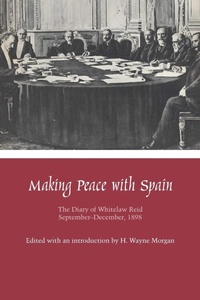
Making Peace with Spain
The Diary of Whitelaw Reid, September-December, 1898
Published on 1. January 1965
Book
Paperback/Softback
304 pages
978-0-292-76922-9 (ISBN)
Description
Whitelaw Reid, according to H. Wayne Morgan, was a "leading newspaperman, more than an occasional diplomat, a power in his party's politics, a supporter of some of the best in his era's culture . . . Of all his legacy, perhaps the record he left of his part in the Peace of Paris is the most significant and most interesting. It not only reveals the workings of his mind and of the peace conference, but also suggests the complex currents that carried his country into the realities of world power in the twentieth century."
In editing Reid's diary, Morgan used much material pertinent to the Paris Peace Conference of 1898, employed here for the first time. This material is a rich assortment of archival matter: the Reid Papers, the John Hay Papers, the John Bassett Moore Papers, and the McKinley Papers, in the Library of Congress; the Peace Commission records, in the National Archives; and unpublished materials in the Central Files of the Department of State.
Whitelaw Reid, as a war correspondent during the Civil War, as clerk of the House Military Affairs Committee, and later as a successor to Horace Greeley on the Tribune, gained access to the leaders of his times and insight into their actions. In 1889 he was appointed U.S. Minister to France by Harrison, and in 1892 he had the dubious honor of being chosen as Harrison's running mate on the losing presidential ticket. An influential friend and supporter of President McKinley and an occasional advisor to him, Reid was no stranger to politics and to international diplomacy when McKinley appointed him to the Peace Commission that wrote the treaty concluding the Spanish-American War. As a matter of fact, Reid's opinion reflected the administration's attitude of expansionism, the policy of Manifest Destiny-or "imperialism," as it was later called.
Reid's diary records the details of the sessions of the Joint Peace Commission of Paris from September through a large part of December of 1898. His day-by-day entries reveal the complexity of issues to be considered, the tactics of both the Spanish and the American Commissions in attempting to gain advantage for their respective governments, the interplay of the personalities of the once-proud Spaniards and the brash Americans, the political objectives influencing the points of view of the various members, and the maneuverings that brought about the final resolution of debated issues.
In editing Reid's diary, Morgan used much material pertinent to the Paris Peace Conference of 1898, employed here for the first time. This material is a rich assortment of archival matter: the Reid Papers, the John Hay Papers, the John Bassett Moore Papers, and the McKinley Papers, in the Library of Congress; the Peace Commission records, in the National Archives; and unpublished materials in the Central Files of the Department of State.
Whitelaw Reid, as a war correspondent during the Civil War, as clerk of the House Military Affairs Committee, and later as a successor to Horace Greeley on the Tribune, gained access to the leaders of his times and insight into their actions. In 1889 he was appointed U.S. Minister to France by Harrison, and in 1892 he had the dubious honor of being chosen as Harrison's running mate on the losing presidential ticket. An influential friend and supporter of President McKinley and an occasional advisor to him, Reid was no stranger to politics and to international diplomacy when McKinley appointed him to the Peace Commission that wrote the treaty concluding the Spanish-American War. As a matter of fact, Reid's opinion reflected the administration's attitude of expansionism, the policy of Manifest Destiny-or "imperialism," as it was later called.
Reid's diary records the details of the sessions of the Joint Peace Commission of Paris from September through a large part of December of 1898. His day-by-day entries reveal the complexity of issues to be considered, the tactics of both the Spanish and the American Commissions in attempting to gain advantage for their respective governments, the interplay of the personalities of the once-proud Spaniards and the brash Americans, the political objectives influencing the points of view of the various members, and the maneuverings that brought about the final resolution of debated issues.
More details
Language
English
Place of publication
Austin, TX
United States
Target group
Professional and scholarly
Dimensions
Height: 229 mm
Width: 152 mm
Thickness: 18 mm
Weight
496 gr
ISBN-13
978-0-292-76922-9 (9780292769229)
Copyright in bibliographic data and cover images is held by Nielsen Book Services Limited or by the publishers or by their respective licensors: all rights reserved.
Schweitzer Classification
Persons
H. Wayne Morgan (1934-2014) was George Lynn Cross Research Professor of History at the University of Oklahoma.
Content
Editorial Note
Introducing Mr. Reid
The Diary
I. Organizing the Conference: Problems and Persons
II. Organizing for Diplomacy
III. Making Calls and Taking Testimony
IV. Threats of Rupture: The Problem of the Cuban Debt
V. Taking the Philippines
VI. Finishing the Treaty
Appendixes
I. The Armistice Protocol of August 12, 1898
II. President McKinley's Instructions to the Peace Commission, September 16, 1898
III. Opinions of the Peace Commissioners on the Retention of the Philippines, October 25, 1898
IV. Biographical Glossary
Index
Introducing Mr. Reid
The Diary
I. Organizing the Conference: Problems and Persons
II. Organizing for Diplomacy
III. Making Calls and Taking Testimony
IV. Threats of Rupture: The Problem of the Cuban Debt
V. Taking the Philippines
VI. Finishing the Treaty
Appendixes
I. The Armistice Protocol of August 12, 1898
II. President McKinley's Instructions to the Peace Commission, September 16, 1898
III. Opinions of the Peace Commissioners on the Retention of the Philippines, October 25, 1898
IV. Biographical Glossary
Index