

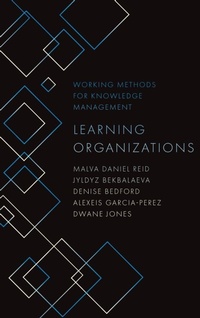
Learning Organizations
Published on 6. September 2021
Book
Hardback
200 pages
978-1-83982-431-9 (ISBN)
Description
The 21st century economy is fuelled by knowledge. Today, knowledge is more than an idea - it is an economic commodity. An organization's knowledge capital is a competitive and comparative advantage. Every organization must now invest in the knowledge assets of all its employees. Learning is the engine that creates and renews knowledge capital.
Learning Organizations delves into why learning is an essential business operation; how modern learning is different from industrial-era training; how to discover learning sources and opportunities; how to design a learning environment and learning strategies that optimize the potential of every employee.
This is essential reading for business managers, human resource professionals, and academic researchers studying knowledge economies, knowledge, and intellectual capital.
Learning Organizations delves into why learning is an essential business operation; how modern learning is different from industrial-era training; how to discover learning sources and opportunities; how to design a learning environment and learning strategies that optimize the potential of every employee.
This is essential reading for business managers, human resource professionals, and academic researchers studying knowledge economies, knowledge, and intellectual capital.
More details
Series
Language
English
Place of publication
Bingley
United Kingdom
Target group
Professional and scholarly
Dimensions
Height: 235 mm
Width: 157 mm
Thickness: 16 mm
Weight
451 gr
ISBN-13
978-1-83982-431-9 (9781839824319)
Copyright in bibliographic data and cover images is held by Nielsen Book Services Limited or by the publishers or by their respective licensors: all rights reserved.
Schweitzer Classification
Other editions
Additional editions
Malva Daniel Reid | Jyldyz Bekbalaeva | Denise Bedford
Learning Organizations
E-Book
09/2021
1st Edition
Emerald Publishing Limited
€85.99
Available for download
Persons
Malva Reid is the Assistant Chief Academic Officer at the University of the District of Columbia (UDC), USA. Dr Reid is a former Associate Dean for the UDC School of Business and Public Administration.
Jyldyz Bekbalaeva is Director of the Library and a faculty member at American University of Central Asia, Kyrgyzstan. Dr. Bekbalaeva is a recipient of Fulbright Visiting Scholar Award.
Denise Bedford is faculty at Georgetown University, USA, a Visiting Scholar at University of Coventry, UK, and Distinguished Practitioner, U.S. Department of State. Dr Bedford has previously worked for Intel and NASA.
Alexeis Garcia-Perez is Professor of Management Information Systems at Coventry University, UK, and a Visiting Research Scholar at Georgetown University, USA. Prof Garcia-Perez has led KM projects for the UK Ministry of Defence and the European Commission.
Dwane Jones is Acting Dean of the College of Agriculture, Urban Sustainability, and Environmental Sciences at the University of the District of Columbia, USA. Dr Jones uses design thinking to problem solve, innovate, prototype, execute, and research human-centered challenges.
Jyldyz Bekbalaeva is Director of the Library and a faculty member at American University of Central Asia, Kyrgyzstan. Dr. Bekbalaeva is a recipient of Fulbright Visiting Scholar Award.
Denise Bedford is faculty at Georgetown University, USA, a Visiting Scholar at University of Coventry, UK, and Distinguished Practitioner, U.S. Department of State. Dr Bedford has previously worked for Intel and NASA.
Alexeis Garcia-Perez is Professor of Management Information Systems at Coventry University, UK, and a Visiting Research Scholar at Georgetown University, USA. Prof Garcia-Perez has led KM projects for the UK Ministry of Defence and the European Commission.
Dwane Jones is Acting Dean of the College of Agriculture, Urban Sustainability, and Environmental Sciences at the University of the District of Columbia, USA. Dr Jones uses design thinking to problem solve, innovate, prototype, execute, and research human-centered challenges.
Content
Part 1. Learing In The Knowledge Economy
Chapter 1. Knowledge Capital and the Knowledge Economy
Chapter 2. Learning
Chapter 3. Learning Cultures
Chapter 4. Designs for Learning
Part 2. Learning environments
Chapter 5. Learning at the Organization Level
Chapter 6. Learning at the Team or Group Level
Chapter 7. Learning at the Individual Level
Part 3. Developing Learning Strategies
Chapter 8. Designing and Developing an Organization-Wide Learning Strategy
Chapter 9. Communicating and Socializing the Learning Strategy
Chapter 10. Maintaining and Sustaining a Learning Strategy
Chapter 1. Knowledge Capital and the Knowledge Economy
Chapter 2. Learning
Chapter 3. Learning Cultures
Chapter 4. Designs for Learning
Part 2. Learning environments
Chapter 5. Learning at the Organization Level
Chapter 6. Learning at the Team or Group Level
Chapter 7. Learning at the Individual Level
Part 3. Developing Learning Strategies
Chapter 8. Designing and Developing an Organization-Wide Learning Strategy
Chapter 9. Communicating and Socializing the Learning Strategy
Chapter 10. Maintaining and Sustaining a Learning Strategy