

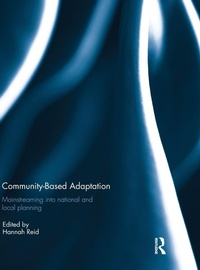
Community-based adaptation
Mainstreaming into national and local planning
1st Edition
Published on 19. October 2015
Book
Hardback
122 pages
978-1-138-96342-9 (ISBN)
Description
Community-based adaptation (CBA) to climate change is based on local priorities, needs, knowledge and capacities. Early CBA initiatives were generally implemented by non-government organisations (NGOs), and operated primarily at the local level. Many used 'bottom-up' participatory processes to identify the climate change problem and appropriate responses.
Small localised stand-alone initiatives are insufficient to address the scale of challenges climate change will bring, however. The causes of vulnerability - such as market or service access, or good governance - also often operate beyond the project level. Larger organisations and national governments have therefore started to implement broader CBA programmes, which provide opportunities to scale up responses and integrate CBA into higher levels of policy and planning.
This book shows that it is possible for CBA to remain centred on local priorities, but not necessarily limited to work implemented at the local level. Some chapters address the issue of mainstreaming CBA into government policy and planning processes or into city or sectoral level plans (e.g. on agriculture). Others look at how gender and children's issues should be mainstreamed into adaptation planning itself, and others describe how tools can be applied, and finance delivered for effective mainstreaming.
This book was published as a special issue of Climate and Development.
Small localised stand-alone initiatives are insufficient to address the scale of challenges climate change will bring, however. The causes of vulnerability - such as market or service access, or good governance - also often operate beyond the project level. Larger organisations and national governments have therefore started to implement broader CBA programmes, which provide opportunities to scale up responses and integrate CBA into higher levels of policy and planning.
This book shows that it is possible for CBA to remain centred on local priorities, but not necessarily limited to work implemented at the local level. Some chapters address the issue of mainstreaming CBA into government policy and planning processes or into city or sectoral level plans (e.g. on agriculture). Others look at how gender and children's issues should be mainstreamed into adaptation planning itself, and others describe how tools can be applied, and finance delivered for effective mainstreaming.
This book was published as a special issue of Climate and Development.
More details
Language
English
Place of publication
London
United Kingdom
Publishing group
Taylor & Francis Ltd
Target group
College/higher education
Dimensions
Height: 286 mm
Width: 221 mm
Thickness: 12 mm
Weight
592 gr
ISBN-13
978-1-138-96342-9 (9781138963429)
Copyright in bibliographic data and cover images is held by Nielsen Book Services Limited or by the publishers or by their respective licensors: all rights reserved.
Schweitzer Classification
Other editions
Additional editions
E-Book
10/2017
1st Edition
Routledge
€47.49
Available for download
E-Book
10/2017
1st Edition
Routledge
€47.49
Available for download
Book
06/2017
1st Edition
Routledge
€52.20
Shipment within 10-20 days
Person
Hannah Reid is a Research Associate at the International Institute for Environment and Development. She has over thirteen years of experience working on climate change and development, with particular focus on how to help those who are most vulnerable to climate change cope with its impacts, and ecosystem-based approaches to adaptation.
Content
1. Mainstreaming community-based adaptation into national and local planning 2. Mainstreaming climate change adaptation into development in Bangladesh 3. Identifying operational mechanisms for mainstreaming community-based adaptation in Nepal 4. Farmers, food and climate change: ensuring community-based adaptation is mainstreamed into agricultural programmes 5. Gender-sensitive adaptation policy-making in Bangladesh: status and ways forward for improved mainstreaming 6. Power and differential climate change vulnerability among extremely poor people in Northwest Bangladesh: lessons for mainstreaming 7. Moving towards inclusive urban adaptation: approaches to integrating community-based adaptation to climate change at city and national scale 8. A review of decision-support models for adaptation to climate change in the context of development 9. Enablers for delivering community-based adaptation at scale 10. Mainstreaming children's vulnerabilities and capacities into community-based adaptation to enhance impact 11. Knowledge flows in climate change adaptation: exploring friction between scales 12. Up-scaling finance for community-based adaptation