

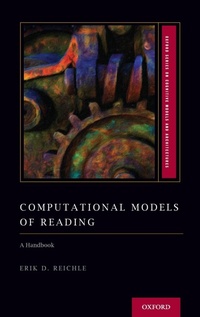
Computational Models of Reading
A Handbook
Published on 15. April 2021
Book
Hardback
608 pages
978-0-19-537066-9 (ISBN)
Description
This book is about computational models of reading, or models that explain (and often simulate) the mental processes that allow us to convert the marks on a printed page into the representations that allow us to understand the contents of what we are reading. Computational Models of Reading assumes no prior knowledge of the topic and is intended for psychologists, linguists, and educators who are interested in gaining a better understanding of what happens in the mind during reading. Erik D. Reichle includes introductory chapters on reading research and computational modelling, and the "core" chapters of the book review both important empirical findings and the models designed to explain those findings within four domains of reading research: word identification, sentence processing, discourse representation, and eye-movement control (which involves coordinating word, sentence, and discourse processing with the perceptual, cognitive, and motoric systems responsible for vision, attention, and eye movements). The final chapter of the book describes a new integrative model of reading, UEber-Reader, and several simulations using the models that demonstrate how it explains several key reading phenomena.
More details
Series
Language
English
Place of publication
New York
United States
Target group
Professional and scholarly
Dimensions
Height: 240 mm
Width: 161 mm
Thickness: 37 mm
Weight
1063 gr
ISBN-13
978-0-19-537066-9 (9780195370669)
Copyright in bibliographic data and cover images is held by Nielsen Book Services Limited or by the publishers or by their respective licensors: all rights reserved.
Schweitzer Classification
Other editions
Additional editions
E-Book
12/2020
1st Edition
OUP eBook
€45.99
Available for download
E-Book
10/2020
1st Edition
OUP eBook
€45.99
Available for download
Person
Erik D. Reichle is a Professor of Cognitive Psychology and the Head of the Department of Psychology at Macquarie University. His research uses computer modelling and eye-tracking experiments to understand the mental processes that are engaged during skilled reading. He has published more than 60 articles on these topics in leading peer-reviewed journals (e.g., Psychological Review, Psychological Science, Brain and Behavioral Sciences) and has received fellowships from the Hanse Institute for Advanced Study (Germany) and the Leverhulme Trust (United Kingdom).
Content
Chapter 1 - Introduction
Chapter 2 - Formal Models
Chapter 3 - Models of Word Identification
Chapter 4 - Models of Sentence Processing
Chapter 5 - Models of Discourse Representation
Chapter 6 - Models of the Reading Architecture
Chapter 7 - Synthesis
Chapter 2 - Formal Models
Chapter 3 - Models of Word Identification
Chapter 4 - Models of Sentence Processing
Chapter 5 - Models of Discourse Representation
Chapter 6 - Models of the Reading Architecture
Chapter 7 - Synthesis