

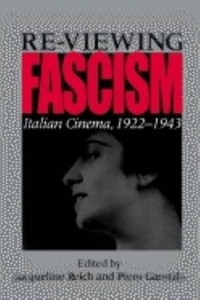
Re-viewing Fascism
Italian Cinema, 1922-1943
Published on 7. May 2002
Book
Hardback
384 pages
978-0-253-34045-0 (ISBN)
Description
When Benito Mussolini proclaimed that "Cinema is the strongest weapon," he was only telling half the story. In reality, very few feature films during the Fascist period can be labelled as propaganda. If not propaganda, what were most films like? Rather than soldiers, schoolgirls dominated the screen; the boudoir, not the battlefield, was the setting of choice. In fact, many of these so-called "white telephone" films openly contradicted Fascist ideology. The first English-language anthology devoted to this subject, Re-viewing Fascism examines just how many films failed as "weapons" in creating cultural consensus and instead came to reflect the complexities and contradictions of Fascist culture. Revealed is a period of over twenty years worth of films ripe with ambiguity due to, as several contributors show, the influential models of American, Soviet and Hungarian cinema and the rapid growth of consumer culture. The volume also examines the connection between cinema of the Fascist period and neo-realism - ties that many scholars previously had denied in an attempt to view Fascism as an unfortunate deviation in Italian history.
The post-war directors Luchino Visconti, Roberto Rossellini and Vittorio de Sica all had important roots in the Fascist era, as did the Venice Film Festival. And while government censorship was an important factor, it did not prevent frank depictions of sexuality and representations of men and women that challenged official gender policies. Re-viewing Fascism brings together scholars from different cultural and disciplinary backgrounds as it offers an engaging and innovative look into Italian cinema, Fascist culture and society.
The post-war directors Luchino Visconti, Roberto Rossellini and Vittorio de Sica all had important roots in the Fascist era, as did the Venice Film Festival. And while government censorship was an important factor, it did not prevent frank depictions of sexuality and representations of men and women that challenged official gender policies. Re-viewing Fascism brings together scholars from different cultural and disciplinary backgrounds as it offers an engaging and innovative look into Italian cinema, Fascist culture and society.
Reviews / Votes
"Each essay makes a point of correcting misconceptions about the cinema during the ventennio [the period of fascist rule], which makes this book a significant contribution to the literature."--ChoiceMore details
Language
English
Place of publication
Bloomington, IN
United States
Target group
Professional and scholarly
Illustrations
25 b&w photos, 1 index
Dimensions
Height: 235 mm
Width: 156 mm
ISBN-13
978-0-253-34045-0 (9780253340450)
Copyright in bibliographic data and cover images is held by Nielsen Book Services Limited or by the publishers or by their respective licensors: all rights reserved.
Schweitzer Classification
Other editions
Additional editions
E-Book
05/2002
Indiana University Press
€18.18
Available for download
Content
Contents; Acknowledgements; Preface Piero Garofalo and Jacqueline Reich; Part 1: Framing Fascism and Cinema; 1. Mussolini at the Movies: Fascism, Film, and Culture Jacqueline Reich; 2. Dubbing L'Arte Muta: Poetic Layerings Around Italian Cinema's Transition to Sound Giorgio Bertellini; 3. Intimations of Neorealism in the Fascist Ventennio Ennio Di Nolfo; 4. Placing Cinema, Fascism, and the Nation in a Diagram of Italian Modernity James Hay; Part 2: Fascism, Cinema, and Sexuality; 5. Sex in the Cinema: Regulation and Transgression in Italian Films, 1930-1943 David Forgacs; 6. Luchino Visconti's (Homosexual) Ossessione William Van Watson; 7. Ways of Looking in Black and White: Female Spectatorship and the Miscege-national Body in Sotto la croce del sud Robin Pickering-Iazzi; Part 3: Fascism and Film in (Con)texts; 8. Seeing Red: The Soviet Influence on Italian Cinema in the Thirties; Piero Garofalo; 9. Theatricality and Impersonation: The Politics of Style in the Cinema of the Italian Fascist Era Marcia Landy; 10. Shopping for Autarchy: Fascism and Reproductive Fantasy in Mario Camerini's Grandi magazzini Barbara Spackman; 11. The Last Film Festival: The Venice Biennale Goes to War Marla Stone; 12. Film Stars and Society in Fascist Italy Stephen Gundle; Selected Bibliography; Index