

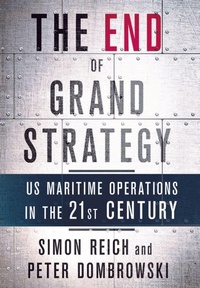
The End of Grand Strategy
US Maritime Operations in the Twenty-First Century
Published on 15. January 2018
Book
Hardback
252 pages
978-1-5017-1462-7 (ISBN)
Description
In The End of Grand Strategy, Simon Reich and Peter Dombrowski challenge the common view of grand strategy as unitary. They eschew prescription of any one specific approach, chosen from a spectrum that stretches from global primacy to restraint and isolationism, in favor of describing what America's military actually does, day to day. They argue that a series of fundamental recent changes in the global system, the inevitable jostling of bureaucratic politics, and the practical limitations of field operations combine to ensure that each presidential administration inevitably resorts to a variety of strategies.
Proponents of different American grand strategies have historically focused on the pivotal role of the Navy. In response, Reich and Dombrowski examine six major maritime operations, each of which reflects one major strategy. One size does not fit all, say the authors-the attempt to impose a single overarching blueprint is no longer feasible. Reich and Dombrowski declare that grand strategy, as we know it, is dead. The End of Grand Strategy is essential reading for policymakers, military strategists, and analysts and critics at advocacy groups and think tanks.
Proponents of different American grand strategies have historically focused on the pivotal role of the Navy. In response, Reich and Dombrowski examine six major maritime operations, each of which reflects one major strategy. One size does not fit all, say the authors-the attempt to impose a single overarching blueprint is no longer feasible. Reich and Dombrowski declare that grand strategy, as we know it, is dead. The End of Grand Strategy is essential reading for policymakers, military strategists, and analysts and critics at advocacy groups and think tanks.
Reviews / Votes
The End of Grand Strategy should be widely read, first, to distinguish grand strategy from traditional strategy.... The second reason to read Reich and Dombrowski is to see the difficulties 21st-century decision makers confront in preparing to fight.... Today, a strategy's aim almost always should be to establish what constitutes a satisfactory outcome rather than a clear-cut victory. A grand strategic goal should be expressed in terms of control that may take a long time to achieve and require great patience. I think Reich and Dombrowski have implied as much, and that is one more reason for reading their fine book.(Proceedings) Reich and Dombrowski's approach offers a description of US grand strategic theory found in no other text and a set of developed case studies that flesh out each identified strategic approach.... The End of Grand Strategy presents highly comprehensible policy overviews and histories of each topic engaged with.
(H-NET Reviews) Insightfully examines both the contemporary US NSS approach and current US Navy operations across the globe. While American-centric by intent, the book contains many concepts and ideas that smaller nations may find useful, especially in contemplating future multilateral naval operations, an area of growing importance. The book offers much for policymakers, military planners, academics and all those concerned with understanding the business of strategising.
(The RUSI Journal) The End of Grand Strategy provides a balanced presentation based on broad research drawn from published government documents and secondary sources. Clear in argument and prose, the book accomplishes its goals by effectively relating the ways and means of sea power to specific regional grand strategies.... This work will appeal to both generalists and specialists of American national security and strategy. Upper level undergraduate, graduate, and war college students in national security, international relations, and strategic studies would especially benefit from this work.
(The Journal of Military History) While the broad strokes of Reich and Dombrowski's theoretical argument are thought provoking, it is their descriptive empirical analysis that stands out for its concision and clarity. Any one of their empirical chapters could serve as a high-level primer on the topic it discusses.
(Stategic Studies Quarterly) The book will be important for readers studying or involved in American politics and policy-making. It can also be recommended to students of American strategic thought and strategic planning, given the relatively low cost of the book.
(international affairs) In this academic treatise, the authors challenge the notion of the effectiveness of a unified grand strategy and posit that in the current era a spectrum of strategies is needed depending on the region and the threats therein.
(SeaPower Magazine) The authors make a positive contribution when they describe Iranian use of asymmetric warfare.[T] he book is useful to the reader because of the information it conveys: in particular, six strategies of American foreign policy; case studies of inter-allied maritime operations that strengthened regional military and political cooperation and enhanced US alliances (this is also important in the context of the increased use of military forces as a political instrument); case study on racing for the Arctic with a strategy of restraint; and adversary use of asymmetric warfare.
(H-War)
More details
Language
English
Place of publication
Ithaca
United States
Product notice
Paper over boards
Dimensions
Height: 238 mm
Width: 161 mm
Thickness: 30 mm
Weight
557 gr
ISBN-13
978-1-5017-1462-7 (9781501714627)
Copyright in bibliographic data and cover images is held by Nielsen Book Services Limited or by the publishers or by their respective licensors: all rights reserved.
Schweitzer Classification
Other editions
Additional editions
Simon Reich | Peter Dombrowski
The End of Grand Strategy
US Maritime Operations in the Twenty-First Century
E-Book
01/2018
Cornell University Press
€14.49
Available for download
Persons
Simon Reich is Professor of Global Affairs and Political Science at Rutgers University, Newark. He is the author of Global Norms, American Sponsorship and the Emerging Patterns of World Politics and coauthor most recently of Good-bye Hegemony!. Peter Dombrowski is Professor in the Strategic Research Department at the Naval War College. He is the coeditor of The Indian Ocean and US Grand Strategy and Regional Missile Defense from a Global Perspective.
Content
Preface and Acknowledgments
Introduction
1. Naval Operations and Grand Strategy in the New Security Environment
2. Comparing Grand Strategies-and Their Inherent Limitations
3. A Maritime Strategy of Primacy in the Persian Gulf
4. Playing a Follow-the-Leader Strategy on the High Seas
5. Pirates, Terrorists, and Formal Sponsorship
6. Navigating the Proliferation Security Initiative and Informal Sponsorship
7. Racing for the Arctic with a Strategy of Restraint
8. Controlling the Southern Maritime Approaches with
an Isolationist Strategy
Conclusion
Appendixes
1. The Strategies of American Foreign Policy
2. Select Multilateral Exercises in the Indo-Pacific
3. PSI Multinational Exercises
Notes
Index
Introduction
1. Naval Operations and Grand Strategy in the New Security Environment
2. Comparing Grand Strategies-and Their Inherent Limitations
3. A Maritime Strategy of Primacy in the Persian Gulf
4. Playing a Follow-the-Leader Strategy on the High Seas
5. Pirates, Terrorists, and Formal Sponsorship
6. Navigating the Proliferation Security Initiative and Informal Sponsorship
7. Racing for the Arctic with a Strategy of Restraint
8. Controlling the Southern Maritime Approaches with
an Isolationist Strategy
Conclusion
Appendixes
1. The Strategies of American Foreign Policy
2. Select Multilateral Exercises in the Indo-Pacific
3. PSI Multinational Exercises
Notes
Index