

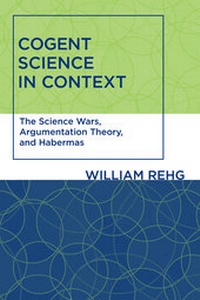
Cogent Science in Context
The Science Wars, Argumentation Theory, and Habermas
Published on 5. December 2008
Book
Hardback
360 pages
978-0-262-18271-3 (ISBN)
Description
A proposal for an interdisciplinary, context-sensitive framework for assessing the strength of scientific arguments that melds Jürgen Habermas's discourse theory and sociological contextualism.Recent years have seen a series of intense, increasingly acrimonious debates over the status and legitimacy of the natural sciences. These "science wars" take place in the public arena-with current battles over evolution and global warming-and in academia, where assumptions about scientific objectivity have been called into question. Given these hostilities, what makes a scientific claim merit our consideration? In Cogent Science in Context, William Rehg examines what makes scientific arguments cogent-that is, strong and convincing-and how we should assess that cogency. Drawing on the tools of argumentation theory, Rehg proposes a multidimensional, context-sensitive framework both for understanding the cogency of scientific arguments and for conducting cooperative interdisciplinary assessments of the cogency of actual scientific arguments. Rehg closely examines Jürgen Habermas's argumentation theory and its implications for understanding cogency, applying it to a case from high-energy physics. A series of problems, however, beset Habermas's approach. In response, Rehg outlines his own "critical contextualist" approach, which uses argumentation-theory categories in a new and more context-sensitive way inspired by ethnography of science.
More details
Series
Language
English
Place of publication
Cambridge, Mass.
United States
Publishing group
MIT Press Ltd
Target group
College/higher education
Professional and scholarly
US School Grade: College Graduate Student and over
Product notice
Cloth over boards
Dimensions
Height: 229 mm
Width: 152 mm
Thickness: 22 mm
Weight
635 gr
ISBN-13
978-0-262-18271-3 (9780262182713)
Copyright in bibliographic data and cover images is held by Nielsen Book Services Limited or by the publishers or by their respective licensors: all rights reserved.
Schweitzer Classification
Other editions
New editions
Book
08/2011
MIT Press
€10.00
No shipping information available
Additional editions
Book
08/2011
MIT Press
€10.00
No shipping information available
Person
William Rehg is Associate Professor of Philosophy at Saint Louis University. He is the translator of Jürgen Habermas's Between Facts and Norms: Contributions to a Discourse Theory of Law and Democracy (1996) and the coeditor of Deliberative Democracy: Essays on Reason and Politics and Pluralism (1997) and The Pragmatic Turn: The Transformation of Critical Theory (2001), all published by the MIT Press.
Content
Preface and Acknowledgments Introduction: Science Wars, New and Old I The Argumentative Turn in Science Studies 15 1 Science as Argumentative Practice 2 Kuhn's Gap: From Logic to Sociology 33 3 Closing the Gap: Three Rhetorical Perspectives on Science 57 Postscript I: The Return of the Logical Achinstein's Realist Theory of Evidence 81 II Integrating Perspectives: Habermas's Discourse Theory 99 4 Habermas's Critical Theory and Science: Truth and Accountability 101 5 Habermas's Theory of Argumentation as an Integrated Model of Cogency 129 6 Argumentation at Fermilab: Putting the Habermasian Model to Work 163 Postscript II: Who's Afraid of SSK? The Problem and Possibilities of Interdisciplinary Cooperation 195 III Toward a Critical Contextualist Framework for Interdisciplinary Assessment 211 7 Adjusting the Pragmatic Turn: Lessons from Ethnomethodology 213 8 Three Dimensions of Argument Cogency-A Contextualist Case Study 241 9 Critical Science Studies and the Good Society 269 Notes 297 References 313 Index