

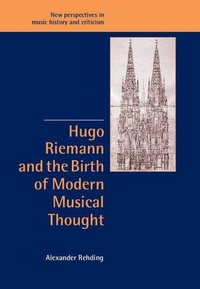
Hugo Riemann and the Birth of Modern Musical Thought
Published on 11. January 2009
Book
Paperback/Softback
232 pages
978-0-521-09636-2 (ISBN)
Description
Generally acknowledged as the most important German musicologist of his age, Hugo Riemann (1849-1919) shaped the ideas of generations of music scholars, not least because his work coincided with the institutionalisation of academic musicology around the turn of the last century. This influence, however, belies the contentious idea at the heart of his musical thought, an idea he defended for most of his career - harmonic dualism. By situating Riemann's musical thought within turn-of-the-century discourses about the natural sciences, German nationhood and modern technology, this book reconstructs the cultural context in which Riemann's ideas not only 'made sense' but advanced an understanding of the tonal tradition as both natural and German. Riemann's musical thought - from his considerations of acoustical properties to his aesthetic and music-historical views - thus regains the coherence and cultural urgency that it once possessed.
Reviews / Votes
Review of the hardback: '... this is a magnificent study. The writing throughout is sympathetic, witty, engaged, quietly ambitious; and Rehding is wonderfully sensitive to the poignancy of Riemann's tale.' Nineteenth-Century Music ReviewMore details
Series
Language
English
Place of publication
Cambridge
United Kingdom
Target group
College/higher education
Product notice
Paperback (trade)
Illustrations
47 Printed music items
Dimensions
Height: 229 mm
Width: 152 mm
Thickness: 14 mm
Weight
383 gr
ISBN-13
978-0-521-09636-2 (9780521096362)
Copyright in bibliographic data and cover images is held by Nielsen Book Services Limited or by the publishers or by their respective licensors: all rights reserved.
Schweitzer Classification
Other editions
Additional editions
Alexander Rehding
Hugo Riemann and the Birth of Modern Musical Thought
E-Book
12/2004
1st Edition
Cambridge University Press
€29.49
Available for download
Person
Alexander Rehding is Cotsen Fellow at the Princeton Society of Fellows. He is co-editor of Music Theory and Natural Order from the Renaissance to the Early Twentieth Century (Cambridge University Press 2001). He was awarded the Jerome Roche Prize of the Royal Musical Society in 2001.
Content
1. Riemann's moonshine experiment; 2. The responsibilities of nineteenth-century music theory; 3. Riemann's musical logic and the 'as if'; 4. Musical syntax, nationhood and universality; 5. Beethoven's deafness and tone imaginations; Epilogue; Glossary: Riemann's key terms as explained in the Musik-Lexikon (5th edn, 1900).