

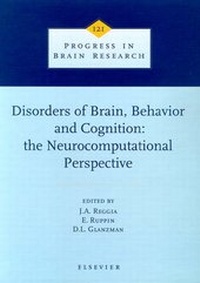
Disorders of Brain, Behavior, and Cognition: The Neurocomputational Perspective: Volume 121
Published on 16. September 1999
Book
Hardback
434 pages
978-0-444-50175-2 (ISBN)
Description
This book contains selected contributions of papers, many presented at the Second International Workshop on Neural Modeling of Brain Disorders, as well as a few additional papers on related topics, including a wide range of presentations describing computational models of neurological, neuropsychological and psychiatric disorders. It is a unique, comprehensive review of the state-of-the-art of modeling cognitive and brain disorders, appealing to a multidisciplinary audience of clinicians, psychologists, neuroscientists, cognitive scientists, computer scientists, and other neural network researchers. The rest of the book is organized along four main themes, involving memory, neuropsychological, neurological and psychiatric disorders. In general, the cognitive disorders and these psychiatric diseases traditionally regarded as "functional" were modeled along functional lines, while those disorders traditionally viewed as "organic" neurological diseases generally drew more from knowledge of the underlying neurobiology and pathophysiology.
More details
Series
Language
English
Place of publication
Oxford
United Kingdom
Publishing group
Elsevier Science & Technology
Target group
Professional and scholarly
Weight
1360 gr
ISBN-13
978-0-444-50175-2 (9780444501752)
Copyright in bibliographic data and cover images is held by Nielsen Book Services Limited or by the publishers or by their respective licensors: all rights reserved.
Schweitzer Classification
Other editions
Additional editions
J. A. Reggia | E. Ruppin | D. L. Glanzman
Disorders of Brain, Behavior, and Cognition: The Neurocomputational Perspective
E-Book
09/1999
Elsevier
€220.00
Available for download
Persons
Editor
University of Maryland, Departments of Computer Science and Neurology, UMIACS, College Park, MD 20742, USA
Tel-Aviv University, Departments of Physiology and Computer Science, Schools of Medicine and Mathematics, Tel-Aviv 69978, Israel
National Institute of Mental Health, The Neuroscience Centre, Theoretical and Computational Neuroscience Research Program, Bethesda, MD 20892, USA
Content
I. Memory Disorders.
Neuromodulation and the hippocampus: memory function and dysfunction in a network simulation.
Cholinergic neuromodulation and alzheimer's disease.
Episodic memory in semantic dementia: a computational approach based on the tracelink model.
Multimodular networks and semantic memory impairments.
II. Neuropsychology.
Understanding failures of learning: hebbian learning, competition for representational space, and some preliminary experimental data.
Frames of reference in hemineglect: a computational approach.
Explaining object-based deficits in unilateral neglect without object based frames of reference. Inter-hemispheric competition of sub-cortical structures is a crucial mechanism in paradoxical lesion effects and spatial neglect. A new model of letter string encoding: simulating right neglect dyslexia.
Prosopagnosia in modular neural network models.
Functional brain imaging and modeling of brain disorders.
III. Neurology.
Unmasking unmasked: neural dynamics following stroke.
Effects of callosal lesions in a computational model of single-word reading.
Penumbral tissue damage following acute stroke: a computational investigation.
The gating functions of the basal ganglia in movement control.
Motor fluctuations in parkinson's disease: a postsynaptic mechanism derived from a striatal model.
Thalamic and thalamocortical mechanisms underlying 3 hz spike-and-wave discharges.
IV. Psychiatry.
Using a speech perception neural network simulation to explore normal neurodevelopment and hallucinated "voices" in schizophrenia.
Dopamine, cognitive control, and schizophrenia: the gating model.
Modeling prefrontal cortex delay cells: the role of dopamine in Schizophrenia.
Neural models of normal and abnormal behaviour: what do schizophrenia, parkinsonism, attention deficit disorder, and depression have in common?.
A neural network model of attention biases in depression.
Neuromodulation and the hippocampus: memory function and dysfunction in a network simulation.
Cholinergic neuromodulation and alzheimer's disease.
Episodic memory in semantic dementia: a computational approach based on the tracelink model.
Multimodular networks and semantic memory impairments.
II. Neuropsychology.
Understanding failures of learning: hebbian learning, competition for representational space, and some preliminary experimental data.
Frames of reference in hemineglect: a computational approach.
Explaining object-based deficits in unilateral neglect without object based frames of reference. Inter-hemispheric competition of sub-cortical structures is a crucial mechanism in paradoxical lesion effects and spatial neglect. A new model of letter string encoding: simulating right neglect dyslexia.
Prosopagnosia in modular neural network models.
Functional brain imaging and modeling of brain disorders.
III. Neurology.
Unmasking unmasked: neural dynamics following stroke.
Effects of callosal lesions in a computational model of single-word reading.
Penumbral tissue damage following acute stroke: a computational investigation.
The gating functions of the basal ganglia in movement control.
Motor fluctuations in parkinson's disease: a postsynaptic mechanism derived from a striatal model.
Thalamic and thalamocortical mechanisms underlying 3 hz spike-and-wave discharges.
IV. Psychiatry.
Using a speech perception neural network simulation to explore normal neurodevelopment and hallucinated "voices" in schizophrenia.
Dopamine, cognitive control, and schizophrenia: the gating model.
Modeling prefrontal cortex delay cells: the role of dopamine in Schizophrenia.
Neural models of normal and abnormal behaviour: what do schizophrenia, parkinsonism, attention deficit disorder, and depression have in common?.
A neural network model of attention biases in depression.