

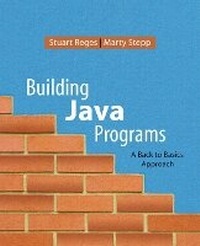
Building Java Programs
A Back to Basics Approach
Published on 10. May 2007
Book
Mixed media product
896 pages
978-0-321-38283-2 (ISBN)
Description
Building Java Programs: A Back to Basics Approach introduces novice programmers to basic constructs and common pitfalls by emphasizing the essentials of procedural programming, problem solving, and algorithmic reasoning. By using objects early to solve interesting problems and defining objects later in the course, Building Java Programs develops programming knowledge for a broad audience.
More details
Language
English
Place of publication
United States
Publishing group
Pearson Education (US)
Target group
College/higher education
Dimensions
Width: 230 mm
Thickness: 28 mm
Weight
1306 gr
ISBN-13
978-0-321-38283-2 (9780321382832)
Copyright in bibliographic data and cover images is held by Nielsen Book Services Limited or by the publishers or by their respective licensors: all rights reserved.
Schweitzer Classification
Other editions
New editions
Book
04/2010
2nd Edition
Pearson
€94.65
Article exhausted; check for reprint
Content
Chapter 1: Introduction to Java Programming
1.1 Basic Computing Concepts
1.2 And Now-Java
1.3 Program Errors
1.4 Procedural Decomposition
1.5 Case Study: DrawFigures
Chapter 2: Primitive Data and Definite Loops
2.1 Basic Data Concepts
2.2 Variables
2.3 The for Loop
2.4 Managing Complexity
2.5 Case Study: A Complex Figure
Chapter 3: Introduction to Parameters and Objects
3.1 Parameters
3.2 Methods That Return Values
3.3 Using Objects
3.4 Interactive Programs
3.5 Case Study: Projectile Trajectory
Chapter3G: Graphics (Optional)
3G.1 Introduction to Graphics
3G.2 Procedural Decomposition with Graphics
3G.3 Case Study: Pyramids
Chapter 4: Conditional Execution
4.1 Loop Techniques
4.2 if/else Statements
4.3 Subtleties of Conditional Execution
4.4 Text Processing
4.5 Methods with Conditional Execution
4.6 Case Study: Body Mass Index
Chapter 5: Program Logic and Indefinite Loops
5.1 The while Loop
5.2 The boolean Type
5.3 User Errors
5.4 Indefinite Loop Variations
5.5 Assertions and Program Logic
5.6 Case Study: NumberGuess
Chapter 6: File Processing
6.1 File-Reading Basics
6.2 Details of Token-Based Processing
6.3 Line-Based Processing
6.4 Advanced File Processing
6.5 Case Study: Weighted GPA
Chapter 7: Arrays
7.1 Array Basics
7.2 Array-Traversal Algorithms
7.3 Advanced Array Techniques
7.4 Multidimensional Arrays (Optional)
7.5 Case Study: Hours Worked
Chapter 8: Classes
8.1 Object-Oriented Programming Concepts
8.2 Object State: Fields
8.3 Object Behavior: Methods
8.4 Object Initialization: Constructors
8.5 Encapsulation
8.6 More Instance Methods
8.7 The Keyword this
8.8 More Classes
8.9 Case Study: Designing a Stock Class
Chapter 9: Inheritance and Interfaces
9.1 Inheritance Basics
9.2 The Mechanics of Polymorphism
9.3 Interacting with the Superclass
9.4 Inheritance and Design
9.5 Interfaces
9.6 Case Study: Designing a Hierarchy of Financial Classes
Chapter 10: ArrayLists
10.1 ArrayLists
10.2 The Comparable Interface
10.3 Case Study: Vocabulary Comparison
Chapter 11: Java Collections Framework
11.1 Lists
11.2 Sets
11.3 Maps
Chapter 12: Recursion
12.1 Thinking Recursively
12.2 A Better Example of Recursion
12.3 Recursive Functions
12.4 Recursive Graphics (Optional)
12.5 Case Study: Prefix Evaluator
Chapter 13: Searching and Sorting
13.1 Searching and Sorting in the Java Class Libraries
13.2 Program Efficiency
13.3 Implementing Searching and Sorting Algorithms
13.4 Case Study: Implementing Merge Sort
Chapter 14: Graphical User Interfaces
14.1 GUI Basics
14.2 Laying Out Components
14.3 Interaction Between Components
14.4 Additional Components and Events
14.5 2D Graphics
14.6 Case Study: Implementing DrawingPanel
Appendices:
A: Answers to Self-Check Problems
B: Java Summary
C: Javadoc Comments and the Java API Specification
1.1 Basic Computing Concepts
1.2 And Now-Java
1.3 Program Errors
1.4 Procedural Decomposition
1.5 Case Study: DrawFigures
Chapter 2: Primitive Data and Definite Loops
2.1 Basic Data Concepts
2.2 Variables
2.3 The for Loop
2.4 Managing Complexity
2.5 Case Study: A Complex Figure
Chapter 3: Introduction to Parameters and Objects
3.1 Parameters
3.2 Methods That Return Values
3.3 Using Objects
3.4 Interactive Programs
3.5 Case Study: Projectile Trajectory
Chapter3G: Graphics (Optional)
3G.1 Introduction to Graphics
3G.2 Procedural Decomposition with Graphics
3G.3 Case Study: Pyramids
Chapter 4: Conditional Execution
4.1 Loop Techniques
4.2 if/else Statements
4.3 Subtleties of Conditional Execution
4.4 Text Processing
4.5 Methods with Conditional Execution
4.6 Case Study: Body Mass Index
Chapter 5: Program Logic and Indefinite Loops
5.1 The while Loop
5.2 The boolean Type
5.3 User Errors
5.4 Indefinite Loop Variations
5.5 Assertions and Program Logic
5.6 Case Study: NumberGuess
Chapter 6: File Processing
6.1 File-Reading Basics
6.2 Details of Token-Based Processing
6.3 Line-Based Processing
6.4 Advanced File Processing
6.5 Case Study: Weighted GPA
Chapter 7: Arrays
7.1 Array Basics
7.2 Array-Traversal Algorithms
7.3 Advanced Array Techniques
7.4 Multidimensional Arrays (Optional)
7.5 Case Study: Hours Worked
Chapter 8: Classes
8.1 Object-Oriented Programming Concepts
8.2 Object State: Fields
8.3 Object Behavior: Methods
8.4 Object Initialization: Constructors
8.5 Encapsulation
8.6 More Instance Methods
8.7 The Keyword this
8.8 More Classes
8.9 Case Study: Designing a Stock Class
Chapter 9: Inheritance and Interfaces
9.1 Inheritance Basics
9.2 The Mechanics of Polymorphism
9.3 Interacting with the Superclass
9.4 Inheritance and Design
9.5 Interfaces
9.6 Case Study: Designing a Hierarchy of Financial Classes
Chapter 10: ArrayLists
10.1 ArrayLists
10.2 The Comparable Interface
10.3 Case Study: Vocabulary Comparison
Chapter 11: Java Collections Framework
11.1 Lists
11.2 Sets
11.3 Maps
Chapter 12: Recursion
12.1 Thinking Recursively
12.2 A Better Example of Recursion
12.3 Recursive Functions
12.4 Recursive Graphics (Optional)
12.5 Case Study: Prefix Evaluator
Chapter 13: Searching and Sorting
13.1 Searching and Sorting in the Java Class Libraries
13.2 Program Efficiency
13.3 Implementing Searching and Sorting Algorithms
13.4 Case Study: Implementing Merge Sort
Chapter 14: Graphical User Interfaces
14.1 GUI Basics
14.2 Laying Out Components
14.3 Interaction Between Components
14.4 Additional Components and Events
14.5 2D Graphics
14.6 Case Study: Implementing DrawingPanel
Appendices:
A: Answers to Self-Check Problems
B: Java Summary
C: Javadoc Comments and the Java API Specification