

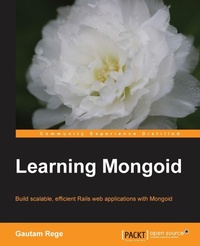
Learning Mongoid
If you know MongoDB and Ruby, then Mongoid is a very handy tool to have at your disposal. Quickly learn to build Rails applications with the helpful code samples and instructions in this book.
Published on 12. December 2013
Book
Paperback/Softback
140 pages
978-1-78216-750-1 (ISBN)
Description
If you know MongoDB and Ruby, then Mongoid is a very handy tool to have at your disposal. Quickly learn to build Rails applications with the helpful code samples and instructions in this book.
Key Features
A step-by-step guide that explains how to use Mongoid through lots of examples and code
Monitor and fine-tune the performance of your application
Work with the MongoDB aggregation framework
Book DescriptionMongoid helps you to leverage the power of schema-less and efficient document-based design, dynamic queries, and atomic modifier operations. Mongoid eases the work of Ruby developers while they are working on complex frameworks.
Starting with why and how you should use Mongoid, this book covers the various components of Mongoid. It then delves deeper into the detail of queries and relations, and you will learn some tips and tricks on improving performance. With this book, you will be able to build robust and large-scale web applications with Mongoid and Rails.
Starting with the basics, this book introduces you to components such as moped and origin, and how information is managed, learn about the various datatypes, embedded documents, arrays, and hashes. You will learn how a document is stored and manipulated with callbacks, validations, and even atomic updates. This book will then show you the querying mechanism in detail, right from simple to complex queries, and even explains eager loading, lazy evaluation, and chaining of queries. Finally, this book will explain the importance of performance tuning and how to use the right indexes. It also explains MapReduce and the Aggregation Framework.What you will learn
Learn the syntax of Mongoid 4 with Rails 4
Understand moped, the new Ruby driver for MongoDB Learn about document relations in Mongoid
Understand origin, the new querying DSL
Manage indexes in Mongoid
Learn about gems that work with Mongoid
Tune and monitor performance
Who this book is forIf you are an application developer who wants to learn how to use Mongoid in a Rails application, this book will be great for you. You are expected to be familiar with MongoDB and Ruby.
Key Features
A step-by-step guide that explains how to use Mongoid through lots of examples and code
Monitor and fine-tune the performance of your application
Work with the MongoDB aggregation framework
Book DescriptionMongoid helps you to leverage the power of schema-less and efficient document-based design, dynamic queries, and atomic modifier operations. Mongoid eases the work of Ruby developers while they are working on complex frameworks.
Starting with why and how you should use Mongoid, this book covers the various components of Mongoid. It then delves deeper into the detail of queries and relations, and you will learn some tips and tricks on improving performance. With this book, you will be able to build robust and large-scale web applications with Mongoid and Rails.
Starting with the basics, this book introduces you to components such as moped and origin, and how information is managed, learn about the various datatypes, embedded documents, arrays, and hashes. You will learn how a document is stored and manipulated with callbacks, validations, and even atomic updates. This book will then show you the querying mechanism in detail, right from simple to complex queries, and even explains eager loading, lazy evaluation, and chaining of queries. Finally, this book will explain the importance of performance tuning and how to use the right indexes. It also explains MapReduce and the Aggregation Framework.What you will learn
Learn the syntax of Mongoid 4 with Rails 4
Understand moped, the new Ruby driver for MongoDB Learn about document relations in Mongoid
Understand origin, the new querying DSL
Manage indexes in Mongoid
Learn about gems that work with Mongoid
Tune and monitor performance
Who this book is forIf you are an application developer who wants to learn how to use Mongoid in a Rails application, this book will be great for you. You are expected to be familiar with MongoDB and Ruby.
More details
Language
English
Place of publication
Birmingham
United Kingdom
Target group
US School Grade: College Graduate Student
Dimensions
Height: 235 mm
Width: 191 mm
Thickness: 8 mm
Weight
277 gr
ISBN-13
978-1-78216-750-1 (9781782167501)
Copyright in bibliographic data and cover images is held by Nielsen Book Services Limited or by the publishers or by their respective licensors: all rights reserved.
Schweitzer Classification
Other editions
Additional editions
Gautam Rege
Learning Mongoid
If you know MongoDB and Ruby, then Mongoid is a very handy tool to have at your disposal. Quickly learn to build Rails applications with the helpful code samples and instructions in this book.
E-Book
01/2025
Packt Publishing
from
€23.99
Available for download
Person
Gautam Rege is the co-founder of Josh Software, an 11-year-old company in India that specializes in quality product development and consulting. Gautam has authored 2 books on MongoDB and has been working in Go for the past 5 years. He organizes Indias largest Go conference, Gophercon India. He is also a speaker who has spoken at many international technical conferences.
Gautam has been part of numerous large-scale architectures that have scaled to millions of requests per second along with large data stores. Gautam has an easy-going, practical and hands-on approach to teaching. He adds humor in this course so that you will enjoy listening to him as much as learning from this course!
Gautam has been part of numerous large-scale architectures that have scaled to millions of requests per second along with large data stores. Gautam has an easy-going, practical and hands-on approach to teaching. He adds humor in this course so that you will enjoy listening to him as much as learning from this course!
Content
Table of Contents