

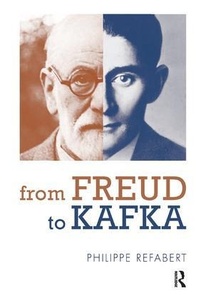
From Freud To Kafka
The Paradoxical Foundation of the Life-and-Death Instinct
Published on 31. May 2014
Book
Paperback/Softback
144 pages
978-1-78220-129-8 (ISBN)
Description
This book takes the reader on a captivating journey leading from an erroneous founding assumption inherited from Freud, to the proposal of a principle better suited to allowing the psychoanalyst to accompany the patient out of his impasse. The founding assumption of the book, already questioned by many analysts among whom Sandor Ferenczi figures as a brilliant forerunner, was the author's starting point in re-examining the basic precepts of psychoanalysis.Reading Kafka made the author conclude that this masterful storyteller describes borderline situations, so familiar to him, better than anyone. An avid reader of Freud, Kafka suggests that the human capacity to bear a paradoxical position between life and death is not given to the child naturally, at birth. Kafka seems to say that giving life is easy, but that giving it the necessary support in the form of the trace of death is more problematic. Moreover, when the child is deprived of this trace, he faces the void and, in a panic, must use emergency measures to construct a substitute for the necessary trace of death; and he can only do so by sacrificing his sexuality, his ability to feel, his initiative or his judgement. When the conditions necessary for primal repression are not provided to the child by others, he creates them himself at great cost. What he gives himself is not life, but life-death, and he pays the price for doing so. When primal repression is destroyed - something which can happen at any age - we speak of "soul murder". At the very instant when it occurs, a new Subject comes into existence, a Subject who pushes back the threat of destruction. The new Subject constructs otherness out of an object or out of a part of himself, a part he sacrifices in order to recover the primal repression destroyed by the trauma.This book will interest not only psychotherapists, psychoanalysts, philosophers and students of literature, but also a wide range of readers with a passion for the complexities of the human soul.
Reviews / Votes
'What a pleasure to be guided through the chaos of our daily meanderings by the firm footsteps of Philippe Refabert, whose clinical experience throws its fascinating light on Kafka's short stories. The tools he places at our disposal go beyond those granted to us by Freud, while reaffirming the latter's conviction that there is more psychoanalysis in works of literature than in theoretical treatises.'-Francoise Davoine, psychoanalyst; professor at the Ecole des Hautes Etudes en Sciences Sociales, Paris; and co-author of History Beyond Trauma'I find this book fascinating. Its serious questioning of Freud introduces an innovative perspective on an essential matter and provides a perspective both convincing and brilliant on Kafka and the origin of literature. Kafka crossing the Freudian line of closure is an immensely fertile idea.'- Philippe Lacoue-Labarthe, philosopher, literary critic, and translator'This book is a rare event: truly good news for budding psychoanalysts and for many other people. I am thinking particularly of all those kept alive, but captive, by "catastrophic healing". The author dares to say out loud about homosexuality what our culture strives to prevent from being even faintly glimpsed. He has the courage to propose a radically new perspective: he dares to say that there is no third sex, but only people who have been evicted from their "bodies".' - Marie Balmary, psychoanalyst and author'Philippe Refabert confronts Freudian theory with his trauma-related clinical experience. He observes that, at times, trauma is the result of the insidious "soul murder" committed by the parental couple with respect to the child. Refabert reminds us that in the sphere of pain, the psychoanalyst's work is akin to the poet's constant receptivity to astonishment. For therapists, this book is a work of reference; for all of us, it is a joy to read.'- Heitor O'Dwyer de Macedo, psychoanalyst and author of De l'amour a la penseeMore details
Language
English
Place of publication
London
United Kingdom
Publishing group
Taylor & Francis Ltd
Target group
College/higher education
Professional and scholarly
Professional Practice & Development
Product notice
Paperback (trade)
Unsewn / adhesive bound
Dimensions
Height: 226 mm
Width: 150 mm
Thickness: 13 mm
Weight
218 gr
ISBN-13
978-1-78220-129-8 (9781782201298)
Copyright in bibliographic data and cover images is held by Nielsen Book Services Limited or by the publishers or by their respective licensors: all rights reserved.
Schweitzer Classification
Other editions
Additional editions
Book
06/2019
1st Edition
Routledge
€167.13
Shipment within 15-20 days
E-Book
05/2018
1st Edition
Routledge
€32.99
Available for download
E-Book
05/2018
1st Edition
Routledge
€32.99
Available for download
Person
Philippe Refabert obtained his medical degree in 1962 and after working as on-staff doctor in psychiatric hospitals between 1962 and 1966 set up private practice as a psychoanalyst in 1967. Between 1963 and 1973 he was a member of the Paris Psychoanalytic Society, and subsequently became a member of the College of Psychoanalysts and the Federation des Ateliers de Psychanalyse. He served as President of the latter between 1991 and 1992. He is also a prolific author, known for his work on the first years of the psychoanalytic movement, and particularly on Freud's relationship with Fliess, Jung, and Ferenczi. He has led seminars and published articles on psychoanalytic practice, epistemology, analytic commitment, memory and forgetting, and analytic procedure. He is currently leading a workshop on the theme of 'Giving Time', and preparing a book on this primal paradoxical endowment. In this endeavour, he makes use of his clinical experience, and of the light and shadow found in the works of poets like Fernando Pessoa and Paul Celan.
Content
Part 1 , A misunderstanding between Freud and the man from the country , Oedipus' answer to Freud's enigma , A presumed paradoxical endowment , Sketches of the paradoxical system in Freud's work , A transitional psychic matrix , An origin between absorption and expulsion , Destruction of the paradoxical system: murder of the other in the self , Part II , Failure of the paradoxical system (1): before the Law , Failure of the paradoxical system (2): The Silence of the Sirens and Josephine the Singer , Absorption-expulsion: The Vulture , The vicarious system of the man-from-the-country , The paradox of the birth of the artist: The Judgment , The resolution of a misunderstanding , Schreber's transsexuality as catastrophic healing and method of survival after the destruction of the paradoxical system