

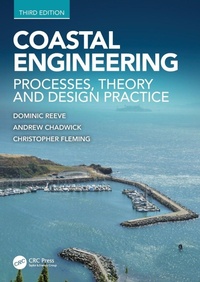
Coastal Engineering
Processes, Theory and Design Practice
3rd Edition
Published on 9. April 2018
Book
Paperback/Softback
512 pages
978-1-138-06043-2 (ISBN)
Description
Effective coastal engineering is expensive, but it is not as costly as neglect or ineffective intervention. Good practice needs to be based on sound principles, but theoretical work and modelling also need to be well grounded in practice, which is continuously evolving. Conceptual and detailed design has been advanced by new industry publications since the publication of the second edition.
This third edition provides a number of updates: the sections on wave overtopping have been updated to reflect changes brought in with the recently issued EurOtop II manual; a detailed worked example is given of the calculation of extreme wave conditions for design; additional examples have been included on the reliability of structures and probabilistic design; the method for tidal analysis and calculation of amplitudes and phases of harmonic constituents from water level time series has been introduced in a new appendix together with a worked example of harmonic analysis; and a real-life example is included of a design adapting to climate change.
This book is especially useful as an information source for undergraduates and engineering MSc students specializing in coastal engineering and management. Readers require a good grounding in basic fluid mechanics or engineering hydraulics, and some familiarity with elementary statistical concepts.
This third edition provides a number of updates: the sections on wave overtopping have been updated to reflect changes brought in with the recently issued EurOtop II manual; a detailed worked example is given of the calculation of extreme wave conditions for design; additional examples have been included on the reliability of structures and probabilistic design; the method for tidal analysis and calculation of amplitudes and phases of harmonic constituents from water level time series has been introduced in a new appendix together with a worked example of harmonic analysis; and a real-life example is included of a design adapting to climate change.
This book is especially useful as an information source for undergraduates and engineering MSc students specializing in coastal engineering and management. Readers require a good grounding in basic fluid mechanics or engineering hydraulics, and some familiarity with elementary statistical concepts.
Reviews / Votes
"I found the book a useful instructional tool that covered the most relevant concepts that coastal engineering students at undergraduate and graduate level must learn. The book is well laid out and provides enough example work-throughs and case studies for students to test the knowledge and see the work in practice."-- Kristen Splinter, University of New South Wales, Australia
"Overall, the book covers the most important material for coastal engineering at both undergraduate and postgraduate level."
-- Dong-Sheng Jeng, Griffith University, Australia
"... a comprehensive work, well-explained and at the same time advanced. It is a good book for both scholars and practitioners."
-- Genserik Reniers, Delft University of Technology, Netherlands "I found the book a useful instructional tool that covered the most relevant concepts that coastal engineering students at undergraduate and graduate level must learn. The book is well laid out and provides enough example work-throughs and case studies for students to test the knowledge and see the work in practice."
-- Kristen Splinter, University of New South Wales, Australia
"Overall, the book covers the most important material for coastal engineering at both undergraduate and postgraduate level."
-- Dong-Sheng Jeng, Griffith University, Australia
"... a comprehensive work, well-explained and at the same time advanced. It is a good book for both scholars and practitioners."
-- Genserik Reniers, Delft University of Technology, Netherlands
More details
Edition
3rd edition
Language
English
Place of publication
London
United Kingdom
Publishing group
Taylor & Francis Ltd
Target group
College/higher education
Professional and scholarly
Illustrations
234 s/w Abbildungen, 49 s/w Photographien bzw. Rasterbilder, 185 s/w Zeichnungen, 81 s/w Tabellen
81 Tables, black and white; 185 Line drawings, black and white; 49 Halftones, black and white; 234 Illustrations, black and white
Dimensions
Height: 246 mm
Width: 174 mm
Thickness: 29 mm
Weight
957 gr
ISBN-13
978-1-138-06043-2 (9781138060432)
Copyright in bibliographic data and cover images is held by Nielsen Book Services Limited or by the publishers or by their respective licensors: all rights reserved.
Schweitzer Classification
Other editions
Additional editions
Dominic Reeve | Andrew Chadwick | Christopher Fleming
Coastal Engineering
Processes, Theory and Design Practice
Book
03/2018
3rd Edition
CRC Press
€245.40
Shipment within 10-20 days
Dominic Reeve | Andrew Chadwick | Christopher Fleming
Coastal Engineering
Processes, Theory and Design Practice
E-Book
03/2018
3rd Edition
CRC Press
€80.49
Available for download
Dominic Reeve | Andrew Chadwick | Christopher Fleming
Coastal Engineering
Processes, Theory and Design Practice
E-Book
03/2018
3rd Edition
CRC Press
€80.49
Available for download
Previous edition
Dominic Reeve | Andrew Chadwick | Christopher Fleming
Coastal Engineering
Processes, Theory and Design Practice
Book
12/2011
2nd Edition
Taylor & Francis
€75.70
Article exhausted; check for reprint
Persons
Dominic Reeve is Professor in the College of Engineering at the University of Swansea, UK and a Chartered Mathematician.
Andrew Chadwick is former Professor of Coastal Engineering at the University of the West Indies and Honorary Professor at Plymouth, UK.
Chris Fleming is a former Group Director of Halcrow, UK.
Andrew Chadwick is former Professor of Coastal Engineering at the University of the West Indies and Honorary Professor at Plymouth, UK.
Chris Fleming is a former Group Director of Halcrow, UK.
Content
Introduction. Wave theory. Design wave specification. Coastal water level variations. Coastal transport processes. Coastal morphology: analysis, modelling and prediction. Design, reliability and risk. Field measurements and physical models. Conceptual and detailed design. Appendices: Summary of statistical concepts and terminology; Maximum likelihood estimation; Harmonic analysis results; Normal distribution tables.