

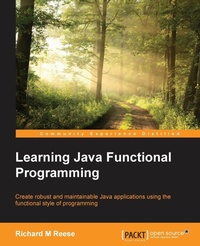
Learning Java Functional Programming
Create robust and maintainable Java applications using the functional style of programming
Published on 14. October 2015
Book
Paperback/Softback
296 pages
978-1-78355-848-3 (ISBN)
Description
Create robust and maintainable Java applications using the functional style of programming
Key Features
Explore how you can blend object-oriented and functional programming styles in Java
Use lambda expressions to write flexible and succinct code
A tutorial that strengthens your fundamentals in functional programming techniques to enhance your applications
Book DescriptionFunctional programming is an increasingly popular technology that allows you to simplify many tasks that are often cumbersome and awkward using an object-oriented approach. It is important to understand this approach and know how and when to apply it. Functional programming requires a different mindset, but once mastered it can be very rewarding.
This book simplifies the learning process as a problem is described followed by its implementation using an object-oriented approach and then a solution is provided using appropriate functional programming techniques.
Writing succinct and maintainable code is facilitated by many functional programming techniques including lambda expressions and streams. In this book, you will see numerous examples of how these techniques can be applied starting with an introduction to lambda expressions. Next, you will see how they can replace older approaches and be combined to achieve surprisingly elegant solutions to problems.
This is followed by the investigation of related concepts such as the Optional class and monads, which offer an additional approach to handle problems. Design patterns have been instrumental in solving common problems. You will learn how these are enhanced with functional techniques.
To transition from an object-oriented approach to a functional one, it is useful to have IDE support. IDE tools to refactor, debug, and test functional programs are demonstrated through the chapters. The end of the book brings together many of these functional programming techniques to create a more comprehensive application. You will find this book a very useful resource to learn and apply functional programming techniques in Java.What you will learn
Use lambda expressions to simplyfy code
Use function composition to achieve code fluency
Apply streams to simply implementations and achieve parallelism
Incorporate recursion to support an application's functionality
Provide more robust implementations using Optionals
Implement design patterns with less code
Refactor object-oriented code to create a functional solution
Use debugging and testing techniques specific to functional programs
Who this book is forIf you are a Java developer with object-oriented experience and want to use a functional programming approach in your applications, then this book is for you. All you need to get started is familiarity with basic Java object-oriented programming concepts.
Key Features
Explore how you can blend object-oriented and functional programming styles in Java
Use lambda expressions to write flexible and succinct code
A tutorial that strengthens your fundamentals in functional programming techniques to enhance your applications
Book DescriptionFunctional programming is an increasingly popular technology that allows you to simplify many tasks that are often cumbersome and awkward using an object-oriented approach. It is important to understand this approach and know how and when to apply it. Functional programming requires a different mindset, but once mastered it can be very rewarding.
This book simplifies the learning process as a problem is described followed by its implementation using an object-oriented approach and then a solution is provided using appropriate functional programming techniques.
Writing succinct and maintainable code is facilitated by many functional programming techniques including lambda expressions and streams. In this book, you will see numerous examples of how these techniques can be applied starting with an introduction to lambda expressions. Next, you will see how they can replace older approaches and be combined to achieve surprisingly elegant solutions to problems.
This is followed by the investigation of related concepts such as the Optional class and monads, which offer an additional approach to handle problems. Design patterns have been instrumental in solving common problems. You will learn how these are enhanced with functional techniques.
To transition from an object-oriented approach to a functional one, it is useful to have IDE support. IDE tools to refactor, debug, and test functional programs are demonstrated through the chapters. The end of the book brings together many of these functional programming techniques to create a more comprehensive application. You will find this book a very useful resource to learn and apply functional programming techniques in Java.What you will learn
Use lambda expressions to simplyfy code
Use function composition to achieve code fluency
Apply streams to simply implementations and achieve parallelism
Incorporate recursion to support an application's functionality
Provide more robust implementations using Optionals
Implement design patterns with less code
Refactor object-oriented code to create a functional solution
Use debugging and testing techniques specific to functional programs
Who this book is forIf you are a Java developer with object-oriented experience and want to use a functional programming approach in your applications, then this book is for you. All you need to get started is familiarity with basic Java object-oriented programming concepts.
More details
Language
English
Place of publication
Birmingham
United Kingdom
Target group
Professional and scholarly
US School Grade: College Graduate Student
Dimensions
Height: 235 mm
Width: 191 mm
Thickness: 17 mm
Weight
557 gr
ISBN-13
978-1-78355-848-3 (9781783558483)
Copyright in bibliographic data and cover images is held by Nielsen Book Services Limited or by the publishers or by their respective licensors: all rights reserved.
Schweitzer Classification
Other editions
Additional editions
Richard M. Reese
Learning Java Functional Programming
Create robust and maintainable Java applications using the functional style of programming
E-Book
01/2025
Packt Publishing
from
€44.39
Available for download
Person
Richard M. Reese has worked in both industry and academia. For 17 years, he worked in the telephone and aerospace industries, serving in several capacities, including research and development, software development, supervision, and training. He currently teaches at Tarleton State University, where he has the opportunity to apply his years of industry experience to enhance his teaching. Richard has written several Java books and a C pointer book. He uses a concise and easy-to-follow approach to the topics at hand. His Java books have addressed EJB 3.1, updates to Java 7 and 8, certification, jMonkeyEngine, natural language processing, functional programming, networks, and data science. Richard Reese has worked in the industry and academics for the past 29 years. For 10 years he provided software development support at Lockheed and at one point developed a C based network application. He was a contract instructor providing software training to industry for 5 years. Richard is currently an Associate Professor at Tarleton State University in Stephenville Texas. Richard is the author of various books and video courses some of which are as follows: Natural Language Processing with Java. Java for Data Science Getting Started with Natural Language Processing in Java
Content
Table of Contents
Getting started with Functional Programming
Putting the Function in Functional Programming
Function Composition
Streams and the Evaluation of Expressions
Recursion Techniques in Java 8ures
Optional and Monads
Supporting Design Patterns using Functional Programming
Refactoring, Debugging, and Testing
Bringing it all Together
Getting started with Functional Programming
Putting the Function in Functional Programming
Function Composition
Streams and the Evaluation of Expressions
Recursion Techniques in Java 8ures
Optional and Monads
Supporting Design Patterns using Functional Programming
Refactoring, Debugging, and Testing
Bringing it all Together