

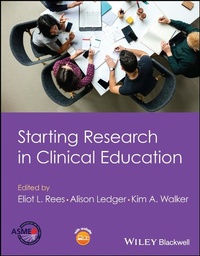
Starting Research in Clinical Education
Description
Starting Research in Clinical Education is written by a global team of experienced and emerging clinical education researchers who have a wealth of knowledge designing rigorous research projects and expertise in contemporary methods.
Covering a broad spectrum of methods used by clinical education researchers, the book is split into five parts: research design, evidence synthesis and mixed methods research, qualitative research, quantitative research and succeeding in clinical education research. These sections are also accompanied by a companion website which provides further resources. The methods discussed are illustrated with real life examples and case studies to support the reader in designing their own project.
The new edition includes information on:
Getting started in clinical education research, constructing a research question, clarifying research paradigms and design, using educational theory, involving stakeholders, sampling and recruiting participants and conducting ethical research
Evidence synthesis, realist research, mixed methods research, action research and emerging possibilities in online data collection
Interviews and focus groups, visual elicitation, ethnography, narrative research, thematic analysis and struggles new researchers often face in qualitative research
Survey research, experimental methods, statistical analysis and big data
Maximising opportunities, project management, writing dissertations, writing for publication, research dissemination and career development
This edition is designed to support those new to clinical education research, including those undertaking intercalated or postgraduate degrees in clinical, medical, dental or general health education. Starting Research in Clinical Education is an ideal resource for those embarking on their first research projects or using methods they are unfamiliar with.
<b>A practical guide to clinical education research with top tips, common pitfalls and ethical issues.</b>
<i>Starting Research in Clinical Education</i> is written by a global team of experienced and emerging clinical education researchers who have a wealth of knowledge designing rigorous research projects and expertise in contemporary methods.
Covering a broad spectrum of methods used by clinical education researchers, the book is split into five parts: research design, evidence synthesis and mixed methods research, qualitative research, quantitative research and succeeding in clinical education research. These sections are also accompanied by a companion website which provides further resources. The methods discussed are illustrated with real life examples and case studies to support the reader in designing their own project.
The new edition includes information on:
<ul><li>Getting started in clinical education research, constructing a research question, clarifying research paradigms and design, using educational theory, involving stakeholders, sampling and recruiting participants and conducting ethical research</li><li>Evidence synthesis, realist research, mixed methods research, action research and emerging possibilities in online data collection</li><li>Interviews and focus groups, visual elicitation, ethnography, narrative research, thematic analysis and struggles new researchers often face in qualitative research</li><li>Survey research, experimental methods, statistical analysis and big data</li><li>Maximising opportunities, project management, writing dissertations, writing for publication, research dissemination and career development</li></ul>This edition is designed to support those new to clinical education research, including those undertaking intercalated or postgraduate degrees in clinical, medical, dental or general health education. <i>Starting Research in Clinical Education</i> is an ideal resource for those embarking on their first research projects or using methods they are unfamiliar with.
More details
Other editions
Additional editions
Persons
Dr. Alison Ledger, Associate Professor of Medical Education, University of Queensland, Australia; Chair, Education Research Committee, Association for the Study of Medical Education (ASME).
Dr. Kim Walker, Senior Lecturer, University of Aberdeen, UK; and Director of Publications, Association for the Study of Medical Education (ASME).
<b>Dr. Eliot Rees</b>, Lecturer in Medical Education, Keele University, UK; National Institute for Health and Care Research (NIHR) Academic Clinical Fellow in General Practice, University College London, UK; and Education Research Committee, Association for the Study of Medical Education (ASME)
<b>Dr. Alison Ledger</b>, Associate Professor of Medical Education, University of Queensland, Australia; Chair, Education Research Committee, Association for the Study of Medical Education (ASME).
<b>Dr. Kim Walker</b>, Senior Lecturer, University of Aberdeen, UK; and Director of Publications, Association for the Study of Medical Education (ASME).
Content
i. Contributors
ii. Foreword
iii. Preface
iv. Acknowledgements
<b>Part 1: Research design</b>
1. Getting started in clinical education research
Jennifer Routh and Robert K McKinley
2. Constructing a research question
Megan Anakin, Joanne Robertson-Smith and Tim J Wilkinson
3. Clarifying research paradigms and design
J. Cristian Rangel, Meredith Young and Lara Varpio
4. Using educational theory
Clare Morris and Nick Schindler
5. Involving stakeholders
Katherine A Moreau, Catherine Giroux and Kaylee Eady
6. Sampling and recruiting participants
Jennifer Cleland, Kirsty Alexander and Amudha Poobalan
7. Conducting ethical research
Anne-Marie Reid and Susan Jamieson
<b>Part 2: Evidence syntheses and mixed methods</b>
8. Evidence syntheses: choosing an approach
Catherine Giroux, Susanne Mak, Rebecca Ataman and Aliki Thomas
9. Evidence synthesis: key steps and design considerations
Claire Duddy and Sophie Park
10. Realist research: unpicking the influence of context
Claire Duddy and Geoff Wong
11. Mixed methods research: the sum is greater than the parts
Catherine Scarff, Christy Noble, Koshila Kumar and Wendy Hu
12. Action research: improving clinical education programmes
Janet Lefroy and Emma Collins
13. Online data collection: emerging possibilities
Dominique Harz and Kristina Dzara
<b>Part 3: Qualitative research</b>
14. Interviews and focus groups: guided conversations
Lucy Wallis, Becky Petley and Rachel Locke
15. Visual elicitation: techniques for digging deeper in interviews
Gerry J Gormley, Sayra Cristancho and Katherine Crook
16. Ethnography: sense and sensibilities in conducting fieldwork
Lisa Dikomitis and Brianne Wenning
17. Narrative research: from the general to the particular
Kathleen E Leedham-Green, Alexandra Wright, and Giskin Day
18. Approaches to thematic analysis: becoming a knowing researcher
Virginia Braun and Victoria Clarke
19. Behind the scenes of qualitative analysis: learning from new researchers' struggles
Anna de la Croix, Malou Stoffels and Jan Willem Grijpma
<b>Part 4: Quantitative research</b>
20. Survey research: uses and misuses
Patrick G. Corr, Radwa Aly and Anthony R Artino
21. Experimental methods: more than simply testing a hypothesis
Peter Yeates and Rebecca Edwards
22. Statistical analysis: unpacking uncertainty
Christy K. Boscardin, H. Carrie Chen and Justin L. Sewell
23. Big Data: where to start and what to expect
Milou Silkens, Asta Medisauskaite and Chris McManus
<b>Part 5: Succeeding in clinical education research</b>
24. Maximising opportunities and overcoming challenges
Susil Pallikadavath and Simon Gay
25. Managing your project
Michelle D Lazarus and Georgina C Stephens
26. Writing your dissertation
Frederick Speyer, Ben Davies and Sarah Yardley
27. Writing for publication
Amaya Ellawala and Aileen Barrett
28. Disseminating your findings
Jonathan Guckian and Teresa Chan
29. Developing your career
Gillian Vance, Sarah Simpson, Sue Jackson and Richard Conn
Conclusion