

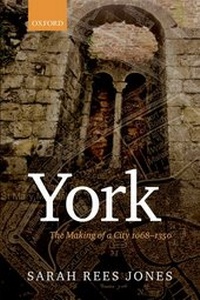
York
The Making of a City 1068-1350
Published on 24. October 2013
Book
Hardback
408 pages
978-0-19-820194-6 (ISBN)
Description
York was one of the most important cities in medieval England. This original study traces the development of the city from the Norman Conquest to the Black Death. The twelfth and thirteenth centuries are a neglected period in the history of English towns, and this study argues that the period was absolutely fundamental to the development of urban society and that up to now we have misunderstood the reasons for the development of York and its significance within our history because of that neglect.
Medieval York argues that the first Norman kings attempted to turn the city into a true northern capital of their new kingdom and had a much more significant impact on the development of the city than has previously been realised. Nevertheless the influence of York Minster, within whose shadow the town had originally developed, remained strong and was instrumental in the emergence of a strong and literate civic communal government in the later twelfth and thirteenth centuries. Many of the earlier Norman initiatives withered as the citizens developed their own institutions of government and social welfare.
The primary sources used are records of property ownership and administration, especially charters, and combines these with archaeological evidence from the last thirty years. Much of the emphasis of the book is therefore on the topographical development of the city and the changing social and economic structures associated with property ownership and occupation.
Medieval York argues that the first Norman kings attempted to turn the city into a true northern capital of their new kingdom and had a much more significant impact on the development of the city than has previously been realised. Nevertheless the influence of York Minster, within whose shadow the town had originally developed, remained strong and was instrumental in the emergence of a strong and literate civic communal government in the later twelfth and thirteenth centuries. Many of the earlier Norman initiatives withered as the citizens developed their own institutions of government and social welfare.
The primary sources used are records of property ownership and administration, especially charters, and combines these with archaeological evidence from the last thirty years. Much of the emphasis of the book is therefore on the topographical development of the city and the changing social and economic structures associated with property ownership and occupation.
Reviews / Votes
Anyone with an interest in York will have to read this book. * Christopher Dyer, Medieval Settlement Research * With meticulous scholarship, the author expands the understanding of one of the most important cities in medieval England ... Highly recommended. * CHOICE * As it was one of the great medieval cities of Europe, it is not surprising that York has engaged the attention and talents of many distinguished scholars. With this very welcome new volume, Sarah Rees Jones confirms her place as one of the most capable and perceptive of them all ... a detailed and rounded picture of a great Northern city * Patrick Ottaway, Society for Medieval Archaeology * a superbly rich and forensic examination of the city, which demonstrates both the numerous transformations and continuities in York's topography, as well as how power was wielded within, and mapped onto, the city ... Above all, Rees-Jones's interpretative approach is nuanced and searching, and shows great skill in drawing compelling conclusions from a wealth of tangled evidence ... [it] will play an important ongoing role in elucidating the history of medieval York for future generations. * Paul Oldfield, History * This is a very rich book. It covers a tremendous amount of ground ... the argument is presented clearly, and the text is well written and eminently readable * P.S. Barnwell, Northern History * detailed and stimulating monograph * Nigel Tringham, Yorkshire Archaeological Journal * a comprehensive account of this period of York's history and makes a substantive contribution to social and economic history. Economic historians will find this book of interest because it provides a detailed investigation of York's economy and represents a significant new contribution to research on the medieval property market. For social historians the wide range of social interactions examined will be of particular relevance, as will the discussion of civic identity. * Catherine Casson, The Economic History Review * thorough and utterly engaging * Philipp Schofield, English Historical Review *More details
Language
English
Place of publication
Oxford
United Kingdom
Target group
College/higher education
Professional and scholarly
Illustrations
17 black and white maps
Dimensions
Height: 237 mm
Width: 162 mm
Thickness: 31 mm
Weight
764 gr
ISBN-13
978-0-19-820194-6 (9780198201946)
Copyright in bibliographic data and cover images is held by Nielsen Book Services Limited or by the publishers or by their respective licensors: all rights reserved.
Schweitzer Classification
Other editions
Additional editions
E-Book
10/2013
1st Edition
OUP eBook
€55.49
Available for download
Person
Sarah Rees Jones is a Senior Lecturer in the Department of History at the University of York where she is based in the interdisciplinary postgraduate Centre for Medieval Studies. For many years she has worked with archaeologists in York studying the material development of the city and she has also published broadly in the field of medieval urban social and cultural history.
Content
Acknowledgements ; Abbreviations ; 1. Introduction ; 2. Landscapes of Lordship at the time of the Conquest: The Minster, the King, and the Earl ; 3. Landscapes of Lordship on the Eve of the Conquest: Lesser Landowners and their Urban Estates ; 4. The King, the Barons, and the Shire ; 5. Church Landlords ; 6. Householders, Civic Society, and Civic Government ; 7. Town and Country: Trade, Fairs, Markets, and Festivals ; 8. Domestic Property ; 9. Conclusion ; Bibliography