

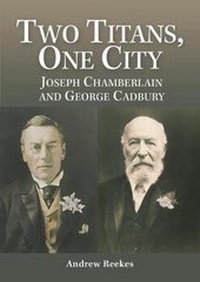
Two Titans, One City
Joseph Chamberlain & George Cadbury
Published on 28. February 2017
Book
Paperback/Softback
156 pages
978-1-905036-34-9 (ISBN)
Description
Two famous and powerful men of the late Victorian and early Edwardian era, Joseph Chamberlain (1836-1914) and George Cadbury (1839-1922), towered over one of the great cities of the British Empire - Birmingham. Together, they offer a fascinating window into the rapidly changing world in which they lived and the preoccupations of their generation.
Throughout their lives both men pursued a common mission - to improve the lives of their fellow citizens - and zealously pursued a philosophy of social and civic responsibility rooted in nonconformist religion. However, these were very different characters sharing a single stage. Having aggressively built a fortune in engineering as a young man, Chamberlain entered civic politics and, during three terms as mayor, he made Birmingham the global model of good civic governance. But his ambitions stretched beyond Birmingham to Westminster where he became the first great middle-class statesman of modern Britain and the leading Radical of the age, although his career ended in failure and he never achieved the highest office he craved. Throughout this turbulent career, Birmingham, sometimes referred to as his "Duchy", remained Chamberlain's political base and his family home. It was here, after an incapacitating stroke, that Chamberlain was buried following a funeral where the size of the crowds brought the whole city to a halt.
It was also here in Birmingham that Cadbury created his fortune and where his programmes for social improvement caught the attention of the world. Taking control of the confectionery business established by his Quaker family, Cadbury built it into one of the first great global brands. The wealth he created allowed Cadbury to introduce far-sighted benefits for his workers, including the visionary model village of Bournville which was his response to the jerry-built slum housing of his workforce. Then around the houses, schools and green open spaces of Bournville Cadbury created a distinct community founded on strict adherence to his Quaker values of temperance and industrial discipline. Meanwhile, on the national stage, Cadbury successfully campaigned to improve the lives of men and women labouring in sweatshops and worked for the introduction of pioneering social reforms, including non-contributory old age pensions. Throughout this time, unlike Chamberlain, he abhorred party politics and his pacifist views brought the two men into conflict during the Anglo-Boer War which Chamberlain championed. By his death, Cadbury was lauded as one of the leading philanthropists of his age.
So, both Chamberlain and Cadbury championed political and social reform based on their experiences in Birmingham and subsequently became important figures in British life.
Yet for all that they had in common, they were radically different from each other. Their ambitions and their methods for effecting change took divergent routes: as a result from time to time they came into conflict in the arena of national affairs and in Birmingham, where they were reluctant neighbours.
Two Titans: One City is the first study to explore, compare and contrast the lives of these two very famous but very different figures. Historian and author Andrew Reekes uses archives, correspondence and contemporary accounts to reveal the fascinating lives and rivalries of these two important figures of their age.
Throughout their lives both men pursued a common mission - to improve the lives of their fellow citizens - and zealously pursued a philosophy of social and civic responsibility rooted in nonconformist religion. However, these were very different characters sharing a single stage. Having aggressively built a fortune in engineering as a young man, Chamberlain entered civic politics and, during three terms as mayor, he made Birmingham the global model of good civic governance. But his ambitions stretched beyond Birmingham to Westminster where he became the first great middle-class statesman of modern Britain and the leading Radical of the age, although his career ended in failure and he never achieved the highest office he craved. Throughout this turbulent career, Birmingham, sometimes referred to as his "Duchy", remained Chamberlain's political base and his family home. It was here, after an incapacitating stroke, that Chamberlain was buried following a funeral where the size of the crowds brought the whole city to a halt.
It was also here in Birmingham that Cadbury created his fortune and where his programmes for social improvement caught the attention of the world. Taking control of the confectionery business established by his Quaker family, Cadbury built it into one of the first great global brands. The wealth he created allowed Cadbury to introduce far-sighted benefits for his workers, including the visionary model village of Bournville which was his response to the jerry-built slum housing of his workforce. Then around the houses, schools and green open spaces of Bournville Cadbury created a distinct community founded on strict adherence to his Quaker values of temperance and industrial discipline. Meanwhile, on the national stage, Cadbury successfully campaigned to improve the lives of men and women labouring in sweatshops and worked for the introduction of pioneering social reforms, including non-contributory old age pensions. Throughout this time, unlike Chamberlain, he abhorred party politics and his pacifist views brought the two men into conflict during the Anglo-Boer War which Chamberlain championed. By his death, Cadbury was lauded as one of the leading philanthropists of his age.
So, both Chamberlain and Cadbury championed political and social reform based on their experiences in Birmingham and subsequently became important figures in British life.
Yet for all that they had in common, they were radically different from each other. Their ambitions and their methods for effecting change took divergent routes: as a result from time to time they came into conflict in the arena of national affairs and in Birmingham, where they were reluctant neighbours.
Two Titans: One City is the first study to explore, compare and contrast the lives of these two very famous but very different figures. Historian and author Andrew Reekes uses archives, correspondence and contemporary accounts to reveal the fascinating lives and rivalries of these two important figures of their age.
More details
Language
English
Place of publication
Alcester
United Kingdom
Target group
Professional and scholarly
Dimensions
Height: 240 mm
Width: 170 mm
ISBN-13
978-1-905036-34-9 (9781905036349)
Copyright in bibliographic data and cover images is held by Nielsen Book Services Limited or by the publishers or by their respective licensors: all rights reserved.
Schweitzer Classification
Other editions
Additional editions

Andrew Reekes
TWO TITANS, ONE CITY: Joseph Chamberlain and George Cadbury
Joseph Chamberlain and George Cadbury
E-Book
04/2017
West Midlands History Limited
€12.99
Available for download
Andrew Reekes
TWO TITANS, ONE CITY: Joseph Chamberlain and George Cadbury
Joseph Chamberlain and George Cadbury
E-Book
04/2017
West Midlands History Limited
€12.99
Available for download
Person
Educated at King's School Worcester & Exeter College, Oxford, Andrew Reekes spent a lifetime in education, leading History departments at Tonbridge, Cranleigh & Cheltenham College. He was headteacher of Arnold Lodge School & then became Sub-Warden of Radley College. Also, Chief Examiner for O Level History, Oxford & Cambridge Board, an inspector with Independent Schools Inspectorate & for 12 years he led training for senior leaders in HMC & GSA schools.
In retirement he returned to his first love, History, studying for a research degree under Malcolm Dick at the University of Birmingham, & writing for History West Midlands.
In retirement he returned to his first love, History, studying for a research degree under Malcolm Dick at the University of Birmingham, & writing for History West Midlands.