

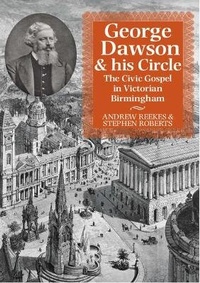
George Dawson and His Circle
The Civic Gospel in Victorian Birmingham
Published on 1. April 2021
Book
Paperback/Softback
256 pages
978-0-85036-771-3 (ISBN)
Description
'By the gains of Industry, we promote Art'
'In Birmingham you may generally recognise a board school by it being the best building in the neighbourhood, with its lofty towers, gabled windows, warm red bricks and stained glass.' So observed the Pall Mall Gazette in 1894. The famous civic gospel shaped Birmingham as 'the best governed city in the world.'
The inspiration for the transformation of Birmingham in the second half of the 19th century came from the sermons of 'the greatest talker in England' George Dawson. The men who oversaw the improvement of the town mostly sat on Sunday mornings in the pews of the Church of the Saviour.
These were the men who were responsible for: a unique memorial library dedicated to the works of Warwickshire's very own William Shakespeare; the foremost provincial institute (the Birmingham and Midland Institute); the first municipal technical school; the most famous art school in the country; and an enviable new art gallery.
More improvements were developed by the town council: schools, baths and wash houses; the municipalisation of the gas and water supplies; and an impressive new thoroughfare, suitably christened Corporation Street.
'In Birmingham you may generally recognise a board school by it being the best building in the neighbourhood, with its lofty towers, gabled windows, warm red bricks and stained glass.' So observed the Pall Mall Gazette in 1894. The famous civic gospel shaped Birmingham as 'the best governed city in the world.'
The inspiration for the transformation of Birmingham in the second half of the 19th century came from the sermons of 'the greatest talker in England' George Dawson. The men who oversaw the improvement of the town mostly sat on Sunday mornings in the pews of the Church of the Saviour.
These were the men who were responsible for: a unique memorial library dedicated to the works of Warwickshire's very own William Shakespeare; the foremost provincial institute (the Birmingham and Midland Institute); the first municipal technical school; the most famous art school in the country; and an enviable new art gallery.
More improvements were developed by the town council: schools, baths and wash houses; the municipalisation of the gas and water supplies; and an impressive new thoroughfare, suitably christened Corporation Street.
More details
Language
English
Place of publication
London
United Kingdom
Product notice
Paperback (trade)
Unsewn / adhesive bound
Dimensions
Height: 229 mm
Width: 152 mm
ISBN-13
978-0-85036-771-3 (9780850367713)
Copyright in bibliographic data and cover images is held by Nielsen Book Services Limited or by the publishers or by their respective licensors: all rights reserved.
Schweitzer Classification
Persons
After a career in education, running schools and history departments, Andrew Reekes returned to academia on retirement in 2012, studying for an M.Res at the University of Birmingham and writing a dissertation on 'Birmingham exceptionalism and the 1906 General Election.' He has spent eight years subsequently writing about Joseph Chamberlain, the Birmingham caucus, and the promotion of its civic gospel. He has written extensively on the Chamberlain family. He also wrote on Worcester and was on local television and radio talking about this book; there is a number of podcasts on Worcester and on Oswald Mosley,
Stephen Roberts hold the honorary positions of Associate Professor at the Australian National University and Fellow at the University of Birmingham. He lives in Birmingham, and his most recent book is an edited collection called The Dignity of Chartism: Essays by Dorothy Thompson (Verso, 2015).
Stephen Roberts hold the honorary positions of Associate Professor at the Australian National University and Fellow at the University of Birmingham. He lives in Birmingham, and his most recent book is an edited collection called The Dignity of Chartism: Essays by Dorothy Thompson (Verso, 2015).