

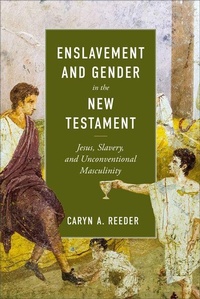
Enslavement and Gender in the New Testament
Jesus, Slavery, and Unconventional Masculinity
Will be published approx. on 3. November 2026
Book
Paperback/Softback
272 pages
978-1-5409-6903-3 (ISBN)
Description
In the first-century Roman Empire, men generally held privileged status. Masculinity was conceived as exercising power over both self and others through self-discipline, violence, and authority in the community and household. This paradigm often proved socially problematic and fostered injustice and abuse of those in socially weaker positions. Masculinity was defined in contrast with femininity, childishness, and (significantly) slavery. Enslavement was masculinity's opposite, entailing a lack of power and autonomy over oneself or others.
Against this background, the New Testament uses the metaphor of slavery to describe both Jesus and what he expected of his disciples. In doing so, it redefined masculinity for the Christian. This well-researched book by an expert on gender and the New Testament explores slavery and gender in the Roman Empire and uses that background to interpret key passages that employ enslavement imagery, such as Mark 10:41-45, Luke 22:24-27, Philippians 2:1-11, and 1 Peter 2:18-25. Further, it helps readers understand how enslaved first-century Christians may have interpreted and applied these texts. The book's conclusions address the significance of "unconventional masculinity" for Christology, discipleship, and church leadership.
Against this background, the New Testament uses the metaphor of slavery to describe both Jesus and what he expected of his disciples. In doing so, it redefined masculinity for the Christian. This well-researched book by an expert on gender and the New Testament explores slavery and gender in the Roman Empire and uses that background to interpret key passages that employ enslavement imagery, such as Mark 10:41-45, Luke 22:24-27, Philippians 2:1-11, and 1 Peter 2:18-25. Further, it helps readers understand how enslaved first-century Christians may have interpreted and applied these texts. The book's conclusions address the significance of "unconventional masculinity" for Christology, discipleship, and church leadership.
More details
Person
Caryn A. Reeder (PhD, University of Cambridge) is professor of New Testament and coordinator of the gender studies program at Westmont College in Santa Barbara, California. She is the author of The Enemy in the Household, Gendering War and Peace in the Gospel of Luke, and The Samaritan Woman's Story, as well as a number of scholarly articles and chapters.