

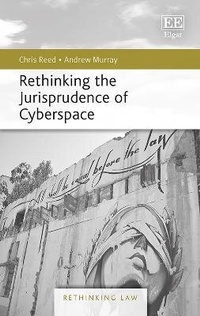
Rethinking the Jurisprudence of Cyberspace
Published on 30. November 2018
Book
Hardback
256 pages
978-1-78536-428-0 (ISBN)
Description
Cyberspace is a difficult area for lawyers and lawmakers. With no physical constraining borders, the question of who is the legitimate lawmaker for cyberspace is complex. Rethinking the Jurisprudence of Cyberspace examines how laws can gain legitimacy in cyberspace and identifies the limits of the law's authority in this space.
Two key questions are central to the book: Who has authority to make laws within cyberspace and how do laws in cyberspace achieve legitimacy? Chris Reed and Andrew Murray answer these questions by examining the jurisprudential principles that explain law in the physical world and rethinking them for the cyberworld. In doing so they establish that cyberlaw is more similar to traditional law than previously thought, but that establishing legitimate authority is quite different. This book provides the first thorough examination of the jurisprudence of cyberspace law, asking why any law should be obeyed and how the rule of law is to be maintained there.
Academics and researchers who are interested in the regulation of cyberspace will find this to be a compelling study. More broadly, it will appeal to those researching in the fields of transnational legal studies, jurisprudence and legal thought.
Two key questions are central to the book: Who has authority to make laws within cyberspace and how do laws in cyberspace achieve legitimacy? Chris Reed and Andrew Murray answer these questions by examining the jurisprudential principles that explain law in the physical world and rethinking them for the cyberworld. In doing so they establish that cyberlaw is more similar to traditional law than previously thought, but that establishing legitimate authority is quite different. This book provides the first thorough examination of the jurisprudence of cyberspace law, asking why any law should be obeyed and how the rule of law is to be maintained there.
Academics and researchers who are interested in the regulation of cyberspace will find this to be a compelling study. More broadly, it will appeal to those researching in the fields of transnational legal studies, jurisprudence and legal thought.
Reviews / Votes
'Reed and Murray have, in their own earlier work, separately emphasised the significance of legal theory to the study of Internet law - and, crucially, of Internet law to legal theory. In this thoughtful joint project, they take a fresh look at the development of cyberlaw over the last two decades, unpacking a crowded room of regulatory bodies, national governments, intermediaries, corporations, and users. They emphasise authority and legitimacy, offering a powerful critique of inaccessible rules, and propose a new focus on the reception of legal norms. This new book is both a reflection on the progress made in the field and a provocative contribution to a debate that has proven difficult for lawmakers and communities alike to resolve thus far.'--Daithi Mac Sithigh, Queen's University Belfast, UK'The evolution of cyberspace regulation is creating striking challenges for traditional assumptions of jurisprudence. This innovative and incisive text provides a rich, essential exploration of these challenges and of their immense practical significance for jurisprudence specialists and cyber lawyers alike.'
--Roger Cotterrell, Queen Mary University of London, UK
More details
Series
Language
English
Place of publication
Cheltenham
United Kingdom
Target group
Professional and scholarly
Dimensions
Height: 234 mm
Width: 156 mm
ISBN-13
978-1-78536-428-0 (9781785364280)
Copyright in bibliographic data and cover images is held by Nielsen Book Services Limited or by the publishers or by their respective licensors: all rights reserved.
Schweitzer Classification
Persons
Chris Reed, Professor of Electronic Commerce Law, Queen Mary University of London and Andrew Murray, Professor of Information Technology Law and Director of the Law, Technology and Society Research Group, London School of Economics, UK
Content
Contents: Part I Law and Authority in Cyberspace 1. The Lawmaking Authority of States 2. Non-State Rulemakers 3. Communities, Authority and Rules of Recognition Part II Control, Competition and Conversation 4. Control 5. Normative Competition in Cyberspace 6. Networks and nodes 7. Legitimacy and Authority 8. Maintaining the rule of law in cyberspace Afterword Index