

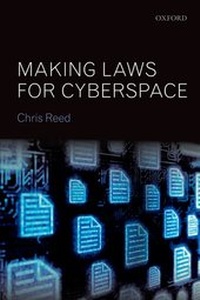
Making Laws for Cyberspace
1st Edition
Published on 8. March 2012
Book
Paperback/Softback
274 pages
978-0-19-965761-2 (ISBN)
Description
Providing a scholarly analysis of how to govern and make the right kinds of laws for cyberspace, in this work, Professor Reed investigates the vast majority of cyberspace users who wish to act lawfully and asks whether the current state of law in cyberspace makes it possible for them to do so. If not, why not, and what is the cure?
In this book, Professor Reed puts forward a new model for cyberspace laws which focuses on human actions rather than the technology used. Arguing that, in cyberspace, law works primarily through voluntary obedience rather than fear of enforcement, Professor Reed explains his thoughtful and controversial new viewpoint as to how cyberspace laws should be devised and re-opens the debate as to the value of law for regulating cyberspace and how best to influence the behaviour of cyberspace actors. The only text to comprehensively analyse European cyberspace lawmaking, this book provides a new perspective to the debate about the proper shape and scope of internet laws.
In this book, Professor Reed puts forward a new model for cyberspace laws which focuses on human actions rather than the technology used. Arguing that, in cyberspace, law works primarily through voluntary obedience rather than fear of enforcement, Professor Reed explains his thoughtful and controversial new viewpoint as to how cyberspace laws should be devised and re-opens the debate as to the value of law for regulating cyberspace and how best to influence the behaviour of cyberspace actors. The only text to comprehensively analyse European cyberspace lawmaking, this book provides a new perspective to the debate about the proper shape and scope of internet laws.
Reviews / Votes
A clearly structured and well-thought out analysis of effective law-making for cyberspace, which will form the debate on the subject for years to comea must read for anyone interested in how cyberspace should be regulated. * Julia Hoernle, International Journal of Law and Technology * In fact, one of the strong features of this book is the extensive review of the literature in the field in a condensed and concise manner and synthesizing the main literature in a clear theory. The author has produced a clearly structured and well-thought out analysis of effective law-making for cyberspace, which will form the debate on the subject for years to come. * Julia Hoernle, International Journal of Law and Technology * This book stands high above the others in this field and Chris Reed is to be congratulated for this achievement. This book is a must read for anyone interested in how cyberspace should be regulated. * Julia Hoernle, International Journal of Law and Technology *More details
Language
English
Place of publication
Oxford
United Kingdom
Target group
Professional and scholarly
Academics and postgraduates in the technology law and regulation field as well as practitioners practicing in this area.
Dimensions
Height: 234 mm
Width: 154 mm
Thickness: 15 mm
Weight
410 gr
ISBN-13
978-0-19-965761-2 (9780199657612)
Copyright in bibliographic data and cover images is held by Nielsen Book Services Limited or by the publishers or by their respective licensors: all rights reserved.
Schweitzer Classification
Other editions
Additional editions
Chris Reed
Making Laws for Cyberspace
Book
03/2012
1st Edition
Oxford University Press
€144.90
Shipment within 15-20 days
Chris Reed
Making Laws for Cyberspace
E-Book
03/2012
1st Edition
OUP eBook
€44.99
Available for download
Person
Chris Reed is Professor of Electronic Commerce Law at Queen Mary, University of
London. He teaches on a number of Queen Mary's LLM courses in the field, which include Computer
Law, Electronic Commerce Law, and Cyberspace Law. From 1997-2000, Chris was Joint Chairman of
the Society for Computers and Law, and in 1997-8 he acted as Specialist Adviser to the House of
Lords Select Committee on Science and Technology. Chris participated as an Expert at the European
Commission/Danish Government Copenhagen Hearing on Digital Signatures, represented the UK
Government at the Hague Conference on Private International Law, and has been an invited speaker
at OECD and G8 international conferences.
London. He teaches on a number of Queen Mary's LLM courses in the field, which include Computer
Law, Electronic Commerce Law, and Cyberspace Law. From 1997-2000, Chris was Joint Chairman of
the Society for Computers and Law, and in 1997-8 he acted as Specialist Adviser to the House of
Lords Select Committee on Science and Technology. Chris participated as an Expert at the European
Commission/Danish Government Copenhagen Hearing on Digital Signatures, represented the UK
Government at the Hague Conference on Private International Law, and has been an invited speaker
at OECD and G8 international conferences.
Content
PART I - CYBERSPACE AS A LAWFUL SPACE ; Introduction ; 1. Command and control ; 2. The route to lawfulness ; PART II - AUTHORITY IN CYBERSPACE ; 3. Extraterritoriality ; 4. Enforcement in cyberspace ; 5. Sources of authority ; 6. Authoritative lawmaking ; PART III - RESPECTWORTHY LAWS ; 7. Cyberspace communities and cyberspace norms ; 8. Three ways to make meaningless law ; 9. Aims and effectiveness ; 10. Mismatch with cyber-reality